
Philadelphia
Philadelphia’s City Government Youth Summit takes over City Hall
Students in the YMCA program got a hands-on legislative experience with Philadelphia lawmakers on Wednesday
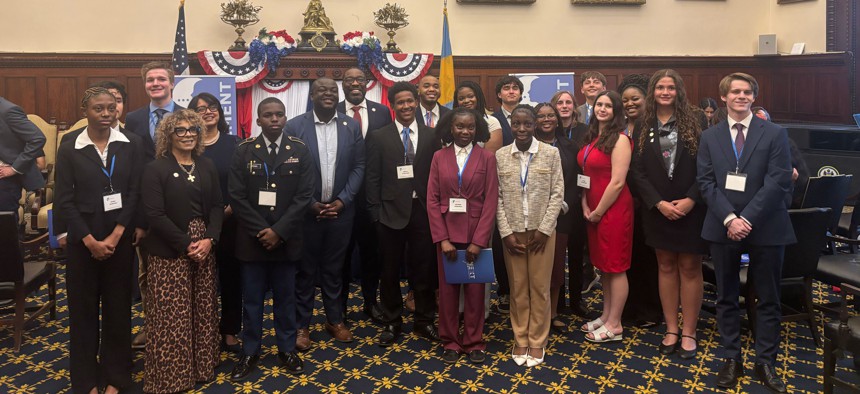
Philadelphia City Government Youth Summit participants pose alongside Philadelphia City Councilmembers also taking part in the daylong event Harrison Cann

Perhaps The Who put it best in the chorus of one of their signature rock anthems: “The kids are alright.” Exhibit A: The Philadelphia City Government Youth Summit, held at City Hall on Wednesday, which showcased potential next-generation public servants eager to gain firsthand experience.
The one-day, immersive civic leadership experience focused on developing tomorrow's public leaders. High school students involved in the program had the opportunity to assume the role of a lawmaker, administrator, stakeholder or member of the press and take part in a mock session within City Hall.
Jada Fagan, the student-elected mayor of the day, is a recent graduate of Cristo Rey Philadelphia High School who is headed to Rutgers University next year and plans to attend law school.
“It’s been a little nerve-wracking,” Fagan admitted to her first-ever gaggle of reporters Wednesday. “(I’ve learned) to be less of a complainer and more of a problem-solver … the team has been pretty easy with articulating what they want to see from me.”
One of the many students-turned-lawmakers working alongside Fagan was Ja’Kiyah Wright, who was chosen to represent the 2nd councilmanic district, which covers much of South Philadelphia and Center City.
“It’s one of those spaces where a lot of people look at me for an answer for things, which has been a little difficult and a little positive,” Wright, a commercial and advertising student at Universal Audenried Charter High School, told reporters.
Between role orientations, individual branch breakout sessions, and negotiation meetings, students heard from Mayor Cherelle Parker and members of City Council, all of whom took questions from participants.
“This is extremely essential for the City of Philadelphia right now – we need to ensure that our young people … understand that, whether or they like it or not, government touches your life from birth to death,” Parker said Wednesday. “It doesn’t matter whether or not you think it’s something that’s engaging – (government) is one of the most influential tools available to ensure the democratic principles that we all hold dear.”
Surrounded by portraits of past mayors in City Hall’s second-floor reception room, Parker stressed the importance of mentorship and feeling like you belong at the table regardless of your background.
“This exposure here today is essential, because we want this to be your norm – we want this to be your standard,” Parker added.
Students peppered Parker and Councilmembers with questions about their motivations, responsibilities and more – and made sure to ask for words of advice from the elected officials too.
“I didn’t run for office to be a footnote in somebody else’s history book,” Parker said. “The fact that I am the first woman to sit at the table makes me feel an extra sense of pressure about needing to deliver on promises.”
Council President Kenyatta Johnson and Councilmembers Quetcy Lozada, Nina Ahmad and Anthony Phillips also offered their takes on community engagement and youth empowerment.
“The work that we do day in and day out allows us to engage with the wider public and listen to what the issues are in terms of how we shape policy and the most important things that we need to address,” Johnson told the students.
Classroom to caucus
The day of activities included parallel and cross-branch simulations, giving students assigned to a given group – whether that be the mayor’s cabinet, City Council, city stakeholders or the press corps – a chance to organize before coming together as a whole to tackle the question of the day.
The central question: How should Philadelphia balance short-term World Cup preparations with long-term investments, while ensuring that commitments to equity and human rights are implemented?
The activities encouraged participants to collaborate on how the city could take advantage of its World Cup opportunities – from tourism and temporary jobs to new investments and business development – while not forgetting about community concerns – affordability, housing, trash and illegal dumping, public transportation and more.
With a hypothetical budget of $60 million, the student leaders had to decide how to invest in tourism areas and youth programs, as well as other key issues such as housing, sanitation, and transit.
For Fagan, who rides public transit every day, SEPTA funding was a clear-cut focus.
“Our main priority is just prioritizing the budget, making sure the culture is there and we’re representing (the people) fairly well,” Fagan said. “Transportation is a big issue … That’s really the main focus right now, and just communicating and being transparent with the public.”
Pennsylvania programming
The nearly 100 students who participated on Wednesday are involved in the Greater Philadelphia YMCA’s Youth Civic Engagement program. Students have previously had the opportunity to do similar exercises at the state legislature in Harrisburg, but Wednesday’s events inside Philadelphia City Hall are a first.
“There’s been a long history of Y’s supporting youth civic engagement, and we have this organization where people have made some donations, and there’s a bit of a legacy fund that helps fund a state program,” Shaun Elliott, president and CEO of the Greater Philadelphia YMCA, told City & State. “This is our first shot at it (in Philadelphia) and I think it’s been really successful.”
Before the closing program, the student City Council debated how to move forward with the $60 million exercise, hearing testimony and recommendations from the individual stakeholder students before proposing and voting on their own legislation.
Lindsay Boyle, the Y’s director of civic engagement, explained that the members of the event’s leadership team were either elected by their fellow students or chosen by staff members, in part because of their experience in the youth civic engagement program. The remaining students were placed into roles in the cabinet, legislative staff, press or community advocates.
“The most important thing is that their voice matters and that they belong in these spaces,” Boyle told City & State. “It’s really incredible to see them in these different spaces, have them interact with the mayor and City Council members, and have those elected officials reinforce the idea that their thoughts and their other ideas and beliefs really matter.”
“There’s two things we want to do: teach kids about civic government and how it works, but also help them develop their own competencies, their own leadership,” Elliott said. “This is a great intersection of the two.”
Kailey Reinboth, a recent graduate of Boyertown Area Senior High School who will be studying communications and political science at Gettysburg College next year, said the experiences have made her a “more conscious citizen,” better able to understand civic responsibilities.
“Ultimately, we, the people, hold the power to make these decisions and make these changes in our communities, but we only have that power if we use it,” Reinboth, who serves as a NextGen Program Ambassador for the Greater Philadelphia YMCA, told reporters. “The youth aren’t the future; they are the present. We really need to enforce that – making sure that we’re not making change in the future – we are making change now.”
NEXT STORY: This week’s biggest Winners & Losers