

Philadelphia
Philly City Council ends the year pushing back against Mayor Parker
Council moved forward with new bond language for Parker’s ambitious housing plan
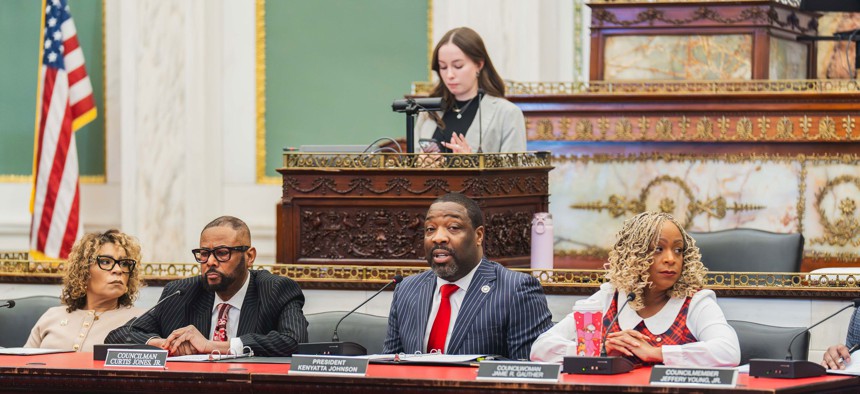
Philadelphia City Council Committee on Public Safety hearing on December 9, 2025 Chris Mansfield & Durrell Hospedale | PHL City Council

Philadelphia’s Mayor-Council relationship, and Cherelle Parker’s ambitious housing plan, hit an icy patch in December, setting the stage for housing funds to once again be front-and-center heading into 2026.
A day after moving an amendment to the mayor’s major housing initiative out of committee, City Council approved the update by a 16-1 vote, altering the eligibility thresholds for two housing programs set to be funded by bond proceeds. Council approved the change as a resolution rather than an ordinance, meaning Parker cannot veto the measure. Councilmember Curtis Jones was the lone “no” vote.
Council President Kenyatta Johnson said there is no “personal animosity” with the administration.
“We're just working to make sure that we get this process right. We continue to do our due diligence, and at the end of the day, that'd be a win-win for the public as well,” Johnson told reporters Thursday. “We want to get shovels in the ground. We want to get these programs up and running for the population that's most in need here in the City of Philadelphia.”
In June, Council approved the city budget with an $800 million bond for Parker’s Housing Opportunities Made Easy initiative, a $2 billion plan focused on creating and preserving 30,000 units of housing, backed by a massive bond. The plan was set to fund 13,500 new units and 16,500 preserved units, with the caveat that Council must approve annual budget resolutions to determine how the bond proceeds will be spent.
But progressives in City Council pushed back on the initiative’s income eligibility, arguing the funds should be directed more toward low-income individuals.
On Wednesday, City Council's Committee of the Whole voted out on a new bond issuance to start the H.O.M.E. initiative, which includes language that will allocate most of the home repair funds for those making 60% of area median income — $50,180 for a single person, $71,640 for a household of four, according to current city data.
The change would impact both the Basic Systems Repair Program home improvement initiative and the Adaptive Modification Program, which seeks to fund projects that improve mobility for disabled renters and homeowners. Under the plan, 90% of funding for the repair program will go toward those earning up to 60% of the AMI.
The move also adds funding for the Turn the Key program, which uses public lots to build homes for first-time homebuyers.
City Councilmember Jamie Gauthier, a strong proponent of the changes, said the move effectively doubles the number of households eligible for the house repair programs.
“Under Council President Kenyatta Johnson's leadership, we made targeted, high-impact investments that will strengthen housing stability and economic mobility for every Philadelphian,” Gauthier said Wednesday. “Most importantly, seniors, public school teachers, sanitation workers, and other working and low-income families will have the help they need to stay in their homes and off the street."
Gauthier said Thursday that Council’s efforts are both fiscally and morally responsible.
“The first-year budget for H.O.M.E. is $277 million. It was imperative that City Council not simply rush through a proposal that didn't serve the most vulnerable people in the city,” Gauthier told reporters. “It was imperative that city council Be thoughtful, be deliberate, pick the proposal apart and ultimately strengthen it, which we did.”
Johnson, a longtime ally of Parker’s, also refused to allow a vote on an amendment brought by the Parker administration Wednesday, instead moving forward with Council’s updated version of the housing proposal.
Johnson asserted Thursday that Parker would win re-election in 2028, so she’ll have a second term to implement the major housing initiative.
“I’m pretty confident that our mayor will be reelected,” Johnson said Thursday. “That's my personal opinion, and will have my support to get reelected, and so she'll have a six-year run to actually get this initiative, not only impactfully done, but also it's enough time for us to really have a significant impact.”
Affordable housing advocates praised the move, stating that the city’s most vulnerable residents should be the focus of the affordable housing push. A group of 11 organizations, including Make the Road PA, Philly DSA, Power Interfaith and Reclaim Philadelphia, released a statement commending Council for fighting for an equitable housing plan.
“We need a housing plan that benefits everyday Philadelphians, from sanitation workers and nurses to elders and disabled individuals on fixed incomes and those who have been forced to live on the streets,” the statement reads. “For too long, developers and corporate landlords have profited from Philadelphia’s housing crisis, causing gentrification, displacement, institutionalization, and homelessness. A true solution to our housing crisis starts by investing most where the pain has been greatest, with the low-income home owners and renters who have been waiting. This amendment is an important step in that direction.”
Parker released a statement after the vote on Wednesday, vowing to continue fighting for rowhomes and their owners. She said that 70% of the city's housing stock consists of rowhomes, 75% of which are at least 50 years old.
“The whole debate over income eligibility limits for BSRP and Adaptive Modifications is to make sure that we leave no working Philadelphian and no qualifying Philly rowhome owner excluded from these vital programs," Parker said in a statement. “That includes city employees, too. We have a duty and a responsibility to them. If we don’t save Philly rowhomes, we’re going to become a city of used-to-be neighborhoods, blocks that used to be nice but now are showing signs of age and decline. I will not allow that to happen – not on my watch as mayor of Philadelphia.”
On Thursday, Council trudged on with its new eligibility requirements, approving the updated bond and bucking Parker’s wishes during its last session day of the year.
The legislative back-and-forth also comes as Parker attempted a last-ditch attempt to persuade residents to support her original plan, not Council’s version. On Sunday, Parker toured several churches in the city to rally support for her vision for how the bonds should be spent, prompting Councilmembers to say her administration was spreading “misinformation.”
The contentious debate took over Wednesday’s committee hearing, with Tiffany Thurman, Parker’s chief of staff, presenting the mayor’s amendment – the same amendment Johnson declined to bring up for a vote.
City Council is set to return to legislative session on Jan. 22, 2026, where the housing discussion is supposed to continue. Whether or not mending relationships will be a New Year’s Resolution remains to be seen.