

Housing
Mayor Cherelle Parker unveils plans for modular housing factory in North Philadelphia
The announcement comes a day after Parker shared plans to redevelop an apartment complex in West Philadelphia
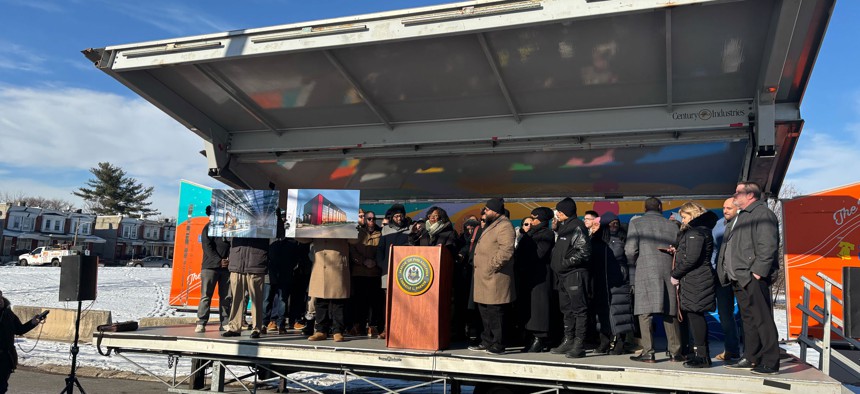
Philadelphia Mayor Cherelle Parker speaks from a podium about her latest affordable housing initiative on Jan. 21, 2026. Harrison Cann

Philadelphia’s housing beat received a duplex of news this week, with Mayor Cherelle Parker announcing a pair of initiatives that seek to produce more affordable housing and manufacturing jobs in the city.
In the snow-covered North Philadelphia neighborhood of Logan, Parker held a press conference Wednesday afternoon to unveil plans to create a “hub for housing manufacturing” in the city.
“Many (cities) are building factories to produce the housing in their respective cities and states. Well, why can’t we do that in the City of Philadelphia?” asked Parker, who cited the City of Cleveland’s modular housing factory initiatives as a leading example in the manufacturing area. “Everything Philadelphia needs to become the hub as a manufacturer of housing in our region, we have it, and if we all work together, we can do it while creating good union jobs trained by our building trades.”
The Parker administration released a request for information on modular construction housing factories on Wednesday afternoon, seeking details on the potential “development of modular housing factories within Philadelphia that will accelerate the production of homes and create jobs.”
The Logan area, which has a long history of redevelopment and abandonment, has more than 30 acres of city-owned property that could be used for manufacturing and training facilities.
And while there’s still plenty of time before a project gets approval and shovels break ground, Parker said the hope is for the modular housing factory – which would manufacture pre-built home sections typically used for affordable housing projects – to bring down housing prices while offering jobs for skilled workers in the city.
Along with the site in Logan, Parker suggested turning vacant school buildings into similar factories, arguing that repurposing long-vacant properties is just one part of a multifaceted approach to developing affordable housing.
“We are working on building new and (the) preservation of existing (housing), so it's not either/or,” Parker told reporters Wednesday. “It’s (about) supply and production.”
On Tuesday, the Philadelphia Inquirer reported that Parker and the politically powerful Building Trades unions reached an agreement to lend $50 million out of the unions’ pension funds to help finance the redevelopment of Brith Sholom House, an aging apartment complex in West Philadelphia that was shut down in 2024.
Parker, who said the funds will assist in the creation of 336 units of affordable housing for seniors on fixed incomes, framed the move as a first-of-its-kind approach to expanding the city’s housing stock. Under the arrangement, the Philadelphia Housing Authority will repay the building trades over 15 years at a 4.5% interest rate, with the building’s restoration expected to take two years to complete.
The Inquirer reported the $50 million investment comes in addition to the $99.6 million that the housing authority is spending on the gut rehabilitation of the Wynnefield apartment complex, bringing the total cost of the project to $150 million.
This week’s announcements are part of Parker’s broader Housing Opportunities Made Easy initiative, a $2 billion plan focused on creating and preserving 30,000 units of housing, backed by a massive bond.
Last June, Philadelphia City Council approved the city budget with an $800 million bond for the H.O.M.E. initiative, a plan set to fund 13,500 new units and 16,500 preserved units, with the caveat that Council must approve annual budget resolutions to determine how the bond proceeds will be spent.
But on the last day of the 2025 legislative session, council updated eligibility thresholds for two housing programs set to be funded by bond proceeds to ensure that more affordable housing is focused on low-income communities, instead of broader requirements that would have allowed some funds to go toward middle-income earners, such as city workers.
The amended plans, in addition to updating income requirements, include investment in the Turn the Key program, which uses public lots to build new houses for first-time homebuyers who would otherwise be unable to afford a home. Council’s revisions also included an additional $21 million for affordable housing preservation and production and an additional $5 million for the Basic Systems Repair Program, which provides free home repairs for low-income homeowners.
The changes focus the funds on low-income housing, with 90% of the H.O.M.E. initiative’s dollars going toward households earning up to 60% of the area median income – roughly $50,180 for a single person or $71,460 for a family of four, according to city data.