
Business
‘Waiting for clarity’: Philadelphia region’s uncertain business climate tied to policy uncertainty
A Federal Reserve Bank of Philadelphia survey finds that health care and social assistance sector are driving job growth
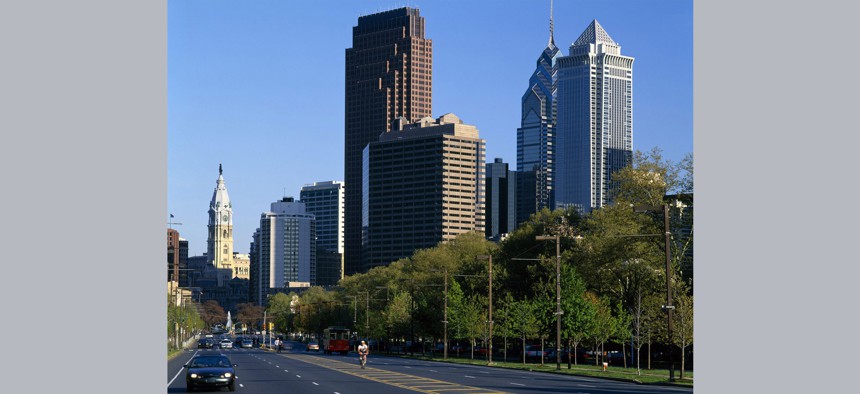
Philadelphia Skyline WikiMedia Commons

The health care and social assistance sector is up, while the rest of the Philadelphia region’s economy is “waiting for clarity,” according to findings from the Federal Reserve Bank of Philadelphia.
The findings informed the Chamber of Commerce for Greater Philadelphia’s annual “State of the Economy” event Wednesday, providing a forward-looking discussion on the economy with representatives from some of the region’s biggest sectors.
The discussion, along with economic forecast survey results, revealed that three sectors continue to offer significant opportunities moving forward: business-to-business technology, advanced manufacturing and life sciences.
Chellie Cameron, president and CEO of the Chamber of Commerce for Greater Philadelphia, said their focus is on making the region “a global destination for business and a leader in inclusive growth.”
“We’ve been armed with that data, (and) we will be much better equipped to build a competitive regional economy that expands access to quality jobs,” said Cameron.
The event coincided with the release of a survey by the Federal Reserve Bank of Philadelphia, which found that 22% of the chamber’s members reported increased regional economic activity in 2025 compared with 2024.
The survey, conducted between Nov. 6 and Nov. 24, 2025, also found that nearly 58% of respondents cited regulatory uncertainty as one of the top three problems they face, while 48% reported a decline in regional business conditions.
Additionally, according to the survey, 56% percent of respondents reported higher prices paid in 2025 than in 2024, while 63% anticipate price increases in 2026.
“I think the theme for 2026 is ‘Waiting for clarity,’” Anna Paulson, president and CEO of the Federal Reserve Bank of Philadelphia, said Wednesday. “Nearly 95% of net private job creation in 2025 occurred in a single sector: health care and social assistance. In the City of Philadelphia, about 27% of employment is in health care and social assistance, compared with 16% nationally. This means that the region has been somewhat insulated from the national slowdown in job creation.”
Paulson described the labor market as “bending, not breaking,” in her opening remarks, adding that income growth is not keeping pace with consumption growth.
The Federal Reserve Bank of Philadelphia’s 16th annual economic outlook survey detailed these trends, showing that respondents’ expectations for 2026 were mixed, with roughly equal shares of regional businesses expecting an improvement or a decline over the next year.
Uncertainty surrounding regulations and government policies was the most prominent issue respondents cited in 2025, with more than 20% listing it as their top concern.
AI, robotics and automation will also continue to be at the forefront of economic discussions going forward. The survey found that more than three-quarters of respondents currently use AI in some capacity, with about half reporting the use of generative AI or a combination of traditional and generative AI. Additionally, most respondents said generative AI hasn’t affected their need for workers, meaning job losses have been prevented for now.
“On the supply side, the sharp drop in immigration has slowed the growth of labor supply,” Paulson added. “On the demand side, firms, both nationally and here in Philadelphia, tell us that there are uncertainties holding back hiring as they consider a range of factors, (including) trade policy and the potential for artificial intelligence to transform the need for workers.”