
Education
Advocates push to upgrade civics education standards
As the semiquincentennial commences, legislators, educators and nonprofit organizations are trying to seize the momentum to spotlight the subject.
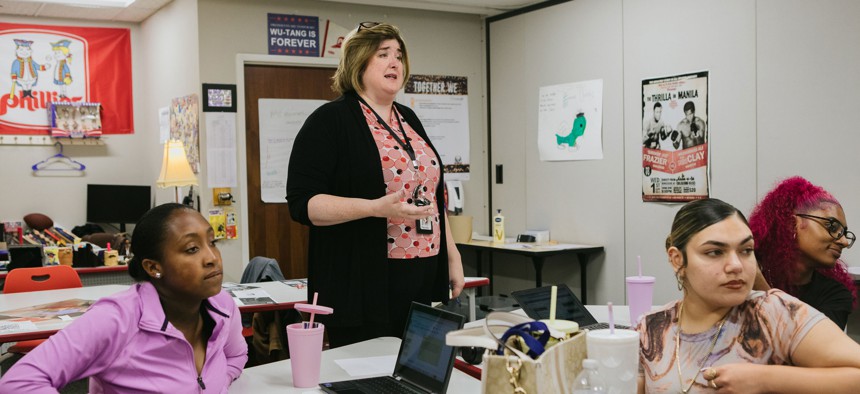
Shannon Salter, an Allentown social studies teacher, gives feedback following a senior presentation. MICHELLE GUSTAFSON/THE WASHINGTON POST VIA GETTY IMAGES

Under the thoughtful gaze of a portrait of George Washington, with Independence Mall and the Liberty Bell just outside, Shannon Salter leaned back in a chair at Philadelphia’s National Constitution Center and talked about the challenges and opportunities of teaching American civics in its birthplace.
“When government is based on ‘We, the people,’ and you place the future of the country in the hands of everyone, then everyone needs to be trained and prepared to do that,” reflected Salter, who teaches high school social studies in Allentown and advises the PA Civics education initiative for the Committee of Seventy, a nonpartisan, Philadelphia-based good-government organization.
That dual mission was her impetus to participate in Teaching250, a national convening of civics education organizations and social studies teachers held in early February. Hosted by the National Constitution Center and co-sponsored by The Center for Civic Education, the event was one of numerous initiatives using the 250th anniversary of America’s democratic founding in Pennsylvania as a springboard to bolster civic education – and reclaim the commonwealth’s legacy as a wellspring of democratic energy.
“Public education was meant to facilitate participation in a democratic republic,” noted Salter.
But despite notable recent gains in civic literacy and a surge of nonprofit educational investment, Pennsylvania remains, in Salter’s words, “behind the curve” compared to neighboring states like Maryland and Ohio. While their schools follow concrete requirements for civics education, Pennsylvania has state guidelines for teaching civics, but no formal statewide measure for student mastery of the topic – a situation that owes much to Pennsylvanians’ preference for local control of public schools.
Civics education in the commonwealth has been further sidelined by districts’ emphasis on math and English – the core of annual state mastery tests – and by the recent vogue for STEM (science, technology, engineering and mathematics) education.
Now, as Pennsylvanians contemplate the 250-year legacy of the American experiment, advocates for civics education hope to reverse what Julie Silverbrook, the National Constitution Center’s vice president of civic education, calls a half-century-long national deprioritization of civics education that, despite significant progress, can still be felt in underresourced social studies classrooms across the commonwealth.
Advocates hope to bolster the teaching of government not only through educational initiatives – including a growing array of civics curricula offered through organizations like the National Constitution Center – but also through state legislation, championed by PA Civics, that would update civics educational standards, create a model mastery test and establish a seal of civics literacy for high school students.
Amid an increasingly polarized civic discourse, a rise in political violence and widespread concerns that democracy is in retreat, educators and lawmakers know what’s at stake.
“There’s a decline in democracy – not just in the United States, but globally. And I absolutely think that that’s related to the decline in civic knowledge, in valuing civics education and civic engagement,” said Silverbrook. “As a civil society, we’re becoming more isolated … In the information environment now, you never have to be confronted with an opinion that’s different from your own.
“This is really much bigger than a political problem. This is tearing at our social fabric,” she added. “Civic education fits within that broader conversation and can help address some of these societal issues, because people who are more civically educated think about civics in those broader terms.”
Former Pennsylvania Secretary of Education Pedro Rivera, the author of Pennsylvania’s current civics education guidelines, concurs. “It’s huge work,” he said, “but when we create civically minded community members, they can be better stewards of democracy and better leaders in their communities.”
Charting the challenge
Many of Pennsylvania’s key civics education initiatives date to the mid-2010s, which is no coincidence: In 2016, nearly three-quarters of Americans could not name the three branches of government, according to an influential annual civics knowledge survey conducted by the Annenberg Public Policy Center at the University of Pennsylvania.
The push for new state civics standards builds on Act 35 of 2018, legislation signed into law by then-Gov. Tom Wolf that requires Pennsylvania schools to administer locally developed tests of U.S. history, civics and government to students in grades 7-12.
Act 35 established guidelines and resources for curricula around the principles and structure of the country’s constitutional democracy and its founding documents, as well as the rights and responsibilities of U.S. citizenship. In addition, the law requires the Pennsylvania Department of Education to survey schools every two years to document civics testing.
The bill’s prime sponsors, then-state Reps. Karen Boback and Bill Kortz, wrote in a co-sponsorship memo to colleagues that the “impetus for this legislation is the alarming decline in civic knowledge among American adults.”
“It is our hope to ensure that students have at least a basic knowledge and understanding of civics and government in order to prepare and encourage them to be responsibly engaged citizens,” they wrote. “We believe that this legislation is an important and necessary step towards achieving this objective.”
Rivera – now president of the Thaddeus Stevens College of Technology in Lancaster – called the 2018 standards “the North Star” for teachers. Drawing on his experience as a bilingual Spanish-English educator in the School District of Philadelphia and, later, superintendent of the School District of Lancaster, Rivera envisioned an approach centering on critical inquiry rather than rote memorization.
“We didn’t want it to be a multiple-choice test,” he said. “We really wanted to create standards that ensure that students understand how government presence impacts the decisions that they make and the conditions that they live in every day.”
Once the standards took effect, a coalition of nonprofits and good-government groups evolved into PA Civics, a nonpartisan organization led by former U.S. Reps. Jim Gerlach and Joe Hoeffel to help both teachers and policymakers meet the state requirements.
“We’re glad that the legislature took it on in 2018, but it didn’t go nearly far enough in terms of quality civics education,” said Justin Villere, the lead administrator for PA Civics and the vice president of strategy and partnerships at the Committee of Seventy. He said Act 35 was well-intentioned, but added: “It’s mostly just a box that school districts are required to check.”
Nonprofit organizations have stepped up to fill the education gap. Villere said the Committee of Seventy offers mock elections each November to teach students how to register to vote and to analyze the races and candidates on the ballot, and also connects students with candidates running for office.
A dozen years ago, the National Constitution Center, a member of PA Civics, launched an education program centered on curricula for middle- and high-school teachers and adult learners, grounded in the U.S. Constitution and democracy. This year, the center launched the America at 250 Civic Toolkit – featuring an interactive multimedia version of the Declaration of Independence – as well as Civic Quest, a play-based family activity that teaches American history to children aged 7 to 12.
Silverbrook explained that anchoring civics discourse in America’s foundational documents offers “a sort of guardrail around the conversation, which I think is really important in a very dynamic, polarized information environment,” she said. The center’s resources are used by approximately 90,000 educators annually, reaching nearly 6 million students nationwide.
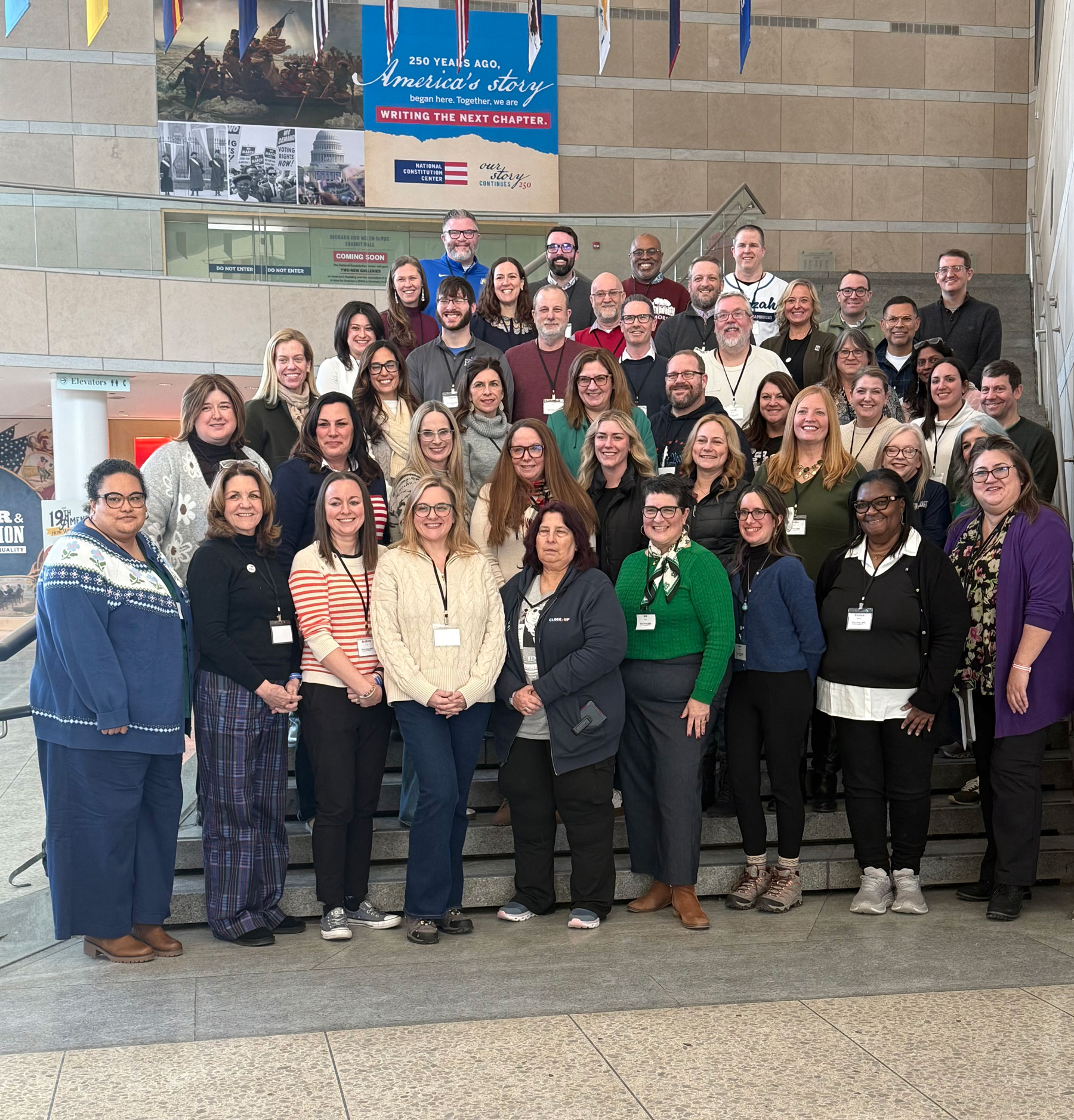
For its part, PA Civics seeks to connect educators with professional development opportunities like its annual educator forum, which attracts dozens of teachers who earn continuing-education credits. At its most recent conference, PA Civics held sessions focused on the Declaration of Independence, First Amendment rights, civil dialogue, and navigating information in the age of artificial intelligence.
“The goal is to have them bring these resources back to their classes and implement them from Day One … in a way that is easy for them to use,” said Villere, “because what we’ve found is, teachers are struggling to find high-quality resources that are easy to access, easy to implement. We’re trying to reduce those barriers.”
In March, Philadelphia will also be home to the Civic Learning Week National Forum, which will convene educators, policymakers, media and members of the public for a civic education forum in conjunction with the nation’s 250th anniversary.
If the Annenberg survey is any indication, these collective efforts are bearing fruit: In the institution’s 2025 survey, some 70% of respondents correctly identified the executive, legislative and judicial branches of government.
Classrooms in flux
However, Americans – particularly young Americans – believe more can be done to improve the nation’s civic discourse and overall civic landscape.
In a 2025 American University poll of roughly 1,200 Americans aged 18 to 35, 69% of respondents described the state of the nation’s civic discourse as a “crisis” or “serious problem.” A majority of respondents identified education as a key factor in improving that discourse: 60% said high schools should offer more classes in civics and community understanding, and 55% said universities should encourage civic discourse through campus life initiatives.
Veteran teachers like Shane Newhouse and Mike Mountz are on the front lines of that effort. Both Newhouse, who teaches high school U.S. government and economics in the Ambridge Area School District, and Mountz, who teaches world history and Advanced Placement U.S. government at York Suburban High School, applaud the state’s move toward teaching critical skills alongside factual knowledge.
Media literacy – the ability to distinguish fact from misinformation and identify reliable, neutral sources – is a key element of teachers’ role today, as young Americans are more exposed to dubious media sources than in past generations.
When Mountz began his teaching career 15 years ago, “we used to take it for granted that, for the most part, you didn’t have to vet the accuracy” of mainstream media, “when everyone’s dealing with the same underlying facts,” he said. He explained that that is no longer the case in an environment where diverse social-media perspectives mean “you’re not even working with a common understanding of reality.”
To combat misinformation he hears from students, Mountz employs a Socratic method, asking a series of probing questions rather than outright challenging a claim. “You now have the burden of proving that right: ‘Where did you hear that?’ ‘I don’t know.’ ‘Okay, why did you trust it?’”
Despite what civics experts describe as an increasingly polarized political environment, Mountz confronts political differences directly. Government and policy can be abstract, educators say, and engaging students with real-world, contemporary issues makes civics feel relevant. “If I didn’t lean into the controversies of the present, I don’t know how interested they would be,” Mountz said.
Case in point: In Western Pennsylvania’s Beaver County, Newhouse teaches about gerrymandering by discussing the recent redistricting that turned this longtime Democratic millworkers’ stronghold into a Republican-leaning district.
He brings discussions about state and local government to life by contrasting Pennsylvania’s motor vehicle regulations with those of neighboring Ohio, which doesn’t require vehicle inspections.
When teaching about the Supreme Court, he involves the class in discussions around major cases – Roe v. Wade, Brown v. Board of Education – that resonate in their lives today. And he drills students on the Constitution and its amendments because, he said, “I believe the kids should know their rights.”
Whatever the topic, “I tell the kids, ‘Don’t judge until you look at both sides,’” Newhouse affirmed. “I try to give them facts and I try to expand their knowledge, and then let them go with it where they want. They’re more intelligent than we give them credit for.”
They’re also more tolerant of diverse opinions, which Mountz attributes to growing up in a swing state. “It’s a purple school district inside of a purple congressional district inside of a purple state,” said Mountz of the 10th congressional district, which the Cook Political Report has rated as a toss-up in 2026. “There’s not a shortage of differences of opinions, but I think that’s an added value” – at least in civics classrooms.
Building on progress
Social studies teachers are a passionate lot, but they are also in short supply – part of a larger education workforce shortage – and struggle to compete with higher-stakes subjects for classroom time and professional development resources.
To build on recent progress, PA Civics and other advocates are pushing for state-level legislative reforms to build on the passage of Act 35.
The three-pronged legislative proposal, which supporters hope to introduce this session in the state legislature, aims to further improve civic education. The first piece calls on the Department of Education and its Board of Education to update Pennsylvania’s social studies standards. They’d also like the state to publish a recommended test based on the updated standards that schools could use to meet Act 35 requirements.
The third part of the proposal calls for a process for students to earn optional Seals of Civic Literacy in Pennsylvania – an incentive-based recognition that students could put on résumés or college transcripts to signify their exemplary knowledge of U.S. civics.
“Those are the proposals that we think thread the needle between local control, unfunded mandates, but then also the clear need and public backing for improved civics education in Pennsylvania,” Villere said.
Several state lawmakers have expressed an interest in examining existing civics education efforts in the commonwealth. Democratic state Rep. Tim Brennan has introduced a resolution asking the Joint State Government Commission to study the state of civics education in Pennsylvania, along with what initiatives have been successful in other states. As for the legislative package seeking to build on Act 35, Villere said the coalition has had early talks with House Education Committee staff, but the bills have yet to be introduced.
For her part, Salter is championing the legislative package, which she calls an ideal compromise between clear standards and local priorities. “One of the beauties of a civic seal, as opposed to a Keystone exam … is that you provide a menu of what excellence looks like, and then allow education leaders and school boards to decide from that menu what it’s going to look like in their community,” nodding to local control, said Salter. “You still set a bar, but there are many ways to meet that bar.”
In the Allentown School District, she explained, a sizable population hails from Puerto Rico and the Dominican Republic, which might prompt a focus on Latino and Caribbean cultures. Pittsburgh educators could choose to spotlight Black history, while classrooms in Lancaster County, home to Amish communities, might explore the German immigration experience.
Whatever local schools choose to emphasize, Salter is hoping the measures pass – and the commonwealth reclaims its role as an exemplar of American democracy, one classroom at a time.
“Everyone’s going to be coming here to talk about how crucial Pennsylvania was – the Keystone State that made the revolution work, 250 years later,” she said. With a third of residents still fuzzy on the resulting government that is the founders’ legacy, she added, “it’s urgent that we do something about that.”