

Criminal Justice
Senate Democrats weigh adult-use cannabis options during Philadelphia hearing
The event coincided with Black Cannabis Week and the Cannabis Opportunities Conference in Philadelphia
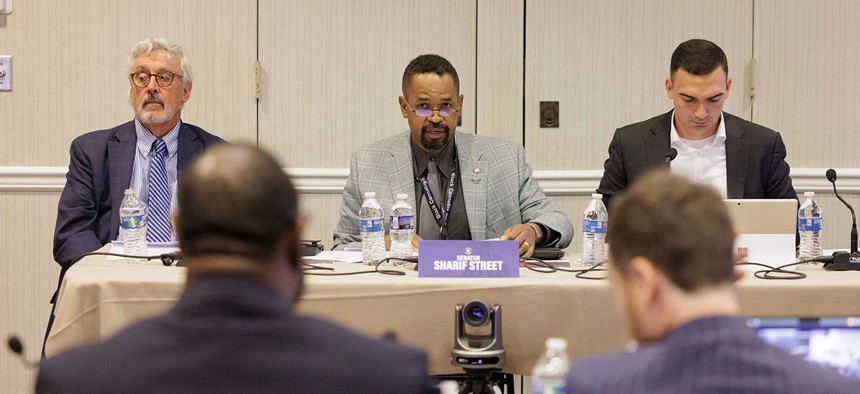
The Senate Democratic Policy Committee met in September to examine cannabis policy in Pennsylvania. James Robinson / Senate Democratic Policy Committee

Pot policy was the burning question in Philadelphia last week.
The state Senate Democratic Policy Committee hosted a hearing in Philadelphia on Friday to look at ways to modernize the cannabis marketplace in the commonwealth – and how adult-use regulations should balance criminal justice, equity and public safety.
The discussion took place alongside the ninth annual Cannabis Opportunities Conference and Black Cannabis Week events in the city.
“Having these hearings will inform us about what the best policies are, how we should operate, and what kinds of policies we should adopt,” state Sen. Sharif Street said to open the hearing. “More and more, it’s not a question of whether we should legalize adult-use cannabis, but how should we do it, and under what time frame it gets done.”
Led by state Sens. Nick Miller, Sharif Street and Tim Kearney, the discussion ranged from the current landscape of cannabis policy in surrounding states and regulatory and safety issues to the social-equity side of the issue and how communities disproportionately impacted by drug enforcement can benefit from the transition to a legal marketplace.
“We know where the war on drugs was mostly fought, where it was waged – and those communities that bore the brunt of that should receive more funding,” Oren Gur, director of research and DATA lab with the Office of the Philadelphia District Attorney, said. “It’s a one-to-one way to address what was taken out of that community in terms of human resources, human capital, by putting resources back into those communities.”
Former Warren County District Attorney Robert Greene testified that the use of cannabis is widespread – and largely not an issue even in rural areas.
“For me, my starting point was freedom – and still is freedom. Adults should have the freedom to choose to consume a plant that has been beneficial to the human race medically, spiritually and for pleasure and happiness for thousands of years,” Greene said Friday. “But with freedom comes responsibility and accountability. So how do we protect safety while making sure law enforcement is fair? What conduct are we actually trying to prevent?”
Leafy legislation
The Bipartisan Adult Use Marijuana Legalization Bill, introduced by Street and Republican state Sen. Dan Laughlin, has been pitched as the legalization measure that would balance safety with social and economic equity. The broader plan would create an adult-use regulatory framework for Pennsylvania while ensuring criminal expungement and other justice reforms also take place.
Panelists throughout the hearing stressed that the cannabis market – legal or not – isn’t going away, and that legalization is not an attempt to liberalize cannabis use, but to pair regulatory clarity with criminal justice and public-safety measures.
“While we are more than a decade and a few billion dollars behind other states, we have the benefit of learning from their experience, and that will be our focus today,” said Gur.
Gur said every neighboring state “offers a lesson” to Pennsylvania lawmakers seeking to make the most of the market as it transitions from solely medical use to both medical and adult recreational use.
According to state filings, Pennsylvania has roughly 439,000 medical marijuana users, nearly 200 dispensaries and 2,000 approved practitioners. And within the last year, the state has notched about $1 billion in medical marijuana sales – all figures that point toward a relatively easy transition to adult use.
“New Jersey and Maryland phased licensing carefully and converted existing medical operators, avoiding the worst oversupply problems,” Gur testified. “New York is a cautionary tale; they had a slow licensing rollout with weak enforcement, and it allowed a lot of illegal shops to develop … Ohio and Delaware show that a mature medical program like ours can support a fast, controlled transition (to adult use).”
He added that, in addition to creating a pathway for medical providers to enter the adult-use market, the commonwealth should be intentional about how it structures its licensing tiers and requirements, and where state revenues will be allocated.
Throughout each panel, the focus kept returning to the concept of equity – and ensuring marginalized communities aren’t once again left out of a burgeoning industry. That discussion, outside of the need for expungement of previous cannabis-related convictions, centered around access to capital.
Street said the priority should be to “make those capital markets available for the social-equity licensees, because most social equity licensees are smaller.”
“They’re not going to have that reservoir of capital, so I think leveraging (capital funds) there will be helpful,” Street told City & State, adding that the social-equity lens can apply to the broader supply chain too. “It’s not just who’s growing and touching the plant. With transportation (and) all those businesses (involved)… it doesn’t mean you can’t have diversity in your subcontractors.”
Street is one of several lawmakers from both sides of the aisle who have sought to push the pot conversation forward in Pennsylvania.
Democrats in the state House and Senate, along with Gov. Josh Shapiro, have expressed support for creating a regulated, adult-use cannabis market in the state, but Senate Republicans – who control the upper chamber – have largely stood their ground on the issue.
Street, who spoke with City & State in May regarding his latest legislative push, has said any “reticence” on the subject “is largely within Republican, more conservative circles.”
But on Friday, Street said he believes Pennsylvanians are closer on the issue than many think.
“We are not as far apart as people believe,” Street said Friday. “Those are issues that unite us, not divide us.”