

Capitol Beat
Gov. Shapiro vows to use ‘every tool’ to stop ICE facilities from coming to Pennsylvania
The governor said ICE facilities proposed for Berks and Schuylkill counties will stretch resources in local communities.
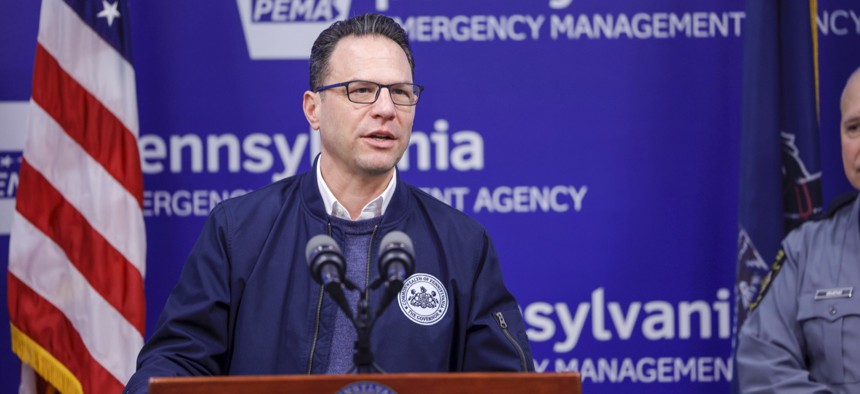
Gov. Josh Shapiro speaks at a February press conference. Commonwealth Media Services

U.S. Immigration and Customs Enforcement has plans to locate two proposed detention facilities in Pennsylvania, but Gov. Josh Shapiro said Thursday that he intends to “use every tool” at his disposal to stop the facilities from coming to the commonwealth.
“I don’t want either of these sites here in the Commonwealth of Pennsylvania,” Shapiro said, referring to detention facilities planned for Berks and Schuylkill counties.
Earlier this month, CBS News Philadelphia reported that ICE purchased a 64-acre warehouse property in Berks County for $87 million. In Schuylkill County, the U.S. Department of Homeland Security’s $119.5 million purchase of a 1.3 million‑square‑foot distribution center in Tremont Township has also raised concerns among local residents.
Shapiro’s remarks to the press came after a meeting with local officials from across the political spectrum, whom he said expressed significant concerns about the strain the facilities could place on local resources.
“To hear from Republicans and Democrats alike expressing opposition to this, I think, speaks volumes about how unwanted these facilities are in our communities,” the governor said.
He added that ICE and the Trump administration have been “violating people's constitutional rights all across this country,” and that in addition to human rights concerns, the facilities could have negative consequences for local economies and the availability of public resources.
Shapiro cited the water system serving Tremont in Schuylkill County, which currently serves around 700 households. He said the system is currently unable to keep up with demand, and that if an ICE facility is built “they will literally run out of water within 24 hours.”
Shapiro said the two facilities will also place a major strain on healthcare, emergency medical services and first responder capacity, as well as local infrastructure.
“We simply don't have the fire and EMS and first responder capacity to deal with it,” Shapiro said. “The 911 system would be taxed and make it very, very difficult for the 911 system to be able to operate.”
The governor – joined in Berks County by Pennsylvania Health Secretary Dr. Debra Bogen, Pennsylvania Department of Labor & Industry Secretary Nancy A. Walker and Jill Whitcomb, the deputy secretary of water programs for the Pennsylvania Department of Environmental Protection – said he will do everything in his legal and regulatory power to stop the facilities from being sited in Pennsylvania. However, he did not go into detail on what those options are.
“There are a number of regulatory steps we could take through the Department of Environmental Protection, Department of Health, Department of Labor and Industry,” he said. “I’m not going to get into the specific steps we are going to take, but I can assure you, over the next couple of weeks or so here, we’ll be prepared to take them.”