

Campaigns & Elections
Sans Stanford, Dems Rabb and Street meet for PA-3 debate on Wednesday
Ala Stanford dropped out of WHYY’s Democratic primary debate hours before it was set to begin
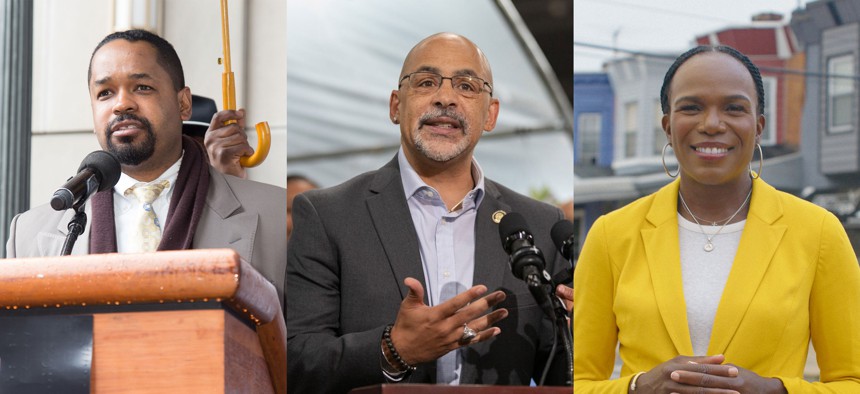
Sharif Street, Chris Rabb & Ala Stanford Brian Stukes/Getty Images; Commonwealth Media Services; Stanford for Congress Campaign

Wednesday’s televised debate between Democratic candidates in the PA-3 primary made headlines before it even started.
The hourlong debate, hosted in WHYY’s Studio 2, was missing one key candidate: Ala Stanford.
Stanford, one of the three leading contenders in the race, backed out of the debate about two hours before it was set to begin, saying her campaign couldn’t agree with the public radio station’s format and criticizing her opponents in the race for “misogynistic attacks.”
“I have never been afraid of a hard room,” Stanford, a physician-turned-political candidate, said in a statement. “After engaging in good faith with WHYY, we could not reach terms on a format that would deliver the serious accountability voters in PA-03 deserve. I am not willing to lend my name to a conversation that falls short of that standard, and so we will not be participating today.”
WHYY said Wednesday it engaged with all three campaigns in good faith and felt strongly that it had met journalistic standards since it began organizing the debate back in February.
“At no time did (the Stanford campaign) say, ‘If ‘X’ doesn’t change, we’re backing out,’” Kevin McCory, executive producer of Studio 2, said before the start of the debate. “All of our interactions with all the candidates kept three things paramount: fairness to all the candidates that we invited; holding ourselves to the highest standards of journalistic integrity; and delivering a program that would enrich and inform our audiences.”
The debate went on without Stanford, as state Sen. Sharif Street and state Rep. Chris Rabb fielded questions about their top policy priorities, track records in Harrisburg and what voters are looking for in a congressperson.
In his opening remarks, Street pitched his campaign as one of substance over statements. Street said he may agree with Rabb on a variety of issues, but that his legislative record – and ability to provide tangible results – sets him apart.
“People have needs – and they need to get things done,” Street said. “I have done that as a member of the Pennsylvania state Senate.”
Rabb leaned on his “bold” stances and solutions, arguing that voters are looking for someone that’s not considered a “party establishment” candidate.
“We have a real choice ahead of us, and that choice is, will we embrace shared prosperity and collective liberation, or will we double down on insiderism and establishment politics?” Rabb said in his opening statement.
Both Street and Rabb agreed that improving the health care system, mainly through Medicare for All, is a top priority for voters, alongside the affordability issues many families face.
Street and Rabb also pushed back against Stanford’s claims that she was the victim of “misogynistic attacks” during the campaign. Both said that while they have all faced some heat throughout the primary run, they support Stanford and spoke out at previous forums when she was heckled.
“I raised my voice multiple times because I didn’t think it was right. I have not been accused of misogyny by anyone. I don’t know what she’s referring to,” Rabb said.
Two-man debate
With less than three weeks until the May 19 primary, the WHYY debate was one of the last chances candidates have to get their message out to voters in PA-3.
Pennsylvania’s third congressional district encompasses North and West Philadelphia and is the most partisan district – regardless of party – in the nation. According to the Cook Political Report, the district performed about 40 points more Democratic in two-party vote share than the nation as a whole in 2020 and 2024.
And as the race narrowed down to a short list of candidates, contentious conversations at forums have become the norm.
Earlier this month, during a candidate forum in Philadelphia’s University City neighborhood, tensions over the Israel-Gaza conflict dominated discussions and led to combative back-and-forths between the candidates and residents in attendance.
That topic – one of the few areas where the Democratic candidates aren’t in agreement – came up again on Wednesday.
When asked about Congress’ role in foreign wars, Street argued no president should unilaterally drag the country into foreign conflict, adding that he believes both President Donald Trump and Israeli Prime Minister Benjamin Netanyahu have committed war crimes.
He clarified that he supports a two-state solution for Israel and Palestine: “I do think there won’t be peace and prosperity for Palestinians without peace and prosperity for Israelis, and there won’t be peace and prosperity for Israelis without peace and prosperity for Palestinians.”
Rabb, who’s been unapologetic about his word usage on the topic, took it a step further, arguing “if we can’t say the thing, we’re not going to address it.”
“I think we have to acknowledge our complicity in an ongoing genocide in Gaza. It’s our taxpayer dollars that are sending bombs,” Rabb said, “Genocide is genocide. If you can’t name the beast, you can’t kill it.”
Lasting lines
Rabb, who used the word “bold” multiple times, called Street “the epitome of establishment politics,” which, he argued, has been a key factor in the current state of the nation.
“We need to have more movement-based candidates who can be public servants, and have fewer politicians in the halls of power,” Rabb added.
Street, the former state Democratic Party chair and the chosen candidate of many sitting Democrats, said that along with the left-leaning ideals, he has the leadership and legislative record to back up his statements.
“Look, Rep. Rabb and I share a lot of value propositions, but the difference is, I deliver on ideas,” Street said. “I’m the only candidate (who has) consistently moved legislation onto a governor’s desk and made sure that people actually saw results.”
In his closing statement, Street reiterated thathe has a demonstrated history of delivering for the community.
“When it came to talking about health care, I didn’t just talk about big ideas, but I actually delivered,” Street said. “And when it comes to standing up to Donald Trump, it wasn’t just a bunch of speeches. I took him to court when he tried to get rid of dropboxes (and) early voting. I took him to court and I beat him every time … I have a history of winning against him.”
In his final pitch, Rabb reiterated that he speaks for himself and doesn’t “ask the party insiders what they think.”
“That’s why when I see genocide, I call it genocide. When I see children in Philly losing access to education, I don’t look the other way, I call it what it is: educational apartheid,” Rabb said in closing. “I speak truth to power even when it’s uncomfortable, because you can’t kill the demon until you have the courage to name it. That demon is injustice, and it must be fought for on every front. Principle is more important than politics. I’m ready to bring that fight to Congress.”