

Campaigns & Elections
Meet the longshot in the PA-3 Democratic primary
Shaun Griffith believes his “people over profit” message is louder than the ones coming from seasoned politicians
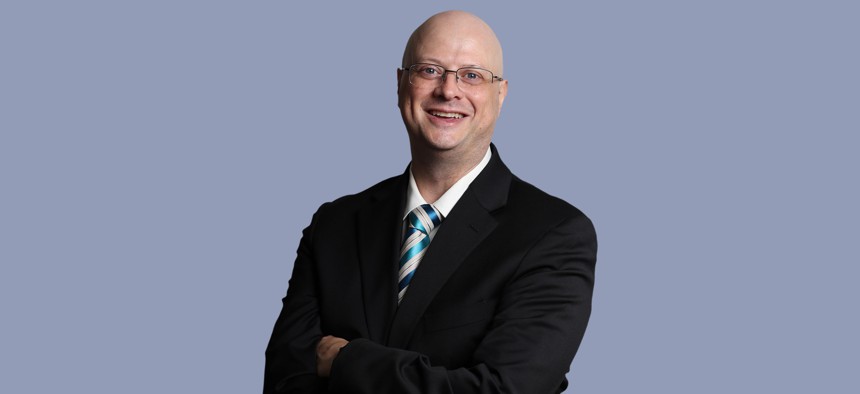
Shaun Griffith Campaign

Shaun Griffith is tired of being left out of the conversation.
The political newcomer – and longshot in the PA-3 Democratic primary – has been putting in the work as the “people over politics” candidate, even as voter guides and community forums exclude him.
Griffith said he personally collected most of the signatures he needed to get on the ballot, but even after gaining enough support on paper, the city’s Democratic Party tried to stop him.
“I did not expect that … the Democratic City Committee would immediately sue me and that I would then spend nearly a month in court, fighting them, (at) first, to win at the Commonwealth Court,” Griffith told City & State. “We don’t have much money, so I couldn’t hire an attorney for the campaign. It was me.
“Then, as soon as we won at the Commonwealth Court, they took me to the Pennsylvania Supreme Court,” Griffith continued. “We won again – so we’ve actually really only been in the race with no cloud over our head for less than a month.”
Neither his late entry into the race nor his low fundraising numbers – at least compared to the three leading candidates, Chris Rabb, Ala Stanford and Sharif Street – has deterred Griffith’s campaign.
“I want to make sure that they’re giving people an opportunity to choose a candidate who is fighting to serve them,” Griffith said. “People don’t even get the chance to know about me, because there's so much institutional bias for well-funded candidates.”
Background
Griffith is a Western Pennsylvania native who moved to Philadelphia’s Cobbs Creek neighborhood in 2009. He now resides in the city’s Grays Ferry section and worked as an appeals referee for unemployment compensation while building up his own firm, USA Tax Service.
Griffith didn’t meet the campaign finance threshold to participate in many of the public forums and debates. He argued that debate hosts – including WHYY, which hosted a debate last week – have been purposefully exclusionary by basing their participation threshold on fundraising from 2025, when Griffith’s campaign had yet to kick off.
“I wasn’t in the race in 2025,” he said. “Even if I were a billionaire and I loaned my campaign $100 million – which I obviously didn’t – I still couldn’t have met (the threshold) because they made a decision on 2025 data … There was a similar (event) at the Mummers Museum where I didn’t get to participate, either.”
In a conversation with City & State, Griffith said his top priorities include a $15-an-hour minimum wage and community protections from data centers. He said the “increasing wealth gap” has made life “unaffordable for working-class people,” adding that if elected, he would immediately push for a Medicare for All vote and “fight the consensus” to get congressmembers to put their healthcare stances on the record.
“I’ve been concerned (about) a lack of access to healthcare for a long time and environmental degradation, but it got much worse after Trump returned to office a year and half ago,” Griffith said. “Now we could see the worst violations of our civil rights … where people are being abducted in the street and being deported without due process.”
On top of calls to increase the minimum wage and implement Medicare for All, Griffith said many of his conversations with residents are about data centers and consumer protections from their effects, including rising energy costs.
“Other candidates are not talking about how much it is costing us – higher electricity costs, as well as polluted water,” he told City & State. “At every forum where people can ask questions, they’ve asked me about it. And then on the street, several times a day, someone will ask about that … Making electricity and water cost more makes everything even more unaffordable, and the billionaires should be paying for that.
“We have socialized risk and privatized gain. And these data centers … it is a symptom of our government always favoring the profit of the very wealthy at the expense of common people,” he added.
The concept of affordability has driven many conversations in the race. And while the Democratic primary for a deep-blue seat features candidates with like-minded ideas, Griffith’s move to stand out is his pitch that he’s a regular person.
“I have made far less money than any of the other people (in this race) … I am the only working-class person,” Griffith said. “Our candidacy has one-fiftieth of the resources of any of the others (and) if I win, it’s going to prove that all of the money spent on campaigns is wasted.”