
Capitol Beat
A Q&A with Senate Democratic Leader Jay Costa
The Democratic leader in the Senate discusses lessons learned from last year and 2026 priorities
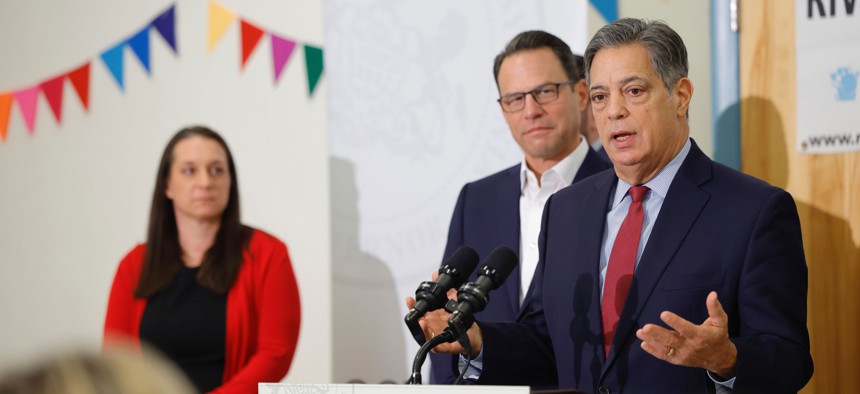
State Sen. Jay Costa speaks at Riverview Children's Center in Verona on Dec. 1, 2025. Commonwealth Media Services

With a new year comes renewed focus on Harrisburg and party leaders as they lay out plans for the legislative session. State Sen. Jay Costa, the Democratic leader in the upper chamber, spoke with City & State to discuss an eventful year in the Capitol and what’s on the agenda going forward.
In a wide-ranging interview, Costa discussed the impacts of education and energy policy, as well as his top agenda items for 2026.
The following conversation has been edited for length and clarity.
What lessons did you take away from last year’s budget negotiations?
I think the most significant thing we can do is start our conversations earlier in the process and stick to them. I think those conversations – the parties being in the room, working through the issues, and narrowing those issues down over the course of weeks – will be the best way for us to be able to get a meaningful budget done by June 30.
What are your priorities in 2026?
Investing in education and fulfilling our commitment to adequately fund our school districts across the commonwealth will remain a priority we share with House Democrats and the governor. Similarly, I think there’s interest in investing in job creation, and affordability will be a priority across a variety of areas.
Another important issue for us is transit and transportation funding. We cannot continue to put this off and keep raiding the Public Transportation Trust Fund for transit system maintenance.
Certainly, energy policy will be a priority in many respects, and we will ensure a balanced approach to addressing it. There are likely many opportunities there. We need to be thoughtful and smart in terms of how we move forward along those lines, finding the right balance to ensure that we’re protecting consumers with respect to the cost of energy, looking forward in terms of the best environmental solutions to allow us to put into place electricity generation facilities and address data centers, electric vehicles and the like.
I think we’re going to want to continue to provide for programs that reduce costs for people, like the Child Care and Dependent Care Tax Credit Program and the Working Pennsylvanians Tax Credit program – we can build upon that. Increasing the minimum wage will be a priority for us. Some states around us have double the minimum wage that we have. It’s embarrassing that we don’t do enough to support those individuals working in that space and provide them with a living wage. We need to take steps to address this.
Another area we’re going to focus on is housing – not only making sure we provide programs that help people afford homeownership, but also giving renters and longtime homeowners the opportunity to stay in their homes and complete necessary repairs and get support similar to the Whole Home Repairs Program. That provides stability for the person in the home and family, as well as for the community.
How are you addressing people’s concerns about the lack of a long-term funding solution for the state’s transit systems?
We’re very much concerned about that. We’ve talked about providing a long-term revenue stream and that’s what we’re going to continue to focus on. We discussed the governor’s proposal, which we support, and which the House passed multiple times. It would increase the sales tax rate we receive and dedicate the revenue to transit. That’s the solution we believe is best, but Republicans are having difficulty getting there. That said, we’ve explored other revenue streams.
There’s a lot of discussion about regulating and establishing parity in taxation for skill games. They’re all over the place now around the commonwealth, everywhere from bars and restaurants to cleaners and grocery stores and so many other places that are going unregulated and untaxed. We think that could be a revenue source along those lines. We propose that and we’re still working towards an end, but that would only be the transit side of things. Our view is that we can utilize skill games not only with transit funding, but for transportation funding as well. When we do these two things together, I think it provides a dedicated funding stream for both and allows us to meet the needs of our roads and bridges, as well as transit.
Would including road and bridge funding with transit funding be considered a compromise between your caucus and the Senate GOP?
That’s a given. I mean, we’re not going to get it done without roads and bridges being part of this discussion – we’ve always done transit and transportation together the years I’ve been there. So to me, they need to go together – and they will – and there needs to be commensurate amounts of money for each of those priorities.
We’ve got to find a revenue stream to be able to do that. We’ve been proposing the governor’s sales tax approach that’s passed in the House, and we’ve also been talking about skill games. We’re going to look at other ways in which we can generate the revenue. My colleagues have talked about utilizing an increase in the car rental tax and increasing the ride share tax to generate revenue there. There are a number of these items that came out of the previous governor’s transportation funding task force that were recommendations, and this was one of them that I think is reasonable and fair, and I think something we should think about as well.
When thinking about other potential revenue sources, including the regulation of skill games and adult-use cannabis, do you believe they are on the table this year?
I think that skill games are definitely going to be on the agenda to be able to try to nail down the solution or compromise. Similarly, with recreational marijuana, I believe the governor is going to propose it again. I think we’re going to be able to get there given that we’re going to need the revenue that could be generated from that later in 2027 and, more importantly, as we look at 2027-2028. We’re not going to get much revenue in the rest of 2026 but we could begin to see some in 2027.
How do you balance spending needs and long-term fiscal stability during budget negotiations?
We really have to be thoughtful in terms of how we prioritize where we’re going to spend additional resources. Certainly, we want to ensure that we’re continuing to provide sufficient resources in education, but also for human service programs. They are a critical part of what we need to do, whether it be the Medicaid program or other human service programs that are helping us be able to address the needs and issues along those lines. They become priorities based on where we plan to be in that space. We have limited resources, so we have a limited number of opportunities to invest across a variety of areas. We must prioritize what matters most to the people of Pennsylvania.
Circling back to housing, do you see Whole Home Repairs or similar programs being reconsidered this year?
We intend to keep a broader housing conversation going, including the Whole Home Repairs program. I don’t think we’ll call it the same thing, but we are looking for it to be one component of a housing plan that we can discuss vigorously as we move forward. It’s about repairing homes, certainly, but it’s also about home ownership and being able to afford the costs associated with utilities, for example. Those are all the things at play.
Is it safe to say that cutting red tape and reducing zoning restrictions are on the table for addressing the housing shortage?
No question. There are many things we can do at the state and local levels to make it easier for people to achieve home ownership, including removing barriers and unnecessary costs. When you take time, it’s money. The longer it takes to be able to do what needs to be done – whether it be a housing development, whether it be affordable housing development, whether it be home ownership – the more difficult it becomes to be able to find the resources to get something done, because expenses go up.
How do you approach energy production while keeping in mind the need for environmental safety, particularly in Western Pennsylvania?
I think that’s going to be our challenge: finding the right balance to create an environment for electricity generation while mitigating the environmental impacts that could result. That’ll be our challenge going forward. We’re going to pursue it aggressively and work to reach a reasonable compromise. Now that the Regional Greenhouse Gas Initiative is off the table, there’s no excuse for not addressing energy policy in the Commonwealth. We stand ready to find the balance we discussed. The environmental balance must be weighed against other societal benefits and concerns, ensuring that people can afford utility bills and that residents are not adversely affected by the extent of the help provided. We’re going to work toward that end.
How are actions by the Trump administration influencing the things your caucus focuses on in Harrisburg?
Last year, Senate Democrats were focused on federal actions, and we went to great lengths to criticize some of the programs implemented. We’re very public and wanted to make sure the public was aware of what was happening. We remain in that space. We are advocating, but also at the same time, making folks aware of what’s coming down the road with this, whether it be what’s going on with the SNAP benefits, the Medicaid program and other programs are being impacted. We’re doing a lot of advocacy, community meetings, town hall meetings and press events to ensure people are aware of what’s happening.
There’s no question that they will affect our commonwealth residents, and they will affect health care. For example, Pennie said 70,000 people did not re-enroll in health care through their program. That’s 70,000 Pennsylvanians who chose not to do it, and countless tens of thousands decided to pay double or triple the cost. That’s having a major impact on people’s pocketbooks, and it goes back to affordability. That’s why we’re continuing to focus on additional child care tax credits, we’re looking at earned income tax credits and other ways to make life easier and more affordable for Pennsylvania residents in a variety of spaces.
It makes it difficult when folks you know have to pay more money – double or triple their premiums for their health insurance – or go without health insurance and don’t go to the doctors. They end up in a hospital and the hospital takes care of them, which drives up uncompensated care. Uncompensated care doesn’t get reimbursed, obviously, and then you find out your premiums are going up because they have to cover much higher costs; that’s why we’re going to continue to be strong advocates in that space right now, but we’re going to continue to talk about what the impact of these program reductions are and, quite frankly, the uncertainty. That’s the frustrating thing. We may have another government shutdown in the coming weeks. That’s going to loom large, and that’s had a major impact on our ability to get our arms around stuff during that shutdown period. It has had a significant impact on certain programs.
We’re concerned about the SNAP situation and its implications for our fiscal responsibility. When you look at what could happen, we already know about the increase in costs associated with the administration of SNAP, but now we have to pick up a greater percentage, about 25% more. If it’s a 10% or more reduction, that’s $36 million a month. That's $365 million less in benefits for Pennsylvanians. Either they’re not going to get the benefits or we’re not going to be able to pay because we’re not going to be able to afford it, and it's going to remain a reduction in benefits.
There’s also an impact on the quality of life for people who will not meet the SNAP work requirements. The 62-year-old widow who now has to go find work somewhere or volunteer somewhere to continue to receive benefits – that’s crazy to me. And for all those years, veterans who were not required to meet those requirements to do that will now need to find work. That’s not even counting what’s going to happen with the work requirements to the Medicaid program and how many additional people in Pennsylvania will no longer have health care coverage because they’re not able to meet the work requirements, or just can’t simply find suitable work or volunteer work to be able to continue to receive those benefits.
NEXT STORY: This week’s biggest Winners & Losers