
Interviews & Profiles
Q&A with SEPTA General Manager Scott Sauer
The leader of the Philly-area transit system provides an update on operations and funding issues
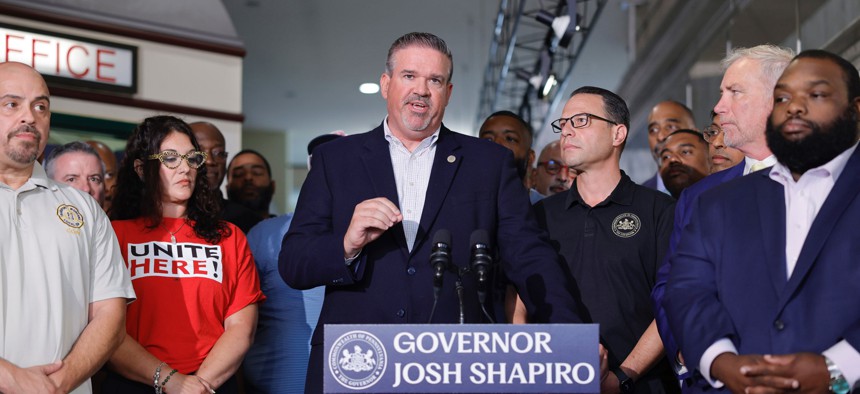
Scott Sauer speaks at a press conference regarding SEPTA’s state funding Commonwealth Media Services

Few know transit like Scott Sauer.
The general manager of the Southeastern Pennsylvania Transit Authority, Sauer took over the role in an interim capacity in late 2024 – a time when the system faced dire financial straits.
Sauer wasn’t new to SEPTA. He followed in his father’s footsteps, beginning as a trolley operator in 1990 before working his way into transportation management and system safety. Fast-forward to 2026, and Sauer was given a three-year contract to remain permanent GM of the system he’s now worked at for more than three decades.
Sauer spoke with City & State about his time at SEPTA, the ongoing challenges transit systems are facing and how state funding can play a role in righting the ship.
The conversation has been edited for length and clarity.
You’ve spent 30-plus years with SEPTA. Looking back, what would you say to your younger self about the position you’re in now?
I waited a long time to make the leap from the front line to management – about 13 years. And over the years, I thought I waited too long and thought I should’ve done it sooner. But looking back now, I’m actually very happy I waited as long as I did, because I see those experiences really helped me in this job. They help me see things through a lens I think is rather unique because I spent 13 years in the union, doing frontline work and working directly with our customers and frontline employees. If I were to give my younger self any perspective: Soak up everything you can, because you’ll need it.
There have been financial concerns related to you having to use funds typically slated for capital projects to meet operational needs. How is that impacting your service and your ability to keep up with ongoing capital projects?
The goal was always to have a dedicated source of operating funding. But when that didn’t materialize, we were faced with 20% service cuts and looking down the road at 25% more and we had a court order to restore service. So knowing that all that was going to happen, we made a really tough decision to tap into capital funding. This was a capital budget that was already constrained. We had already shaved off $2 billion of a $14 billion program to start the fiscal year, so now we were looking at a $394 million shortfall.
We had to make some tough choices, and we couldn’t affect safety. So where we wound up shaving off is we took another five projects. We had already deferred 44 projects at the start of the year; the most impactful project was our bus procurement. We typically will procure about 100 or so buses a year. Now we are going to defer that to the next procurement, which would have started probably this year. So the oldest buses in the fleet will be close to 20 years old by the time we do another procurement. And that gives us pause, because we’ve had problems with older equipment, like our Silverliner fleet.
We now have to dip into more operating money, because we have to give these buses extra maintenance to make them safe and reliable for the next several years. That’s kind of where we are today. As far as operations are concerned, the flex of capital dollars makes us whole enough to run the service as people expected us to, prior to the cuts in August last year. So we’ve been running normal levels of service since September. It’s good for the riders because it gives them the reliability of knowing the service is going to run for the next couple years. But for us, it creates yet another problem for capital funding, and then the operating budget is still unresolved.
The phrase we’ve heard a lot when talking about transit funding is you’re “robbing Peter to pay Paul.” Is that still accurate?
I stopped using that phrase, it was overused. But that's essentially the reaction you're going to get when you use your left hand to take money out and put it in your right hand, more or less.
You mentioned the issues you had with your Silverliner fleet. Can you elaborate on that situation and where you stand as it relates to replacing older rail cars?
This is another part of the capital funding crisis for us. We have the oldest rail fleet in the country, and the Silverliner is the oldest of our rail fleet because they’re 50 years old. But we also have a 40-year-old Broad Street line fleet, a 40-year-old trolley fleet, a 30-year-old Market Frankford line fleet and a 30-year-old Morristown high-speed line fleet. Our cars are ready for replacement, and the reason why they’ve gone this long is because of the historic underfunding of our capital program. The Silverliners are an unfunded replacement project, but we’re essentially using debt to replace those cars. We’ve applied for a Transportation Infrastructure Finance and Innovation Act loan with the U.S. Department of Transportation, and we’re a strong candidate to get it. We meet all the criteria, so we’re fairly confident that we’ll receive the loan. But what that does is add a lot of debt service over the life of the loan, which is about 30 years. It just adds another strain to the capital program because we now have to use capital funds, essentially to pay for debt service on a loan, and the replacement of these vehicles is about $2 billion for 230 cars or so.
In Harrisburg, pushback against increased transit funding has coincided with the argument that most Pennsylvanians may never use a particular transit system if they’re not living in that community. What’s your response to that?
I hear that argument a lot. “We don’t ride SEPTA, so why should I care?” As the largest transportation agency in the commonwealth, in the largest city in the commonwealth, we contribute to the tax base in astronomical ways, and I think that's what gets lost sometimes. As a commonwealth, we share, so we contribute for folks that are on roads and bridges that I’ll never use in my life. And at the same time, they’re contributing to the transit system they may never use. But that’s just the way taxes work, and that’s the way those contributions work … It’s just all part of being part of that system.
Where do funding conversations stand in Harrisburg now?
We were pleased, certainly, that we’re still in the discussion. The governor has a virtually identical proposal this year, with the nuance that funding wouldn’t be needed until next fiscal year. That is certainly true, because we have the capital funding that we were able to transfer for two years. We’re encouraged that we're still in a conversation, and in the conversations I’ve had with lawmakers thus far, I think everybody acknowledges that transit needs funding.
But it has to be part of a larger transportation funding package. I think that people have also acknowledged that it's needed for all the transportation infrastructure in the commonwealth, and we're not going to disagree with that. We just want to make sure that we continue to be in the conversation.
NEXT STORY: This week’s biggest Winners & Losers