
Policy
Artists, politicians join together in state Capitol in bid for increased funding
In speech and song, arts advocates from around the commonwealth made the case for the state budget to expand grant offerings during Harrisburg’s annual PA Arts Advocacy Day.
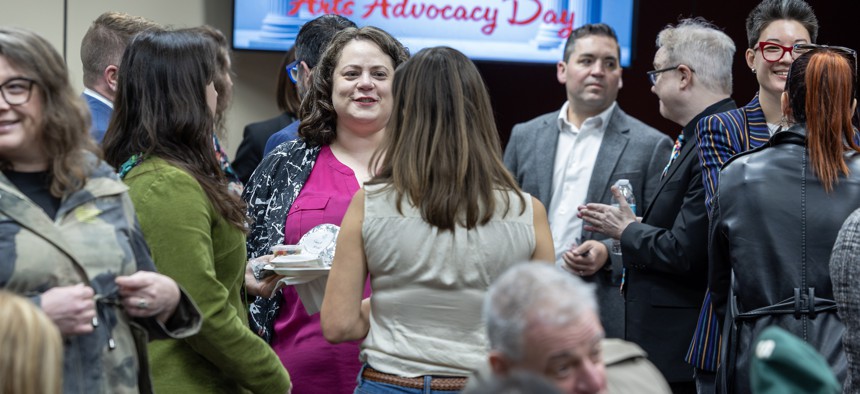
Attendees gather for the annual PA Arts Advocacy Day at the Capitol on March 24, 2026. provided

It’s not often that politicians can be found dancing to Aretha Franklin in the Capitol Rotunda, but on Tuesday afternoon, toes were tapping to the Philly Pops’ instrumental rendition of “Respect.” The performance, capping off the annual PA Arts Advocacy Day at the Capitol, was a tangible demonstration of the point that advocates from across the state sought to convey to Harrisburg legislators: Pennsylvania’s $29 billion arts sector deserves greater support.
“It’s time for our citizens to stand up for the arts, and for the Pennsylvania Assembly to increase the budget for arts and culture,” said Kelley Gibson, the board chair of Creative Pennsylvania – the nonprofit advocacy organization that organizes the annual event – and the president of The Cultural Alliance of York County. “Pennsylvania ranks 33rd in arts funding per capita, yet we are in the top 10 nationally in arts vibrancy. State support should reflect this national standing.”
Specifically, Creative Pennsylvania and the Pennsylvania Legislative Arts and Culture Caucus – the bipartisan, bicameral group that supports the event – want the General Assembly to increase the line item to $12.6 million for grants to the arts in the state budget. They are also seeking an additional $2 million for the creative placemaking programs administered by Pennsylvania Creative Industries, the rebranded grantmaking entity of the Pennsylvania Council for the Arts.
The recent rollout of Pennsylvania Creative Industries, which currently distributes nearly $10 million annually, occasioned a financial restructuring of state arts grantmaking with a new emphasis on economic development – a move that has prompted anxiety and some outrage across the state’s arts community. “Without … additional funding, these changes risk undermining the cultural ecosystem the commonwealth has invested in for nearly three decades,” Gibson affirmed.
Creative Pennsylvania also called on the Arts Council to establish an operational grant pathway for arts organizations with annual budgets of $10,000 to $100,000; to restore $671,000 for programs previously funded by the state’s Preserving Diverse Cultures program; and to extend the statewide Arts in Education and Folk Arts partnerships through 2028.
State Rep. Joe Ciresi, a Montgomery County Democrat and a caucus co-chair, said a $2 million increase is the least the state can do for a sector that delivers such outsized economic returns.
“We are known across the world for arts, whether it’s the museum in Philadelphia or the Carnegie Museum in Pittsburgh, the Philadelphia Orchestra, a world-renowned orchestra,” said Ciresi, who was joined by his co-chairs, state Rep. R. Lee James and state Sens. Jay Costa and Pat Stefano. “These organizations are what shape us as a nation … as humanity. Yet when it comes time to fund them, we say, ‘Oh, it’s just the arts.’
“You know, Taylor Swift … took lessons in singing. She had a music teacher, she had to have somebody teach her how to play piano. Yet we don’t think about the investment of what it takes to be a great artist.”
Swift, a West Reading native whose “Eras” tour generated an estimated $10 billion in economic impact – much of it through tourism and hospitality spending – is a good example of how the arts can bolster local economies. Ciresi noted that on a busy night in Philadelphia’s arts district, hundreds of thousands of dollars are spent not only on show tickets, but also on parking, dining and hotels.
Gibson pointed out that Pennsylvania’s cultural sector represents 3.2% of the state's GDP but barely 0.002% of the state budget – an estimated sevenfold return on each dollar invested.
“Why would you starve … the main driver of tourism … of recruitment and retention for our employers?” she asked the crowd, flanked by colorful posters with slogans like “Do your part, stand up for art.”
She noted that numerous arts groups – especially smaller ones – have lost funding, not only due to changes in state grantmaking but also to federal defunding of the National Endowment for the Arts and the National Endowment for the Humanities. “So we’re not asking for an increase,” she explained. “We’re asking for an inflation adjustment.”
The case was made most lyrically by Kelly Armor, the folklorist in residence at Erie Arts & Culture, who had traveled from Northwest Pennsylvania to set her message to song. “Today’s the day the arts can show the way,” she sang, her alto echoing throughout the Rotunda. “To inspire all PA…So let’s fund the PCA.”