

Healthcare
Prenatal Attraction: The race to bring OB-GYNs to rural PA before maternity care deserts expand farther
Legislators and health officials are mulling a range of potential short- and long-term solutions – including more federal funding, bolstering the health workforce pipeline, and immigration reforms that would expand recruitment of foreign physicians.
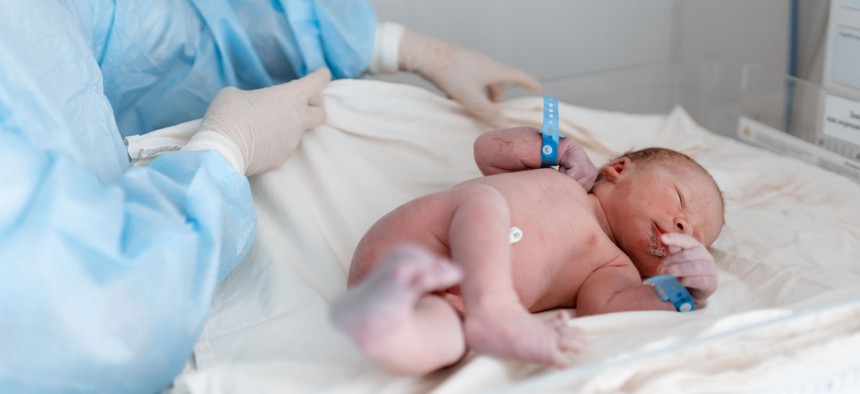
Iuliia Burmistrova via Getty Images

This is the second in a two-part series on Pennsylvania’s rural maternity care crisis. To read part one, click here.
Over the past year, Warren General Hospital CEO Dan Grolemund has spent countless hours talking with his state legislators about how to find more OB-GYNs.
If he’d been able to recruit just one or two more, he might have been able to save the hospital’s labor and delivery department, where he and thousands of other babies first drew breath in this rural corner of Northwest Pennsylvania.
But despite an all-out national recruitment effort, Grolemund came up empty-handed – and with the hospital’s lone OB-GYN well past retirement age, its last baby was delivered in January. Warren General’s was one of numerous recent closures of labor and delivery departments at rural hospitals across the commonwealth – leading to a growing landscape of so-called maternity deserts that, amid a national shortage of OB-GYNs, increases every year.
Grolemund said he has found a sympathetic ear in his legislators. “I told them about the challenges that we faced,” he said of his meetings with state Rep. Kathy Rapp, the Republican chair of the House Health Committee; U.S. Rep. Glenn “GT” Thompson; and state Sen. Scott Hutchinson, all of whom represent Warren County.
“They understood. They were supportive, but basically said it’s a supply-and-demand issue…There just aren’t enough OB-GYN doctors to meet the current demand.”
The situation is dire enough that lawmakers on both sides of the aisle, along with healthcare and policy advocates, have been brainstorming short- and long-term strategies to reverse the crisis in maternity care. But nobody expects solutions to be quick or easy, if they exist at all. As Rapp told City & State recently: “I’m not sure that this is something we can necessarily solve through legislation.”
A multipronged approach
Still, policy can play a role in easing the immediate crisis – and in Harrisburg and beyond, Rapp and her Health Committee co-chair, Democratic state Rep. Dan Frankel of Pittsburgh, are championing a multipronged approach to tackling the rural physician crisis.
Their proposals include more federal funding for rural healthcare workforce recruitment, more visas available to expedite recruitment of foreign physicians to underserved areas, and secondary-school career programs that expand the pipeline of future health workers.
Frankel and Rapp have been nudging their Washington, D.C. colleagues to expand foreign visas for physicians through what Frankel calls a “targeted immigration policy” to fill healthcare staffing gaps.
Specifically, they are championing a bill currently moving through Congress that would expand the J-1 non-immigrant visa, which facilitates short-term exchanges, to recruit physicians to temporarily staff medically underserved areas. One way to do that, Rapp said, is to expand Pennsylvania’s Conrad 30 program, which waives the final year of residency for foreign medical graduates on J-1 visas who are willing to practice in rural regions.
Foreign OB-GYNs could provide an immediate remedy for the quandary faced by hospitals like Warren General – but with current immigration policy, it’s by no means an easy solution. That leaves hiring so-called “locums doctors,” who function much like substitute teachers – filling in for a day, a week or longer – as a stopgap measure for departments left in the lurch.
“Unfortunately, a single day can cost up to $12,000 for an OB-GYN, and $70,000 a week,” said Grolemund. “For a small, rural hospital, that is nearly impossible to sustain.”
Government funding could help. Rapp has called on the Centers for Medicare and Medicaid Services to release $200 million from the One Big Beautiful Bill’s Rural Health Transformation Program, a multiyear commitment to rural healthcare, to invest in workforce development as well as physician recruitment and retention.
Frankel has proposed creating standby capacity payments, which “basically pays for keeping these folks on staff, whether that’s being able to use them in other areas – there needs to be a way to maintain that capacity,” he said.
Paying doctors to be available, he added, could be “a solution for low birthrate areas that need to maintain those doctors 24/7 … Otherwise, we’re going to create what is already a spiraling downward situation that is self-defeating for these communities, where it’s going to be harder to get any staff for your hospitals, then for other services. And as you can’t attract and retain young people, it’s a spiraling economic decline.”
Healthy families, healthy communities
The parallel phenomena of hospital closures and population decline illustrate how inextricably the health of families is tied to the health of their communities.
“Hospitals support 1 in every 8 jobs across the commonwealth, 19% of the state’s GDP,” said Nicole Stallings, the president and CEO of the Hospital and Healthsystem Association of Pennsylvania. “It’s really a significant driver of the health of a community and the health of an economy – and we believe that’s why lawmakers should really be prioritizing the health and stability of hospitals.”
Along with more aggressive measures to combat rural workforce shortages, Stallings said her organization is championing efforts to boost state Medicaid reimbursement rates. She cited the Hospital and Healthsystem Association of Pennsylvania’s recent finding that inadequate reimbursement is the primary driver of financial strain for the state’s hospitals.
“We believe that there is an opportunity for the state Medicaid program … to really look at the adequacy of reimbursement,” Stallings said.
But Medicaid is only part of the problem: In Pennsylvania, according to the association, hospital reimbursement rates are lower for commercial insurance than they are in neighboring states.
All of these issues disproportionately impact rural communities, many of which, with powerhouse industries like agriculture, “are really essential components of Pennsylvania’s economic vitality,” noted Frankel.
“In order to sustain … the small businesses and small farmers, and to make this a viable opportunity for young people, we need to be able to make sure that they can access services in a way that’s comparable to folks in urban communities.”
The economic implications have worried enough stakeholders to generate bipartisan support for such issues as malpractice insurance reform; Frankel said discussions to address the issue are underway in Harrisburg.
Further details about the threat of insurance rates can be found in a report recently commissioned by the Hospital and Healthsystem Association of Pennsylvania, which “speaks to the medical liability climate, showing that we have the highest rate per capita of payouts in the country,” said Stallings.
As a result, the commonwealth’s OB-GYNs – and the health systems and hospitals that employ them – have faced what many call an insurmountable financial burden from malpractice insurance costs, which have risen more sharply here than in most other states in recent years and are among the nation's highest, according to the American Medical Association.
The association is working with lawmakers on a legislative package it hopes to put forward this year to rebalance medical liability in the commonwealth. Such efforts, Stallings said, could help reverse the trend of declining maternity care; she cited malpractice liability rates and low reimbursements as key factors in the March closure of The Lifecycle Wellness and Birth Center in Bryn Mawr, a Philadelphia suburb, which served the community for 47 years.
Community, heal thyself
The longer-term answer may include encouraging those same rural residents to take active roles in their communities’ healthcare renaissance.
Rapp said she and Frankel are working on strategies to bolster the healthcare workforce pipeline in conjunction with the Center for Rural Pennsylvania, a bipartisan, bicameral legislative agency within the General Assembly that functions as a resource for rural policy.
Recent conversations, Rapp said, have included proposals for state career centers to bolster training in health professions, as well as allowing high school students interested in health careers to shadow workers at local hospitals.
Absent foreign recruitment, “we have to have our younger people, or maybe some adults, who would choose to change their careers … and obtain the education that they need to be qualified,” said Rapp. That amounts to years of training, even for nurses specializing in areas like obstetrics, and more than a decade to train an OB-GYN.
UPMC is among the institutions collaborating with local high schools and colleges on health workforce education and training, including clinical rotations and internships.
“Collaboration is the key to the future … working closely with partners across healthcare, education and government,” affirmed Annmarie Lyons, UPMC’s vice president for Women’s Health Services. “There is a critical need for sustained dialogue and innovative, sustainable approaches.”
Among those, she told City & State, is the health system’s “Train rural, stay rural” strategy, which includes rural residency and fellowship programs that prepare clinicians to practice in underserved areas.
UPMC’s Schools of Nursing are a major cultivator of the region’s health workforce pipeline, graduating 600 nurses in 2025. In addition to expanding cohorts at its existing campuses, the system also recently announced new Schools of Nursing at UPMC locations in Altoona and Erie.
In Warren, Dan Grolemund also touts a “homegrown” workforce initiative that brings the county’s 10th- through 12th-graders to tour Warren General Hospital. Those interested can sign up for job-shadowing experiences in 26 health professions, and the hospital will eventually pledge to help secure scholarships for future study.
“It won’t change everything in the next six months or a year,” the CEO reflected. “But it will help us, as the future of our community, to get our kids interested in healthcare – and wanting to come back to Warren County, to serve their community here.”