

Healthcare
The state’s ‘maternity deserts’ are reaching a crisis point as rural hospitals continue to close childbirth services
Health officials blame the closures on a national OB-GYN shortage, along with rural population decline, high liability costs, a drop in immigration and the particular challenges of recruiting rural obstetricians
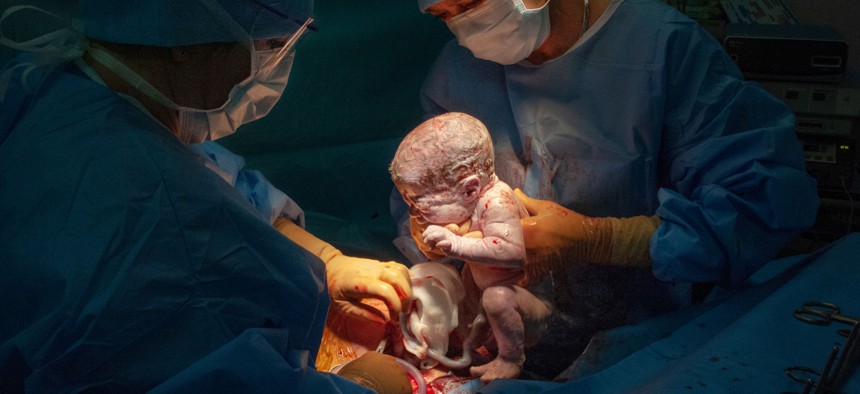
A cesarean section delivery. Pascal Bachelet/BSIP/Universal Images Group via Getty Images

For Warren General Hospital CEO Dan Grolemund, the closure of the facility’s maternity unit was particularly resonant. He himself was delivered in the hospital’s labor & delivery department, back when the population of this rural county in far Northwest Pennsylvania topped 50,000. Returning to his birthplace to lead the community hospital was “a dream,” he says.
But over the past half-century, Warren County has lost a quarter of its residents, while its remaining population skews older each year – mirroring trends across the commonwealth’s rural regions. Births in the hospital dropped from 400 in 2000 to just 175 last year; the hospital had only one OB-GYN: a 78-year-old doctor who’d been forced to postpone retirement while commuting two hours to supervise births that could occur at any time, day or night.
And so, last year, Grolemund saw no option except to shutter the labor and delivery unit where he and so many neighbors had been born. The closure left Warren’s expectant mothers – like those in seven contiguous Northern Pennsylvania counties – without nearby facilities specialized in childbirth, creating what the Center for Rural Pennsylvania calls a “maternity desert” larger than Connecticut.
“I think everyone understands that we did everything we could to keep (labor and delivery) from going away,” Grolemund reflected in a recent interview, describing an expansive but ultimately futile nationwide effort to recruit the doctors needed to keep childbirth services in place. “Warren County is a wonderful community. Everyone knows each other. We care for each other. That is why what has happened is such a difficult thing for all of us.”
Warren is hardly alone. Twenty-three of the state’s 67 counties – all rural – currently have no hospital offering labor and delivery services. That number is likely to rise as more hospitals terminate high-cost, low-revenue departments or close their doors altogether.
Thirty-two commonwealth hospitals have, in fact, shuttered over the past 20 years. (The latest, in mid-February, was Bradford Regional Medical Center, also in Northern Pennsylvania.) Each closure, whether of a department or an entire hospital, puts additional pressure on the closest nearby facilities that inevitably absorb the patient load.
The situation presents a particularly thorny challenge for both healthcare leaders and policymakers, coming as it does against the backdrop of changing demographics: By 2030, 1 in 3 Pennsylvanians will be over 60, and there is projected to be a persistent shortage of physicians, particularly OB-GYNs.
Then there are the brutal economics of rural healthcare – a shrinking and increasingly uninsured clientele, low Medicaid reimbursements and soaring labor and insurance costs.
“This (OB-GYN) shortage is very impactful to rural Pennsylvania,” said state Rep. Kathy Rapp, a Republican who co-chairs the House Health Committee, and whose district includes Warren.
She and her Democratic Health Committee co-chair, State Rep. Dan Frankel of Pittsburgh, are leading Pennsylvania’s efforts to address the crisis through a multipronged approach that includes more funding for OB-GYN recruitment and workforce development, greater recruitment of foreign physicians and policy reforms that address the state’s sky-high medical malpractice rates.
“We have smaller hospitals,” explains Rapp of rural regions’ challenges. “The pay might not be as much as an OB-GYN would receive in a larger hospital. And then the OB-GYN practice area has always been very high in liability cases.”
Balancing safety and proximity
The bipartisan concern about OB-GYN shortages underscores a key point: Virtually no one argues for closing labor and delivery departments. Hospitals that do so insist it is a decision made only when staff shortages, not finances, make childbirth services untenable.
That was the case at St. Luke’s Grand View Hospital in Sellersville, Upper Bucks County, which abruptly paused maternity services in December 2025 after multiple unanticipated physician resignations left the OB-GYN department understaffed, according to hospital officials.
And it was the situation at UPMC Cole in Coudersport, which cited provider shortages when closing down its labor and delivery services last spring, according to Patti Jackson-Gehris, North Central Pennsylvania market president for the UPMC health system.
“At times, UPMC Cole’s labor and delivery unit had a vacancy rate approaching 50%,” she noted. “Without adequate staffing, maintaining the around‑the‑clock coverage required for a safe, fully operational maternity unit became unsustainable.”
The health system consolidated area maternity services at UPMC Wellsboro, an affiliate hospital that is 40 miles and nearly an hour’s drive away. Jackson-Gehris said that families can still access prenatal, postnatal and gynecologic care in Coudersport.
In 2024, Penn Highlands Elk, another Northwest Pennsylvania hospital, closed its labor and delivery unit in a similar scenario: Elk County had only one OB-GYN, and the hospital estimated it would need three more to support childbirths in a sustainable manner.
With births down to nearly 100 per year, the economics of finances, personnel and demand simply didn’t work out, according to Penn Highlands officials. Local labor and delivery needs were directed to Penn Highland’s Dubois hospital, a 45-minute trip away.
UPMC has also consolidated maternity care across several of its facilities, in addition to the closure of the Cole facility. “We’re struggling with a declining population; much of our population is aging, and the younger generation is not staying,” said Jackson-Gehris, adding that childbirth demand has fallen accordingly. “These factors contribute to limited availability in the workforce, which then makes it difficult to recruit and retain staff, especially for highly skilled and specialized roles.”
In 2019, UPMC’s Pittsburgh-area Mercy facility moved childbirth services to UPMC Magee‑Womens Hospital, its regional hub for advanced obstetric and neonatal care. The year prior, UPMC Bedford had shifted its delivery services to nearby UPMC Altoona, an affiliate of UPMC Magee-Womens.
“These decisions are always made with patient safety, quality of care, and long‑term sustainability in mind,” said Annmarie Lyons, UPMC’s vice president, Women’s Health Services.
UPMC has also worked closely with Warren General to help expectant mothers deliver at UPMC Chautauqua in Jamestown, New York, about a half-hour north of Warren; it also added outpatient midwifery services in the Warren and Bradford communities. Rapp said the health system had set up a dedicated hotline with information about UPMC’s labor and delivery services and transferring care.
On its website, Warren General advises pregnant patients that the hospital has coordinated care with OB/GYN Associates of Erie, with inpatient deliveries to take place at Magee-Womens Hospital of UPMC Hamot and Saint Vincent Hospital, both roughly an hour and a half west of Warren in Erie.
Technology can help fill local gaps in care, said Lyons, the Women’s Health Services chief at UPMC. She noted that Magee-Womens Hospital offers maternity counseling via its telemedicine service, including virtual doula visits and childbirth education.
Recruitment is futile
Amid a nationwide OB-GYN shortage that stands out even amid the broader physician shortage, Grolemund mounted a massive effort to keep Warren General’s labor and delivery department open.
He spearheaded a nationwide personnel search, personally appealing to nearly 30 OB-GYN residency programs and working with 10 physician recruitment agencies to identify candidates willing to deliver babies in North Pennsylvania. He reached out to every available candidate on Practice Link, the main physician job board.
The hospital was willing to pay what is known as a “rural premium” to compensate obstetricians for the increased responsibility of being on call for childbirth around the clock at least half the month – a hard sell compared to busy urban practices, where OB-GYNs may only be on call a few days per month. Moreover, Warren General was prepared to spend the $150,000 it could cost for each OB-GYN’s malpractice liability insurance – among the highest rates for any specialty.
Yet Grolemund still came up empty-handed. “There just aren’t enough OB-GYN doctors to meet the current demand,” he said. “It is so tough to find available OB-GYNs, especially to come to rural America.”
The statistics illustrate Grolemund’s seemingly impossible quest. Half of all OB-GYNs in America are 55 or older; over the next several years, an estimated 30% are expected to leave practice, further expanding the nation’s maternal deserts.
Age is one reason they leave; stress is another. OB-GYNs are the second-most-sued doctors nationally, second only to general surgeons, and have among the highest burnout rates across medical specialties. Aspiring physicians understandably gravitate toward specialties with gentler schedules, more reliable hours and shorter training.
“Four years of undergrad, four years of medical school, four years of a residency, and then two to three years of a fellowship … Not a lot of kids who come out of high school can commit to 12 to 15 more years of education,” noted Grolemund.
Frankel, Rapp’s Democratic Health Committee co-chair, pointed to other recent factors that have compounded the OB-GYN workforce shortage.
One was the COVID-19 pandemic, which worsened an existing crisis in maternity care by stretching physicians thinner and accelerating OB-GYN burnout. “A lot of people left the workforce; it was just too much for them,” Frankel said.
More recently, the federal immigration crackdown has exacerbated the workforce shortage by virtually halting new arrivals. Foreign-born workers constitute nearly a third of Pennsylvania’s long-term care labor force; indeed, the state depends on immigrants to staff every level of healthcare, from physicians to home health aides.
The liabilities of liabilities
Nicole Stallings, the CEO of the Hospital and Healthsystem Association of Pennsylvania, cited a recent report from the American Medical Association showing that Pennsylvania had the nation’s second-highest increase in medical liability insurance premiums from 2023 to 2024, behind only Hawaii.
“Pennsylvania is a net exporter of physicians,” she added, “and we believe one of the primary reasons for that is our liability climate.”
The result is that women in Pennsylvania’s rural regions commonly face an hour-long trip to a specialized childbirth unit. According to experts, health outcomes will inevitably suffer when pregnant women are forced to travel for specialized care in emergency situations that can arise around late pregnancy and childbirth.
“If there is delayed care, we all know that there are consequences to the baby,” said Pennsylvania Association of Staff Nurses and Allied Professionals President Maureen May, who, as a neonatal intensive care unit nurse at Temple Health in Philadelphia, has witnessed such scenarios.
May said that all paramedics and emergency medical personnel are trained in delivery and neonatal resuscitation – but added that such training is no substitute for a department that specializes in childbirth. “If an (umbilical) cord is wrapped around the baby’s neck, and you can’t monitor that baby, obviously, they can’t have a stat C-section in the middle of driving them,” she said.
“The health system should be working on how to manage rural care,” she added. “I know people who have said, ‘I’ve moved to an urban area to be close to a hospital that has the ability to care for me.’ Some people actually make that choice. Others don’t have that choice. So for them, how do we make outcomes better?”
Tomorrow: City & State looks at the short- and long-term strategies lawmakers and health officials are proposing to try to reverse Pennsylvania’s maternity crisis.
NEXT STORY: PA House committee advances data center bills