

Policy
Connecting the dots: PA health officials battle historic measles outbreak
Thousands have been vaccinated, but cases are rising fast in an outbreak centered in Lancaster County
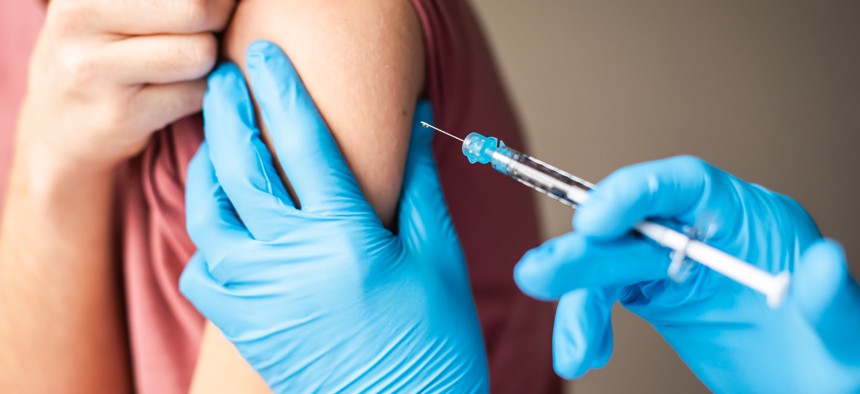
A child gets the MMR vaccine Getty Images/Cavan Images

Like many of the healthcare workers on her staff, Chester County Health Department Director Jeanne Franklin began her career decades ago, when measles presented more often in textbooks than in exam rooms. “My lead nurse just saw her first measles case the other day – and she’s been a nurse forever,” Franklin told City & State in late August.
But with a dozen residents already hospitalized for measles complications, Chester’s public health workers expect to see more. Since April, when Pennsylvania’s largest measles outbreak in recent history began, the commonwealth has recorded more than 400 cases of the airborne virus, with 94 cases in the past week alone (between January and March, for comparison, the commonwealth recorded only a dozen cases). 73 have been severe enough to require hospitalization, and one-third of cases involve children.
Public health experts say the true number of measles victims is almost certainly many times higher, since the disease is highly contagious – nine out of ten people exposed will get sick within three weeks – and infected family members may not bother with testing. All of the reported cases so far are in unvaccinated individuals, “obviously lending credence to the value of the vaccine,” said Franklin, whose county team has administered more than 350 doses thus far this year, most within the last several weeks.
According to the state Department of Health, the vast majority of measles cases – 197 – have been reported in Lancaster County, with an additional 4 confirmed in neighboring Chester County as of Thursday, Aug. 27. Those cases are “predominantly within the plain community,” Franklin said, using a term for the traditional Christian groups, such as Amish and Mennonites, that constitute a significant share of those county’s populations.
“The Pennsylvania Department of Health is working closely with health care providers and local communities to directly combat this measles outbreak,” Neil Ruhland, a press secretary with the state Department of Health, told City & State. The department has responded by vaccinating some 4,100 residents at pop-up clinics across the state, with dozens of additional clinics planned to help curb the outbreak and to complement local efforts by counties, like Chester, which have their own health departments.
On Wednesday, Aug. 26, Gov. Josh Shapiro announced an expansion of the state’s measles efforts in response to the widening outbreak, which has seen cases reported in 30 counties across the commonwealth.
Ruhland added that “the overall risk remains low if you are fully vaccinated,” pointing out that the standard two-dose MMR (measles, mumps and rubella) vaccine is 97% effective at preventing measles infection. “Pennsylvania’s robust baseline immunity is a critical line of defense that will help limit the number of cases compared to regions with lower vaccination coverage,” he noted.
Still, childhood vaccination rates have been falling steadily. By the 2025-26 school year, 93% of kindergarteners statewide had received both MMR vaccines, as compared to 97% of 12th-graders. The decline stems from a decades-old anti-vaccine movement fueled by a scientifically debunked 1998 study showing an association between the MMR vaccine and autism; more recently, vaccine resistance flared during the COVID-19 pandemic’s culture wars.
And U.S. Health & Human Services Secretary Robert F. Kennedy Jr. and his “Make America Healthy Again” movement ushered in a vaccine-skeptical approach at the federal level last year, including a recent push to dramatically pare back America’s childhood immunization schedule.
Nearly two-thirds of the cases in Pennsylvania’s outbreak involve adults between 18 and 49, which reflects the downward age trend of unvaccinated Americans. In Allentown, Health Bureau Director David Synnamon said the state’s third-largest city recently saw its first measles cases since 2019. The two cases, reported in early August, were not connected to the Lancaster outbreak, he noted, adding: “I think we’re seeing the effects of individuals making decisions to not get vaccinated post-COVID starting to really hammer home.”
Before the measles vaccine became available in 1963, the disease killed 400 to 500 Americans annually. Symptoms typically appear one to two weeks after exposure; in addition to the infamous rash, they include high fever, cough, runny nose, and red, watery eyes. According to the U.S. Centers for Disease Control, one in five unvaccinated people will require hospitalization for potentially life-threatening complications like seizures and pneumonia, with babies and young children at highest risk.
With the current outbreak concentrated in plain communities, public health officials have taken a culturally sensitive approach to their vaccination push. (Lancaster County, like many counties across the commonwealth, does not have its own health department and receives public health services from the state Department of Health, which has administered more than 2,700 MMR doses statewide so far this year.)
Franklin said that plain people have historically had lower vaccination rates due more to following tradition and maintaining a separate, pared-down lifestyle than because they subscribe to mainstream anti-vax sentiment. Her team reaches out to plain community elders, who in turn guide families’ decisions and practices. When presented with the facts, Franklin said, many plain people have privately opted for the vaccine.
“We respect their privacy,” she explained. “You have to have trust for the conversation … So, for example, we have immunized just for MMR. We’re not pushing any other vaccines right now.”
Discretion is key when public health officials seek to protect as many as possible, and practices like quarantines and contact tracing may not be feasible. Plain people “have farms to run, they have businesses to run, and it requires all hands on deck from family units,” said Franklin, whose team has jabbed whole families at their farms. “The trend we’re seeing is not wanting to share their close contacts. Some of that could be carryover from COVID, but it’s also ingrained in their culture.
“We don’t have to argue that,” he added. “We meet them where they’re at. Our message is: If you have measles, tell your neighbors and the family members you’ve been around.”
Healthcare workers have faced a learning curve of their own. For most physicians, measles education was a brief overview in medical school – and illustrations featuring pink dots on white skin. Now that real cases are showing up, the state Department of Health has launched a campaign “focusing on health care provider education and community protection,” said Ruhland. That includes reminding providers to encourage vaccination, and bringing frontline workers up to speed on how to recognize measles – including the different ways the signature rash might appear on darker skin tones.
“We took a lot of lessons from COVID. … We kept what went well. We ditched what didn’t,” reflected Franklin, who has led Chester’s health department since 2013. “I am very grateful that I have a team that will do everything possible and not get into personal opinions, political opinions, judgment. We just want to help make this work. But it saddens me, because it is preventable.”
This story has been updated to reflect an evolving situation.
NEXT STORY: Flocked and loaded: Pennsylvania lawmakers look to regulate license plate-reading cameras