

Dave Sunday
Dave Sunday urges businesses to remove skill game machines ahead of October deadline
Businesses that operate skill game machines after the Oct. 13 deadline could face criminal prosecution and machine seizures, the attorney general said.
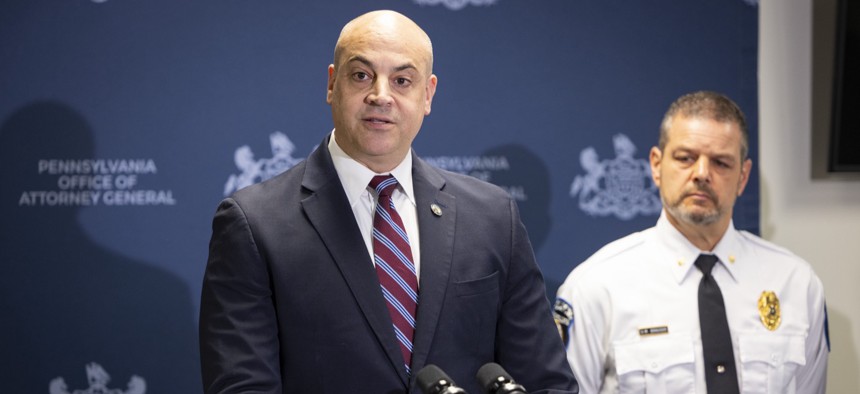
Pennsylvania Attorney General Dave Sunday urged businesses to remove skill game machines from their establishments ahead of an October compliance deadline. Commonwealth Media Services

Pennsylvania Attorney General Dave Sunday is encouraging business owners to remove skill game machines from their establishments ahead of a looming October compliance deadline. After that, businesses and locations that house skill games will be subject to criminal prosecution and face having their machines seized by law enforcement, he said on Tuesday.
Sunday’s warning comes after the Pennsylvania Supreme Court ruled in June that the gaming machines – which are a common sight in bars, fraternal clubs, convenience stores and other locations – are, in fact, illegal gambling machines subject to the state’s Gaming Act and Crimes Code.
When issuing its June opinion, the court instituted a 120-day safe harbor period that protected businesses from penalties and gave state lawmakers a chance to pass a regulatory framework to legalize the games. However, lawmakers have not advanced legislation to regulate the gaming machines to date.
“We do not want to see searches and seizures at storefronts or bar, social club and restaurant establishments – we would much rather business owners and social clubs comply with the law and take steps to get these illegal devices out of their places of business,” Sunday said in a statement.
“Collaborating with our law enforcement partners, my office will act in accordance with the law which prohibits these machines outside of licensed gaming facilities,” he added.
According to the Pennsylvania State Police, only licensed casinos and qualifying licensed truck stops may possess and operate the gaming machines, which the court deemed to be “slot machines” in its June ruling. In a statement circulated earlier in September, the State Police said that law enforcement “may take enforcement action against businesses which continue to possess, operate and/or maintain such machines” as of Oct. 14.
Sunday’s office noted that turning off or unplugging skill game machines is not enough to comply with state law.
Over the last several legislative sessions, lawmakers on both sides of the aisle have expressed a desire to regulate and tax the machines, as has Gov. Josh Shapiro, who called on lawmakers to pass skill games legislation in his most recent budget proposal.
In the state Senate, Republican state Sen. Gene Yaw and Democratic state Sen. Anthony H. Williams introduced Senate Bill 1079, which would create a $500 monthly fee per skill game terminal and limit the total number of gaming terminals in the state to 50,000. They estimated that the proposal would generate $300 million in annual revenue for the state. Democratic state Rep. Danilo Burgos and GOP state Rep. Jonathan Fritz sponsored similar legislation in the state House of Representatives.
In his 2026-27 budget proposal, Shapiro called on the General Assembly to establish a 52% tax on gross terminal revenues from skill games. His administration estimated that a 52% tax would generate more than $2 billion annually, with estimates suggesting there are as many as 70,000 skill game machines across the state.
However, despite advocacy from business owners and the skill game industry – who say the machines are a “lifeline” for small businesses and fraternal organizations throughout the commonwealth – lawmakers have not reached a consensus on how or whether to regulate skill games.
Republican state Rep. Russ Diamond said Tuesday during a House Gaming Oversight Committee meeting that he is “frustrated and dismayed” at the status of efforts to advance a regulatory framework for skill games.
“We are under a Supreme Court deadline and we should be getting something done,” Diamond said. “We have a number of bills before this committee that deal with skill games. I hope that in the coming days we schedule another meeting to talk about that topic, before tens of thousands, or hundreds of thousands, of people who have made those games an integral part of their livelihood – whether they were legal or not – are left out in the cold.”
Democratic state Rep. Patrick Harkins, the majority chair of the House Gaming Oversight Committee, said House lawmakers are “trying our best to try and formulate something that might work,” while placing pressure on Senate Republican leaders to secure enough votes in their chamber to pass skill games legislation.
“I turn it back to the Senate Republican leadership, who has told us for four years that they have no intention and they have no ability to get the votes for anything at this point in time. It’s difficult to negotiate by ourselves,” Harkins said.
Speaking to the Pennsylvania Press Club on Monday, Senate Majority Leader Joe Pittman acknowledged the difficulty of advancing gaming legislation in Harrisburg, adding that Senate Republicans introduced a proposal to regulate skill games that was “rejected by various stakeholders in no uncertain terms.”
“Anything being done in gaming requires really all five parties – the four caucuses and the governor – to come together and figure out what a consensus product can be,” Pittman said.
“This is something that we need to tackle as, not a partisan issue, but come together and understand that there are small businesses, there are clubs and taverns that have gotten to rely on these games for the last several years, and figuring out a regulatory path on them makes sense,” he added. “Whether we can get there is a very open question.”