

Capitol Beat
State health officials pause disease-control strategy proposal
The move, allowing consideration of some 10,000 public comments, comes as the commonwealth battles a historic measles outbreak that now surpasses 900 cases.
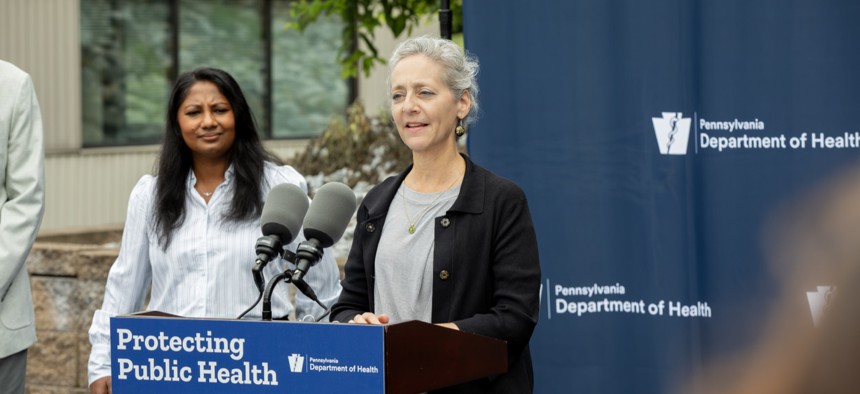
The Pennsylvania Department of Health has paused a planned update to the state disease-control regulations. Commonwealth Media Services

As Pennsylvania battles its worst measles crisis in a generation, the state Department of Health has paused plans for a major overhaul of its disease-control strategy, it announced on Friday. The plan would have expanded the state’s abilities to respond to infectious outbreaks, but encountered fierce opposition from both Harrisburg Republicans – and, notably, from constituents concerned about the potential for a return to pandemic-era health mandates.
The proposal would have updated the state’s public health strategy around disease control for the first time in a quarter-century; the most recent major update was in 2001. While typical regulatory proposals receive only a handful of public comments, this plan had logged more than 10,000 submissions by the time officials paused their plans on Sept. 25, many of them opposing the proposal.
“The Department of Health received a historically high volume of feedback during the public comment period and it is clear additional stakeholder input is needed,” Neil Ruhland, a spokesperson for the Department of Health, said Tuesday in a statement, adding that the proposal was withdrawn in order to incorporate constituent reactions.
Ruhland said the department plans to file a revised draft of the plan “once Pennsylvanians’ feedback has been adequately incorporated into the draft regulations.” While it declined to mention the current measles outbreak – currently the country’s largest, and the most significant in Pennsylvania since the 1990s – the spiraling situation, with more than 900 cases and four deaths reported since April, lends urgency to any public health strategy.
State health officials submitted a 502-page proposal in early June to the Independent Regulatory Review Commission, the agency tasked with approving it. The plan would have expanded the state’s authority over monitoring, defining and responding to both communicable and non-communicable diseases.
In a June analysis to the Review Commission, state health officials said the update is “needed to expand the list of reportable diseases, infections and conditions, to address changing standards and recommendations from experts, such as the (Centers for Disease Control and Prevention) and the (American Academy of Pediatrics), and to ensure the overall public health and safety by reducing the risk and spread of diseases, infections and conditions.”
But the proposal was met with strident opposition from Republicans in the General Assembly. In Harrisburg on Monday, Senate Majority Leader Joe Pittman told the Pennsylvania Press Club that the plan was “probably the most invasive effort that I’ve ever seen of the government coming into individuals’ lives and usurping local control.”
Senate President Pro Tempore Kim Ward, a onetime respiratory therapist, used similar language as she praised the collective efforts to halt what she characterized as government overreach. “Democracy has spoken. Once again, the people of Pennsylvania stood tall and used their voices to declare independence from the executive branch,” she said in a statement, echoing concerns she voiced during the COVID-19 pandemic. “Gov. Shapiro … has once again demonstrated he is willing to prioritize a political agenda over protecting the personal freedoms and liberties of Pennsylvanians.”
In an interview on Monday with the Philadelphia talk-radio host Dom Giordano, Ward called the attempt to expand public health powers “a slap in the face to the 10,000 Pennsylvanians that wrote in” and laid out her reasons for opposing the plan in greater detail. “This was clearly an end run around the constitutional amendment … that limited the governor’s unilateral authority,” she told Giordano. “He’s allowing it because it empowers the governor’s office.”
She suggested that the proposal could potentially put control over public health in the hands of an appointed health secretary with no expertise in health matters. And she urged constituents to maintain their vigilance, warning that Gov. Shapiro – who is up for reelection in November – would continue to advance his regulatory plans in a second term.
“He’s going to let the Department of Health put you in a mask. He’s going to let them come to your door and say you have to get a vaccine,” Ward told Giordano. “They’re going to get into your health records … and go to the schools and talk to your children and your grandchildren without parental knowledge or permission. That is scary stuff that does not sound like America.”