

Josh Shapiro
‘We cannot ignore the warning signs’: Shapiro pushes federal government to act on AI
The governor criticized President Donald Trump and U.S. House Speaker Mike Johnson for failing to prioritize AI regulations in Washington, D.C.
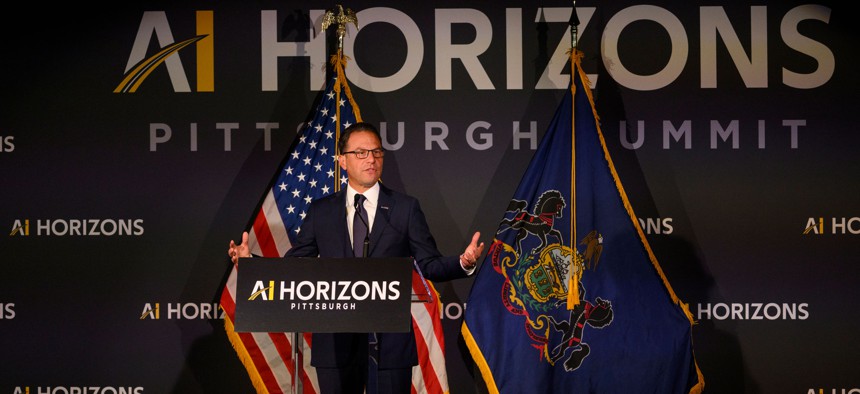
Gov. Josh Shapiro speaks at the AI Horizons 2026 Summit in Pittsburgh. Jeff Swensen/Getty Images

Speaking at an AI-focused summit in Pittsburgh on Thursday, Gov. Josh Shapiro called on the federal government to take a more active role in regulating artificial intelligence, as AI industry leaders call for a slowdown in developing the technology.
Shapiro condemned Washington’s reluctance to act in the wake of warnings from tech industry leaders that rapid advancements in AI systems pose the risk of humans losing control of the technology.
“We need the federal government to establish strict rules of the road, and then enforce those rules to ensure a level playing field – rules that require independent third-party oversight of frontier models, increased transparency into the development of these models and prioritize safety above all else,” Shapiro said at the AI Horizons 2026 Summit in Pittsburgh. “The future of a technology this powerful should be shaped by the American people and their representatives.”
The governor, who is rumored to be a potential 2028 contender for president, highlighted recent examples of AI trying to mislead human developers and warnings that AI tools could be used to develop biological weapons. “All the while, leaders in our federal government refuse to put in place any guardrails to ensure this technology is used responsibly, whether out of willful ignorance or whether out of personal greed,” he said.
The governor lambasted President Donald Trump and U.S. House Speaker Mike Johnson for their lack of urgency on AI regulation. He said that Johnson “abdicated his responsibility to lead at a time when we cannot afford weakness and retreat” and added that Trump should make AI regulation a top priority in his upcoming meetings with Chinese President Xi Jinping.
“I, for one, hope that President Trump will leave the bluster and the showmanship at the door and engage proactively, productively and responsibly on this issue that is so critical to our nation’s future,” Shapiro said.
The governor also stressed the importance of the U.S. beating China in the race to develop AI technology, and said that building international consensus on AI protections is critical. Shapiro said both countries have a mutual interest in ensuring that humans don’t lose control of AI technologies.
His speech came less than a week after the nation’s top AI leaders called for a global slowdown in AI development, warning that rapid advancements in AI technology pose the risk of humans losing control of AI systems, as models have grown increasingly skilled at building the next generation of AI technology – a concept referred to as recursive self-improvement.
In a viral blog post, Anthropic CEO Dario Amodei expressed concerns that highly sophisticated rogue AI agents “could be capable of taking over the entire internet” in six to 12 months, and outlined a three-step plan to slow AI development and properly safeguard models. Components of Amodei’s plan were quickly endorsed by OpenAI CEO Sam Altman, xAI founder Elon Musk and Google DeepMind Chair Demis Hassabis. The agreement on slowing down the pace of AI development comes after multiple warnings from Anthropic researchers that AI “could kill us all by the end of the decade” – and quickly caught the attention of politicians across the U.S., including elected leaders in Pennsylvania.
However, U.S. politicians have been split on how to respond to the AI sector’s voluntary calls for government regulation.
At the federal level, U.S. Sen. Bernie Sanders and U.S. Rep. Greg Casar recently announced their plan to introduce legislation known as the Ban Artificial Superintelligence Act. The bill would temporarily pause advanced AI development until a federal regulator develops safety rules, and permanently ban the development and deployment of artificial superintelligence, or ASI, which refers to an AI system with cognitive capabilities that surpass human intelligence.
Sanders said in a recent social media post that Congress must act immediately to rein in artificial intelligence models. “When the future of humanity is at stake we need a PAUSE on advanced AI development and a ban on artificial superintelligence,” he wrote, urging President Donald Trump to negotiate a treaty with Chinese President Xi Jinping at an upcoming state dinner that OpenAI CEO Sam Altman and Apple Executive Chairman Tim Cook are both expected to attend.
Trump, however, has downplayed warnings from AI leaders, writing in a Truth Social post that his administration has “tremendous CRIMINAL and REGULATORY power over these companies” and that the “only control or “guardrails” that AI needs is a STRONG AND SMART (High IQ!) PRESIDENT, and the U.S.A. has that, in spades!”
In a separate post, Trump referred to the warnings from AI leaders as a hoax. “The claim that ‘AI is going to take over the World’ is a Hoax, just like Global ‘Warming,’ where everyone was going to be dead by now, RUSSIA, RUSSIA, RUSSIA, UKRAINE, UKRAINE, UKRAINE, or Impeachment Hoax #1, or Impeachment Hoax #2,” the president wrote.
Shapiro stated Thursday that he is not a “doomer” – tech industry parlance for someone who fears AI will lead to catastrophic events, including human extinction.
“It has been clear to me for years that technology has the potential to reshape our society in really profound ways,” he said on Thursday. “I still believe that that opportunity exists, but as the events of the past several weeks have made even clear, we cannot ignore the warning signs, nor downplay the very real risks.”