
Philadelphia
New report details the impact immigrants have on Philadelphia’s population and economy
Philadelphia’s Welcoming Center examines the critical economic contributions of the region’s immigrants – and the effects of current federal immigration policies.
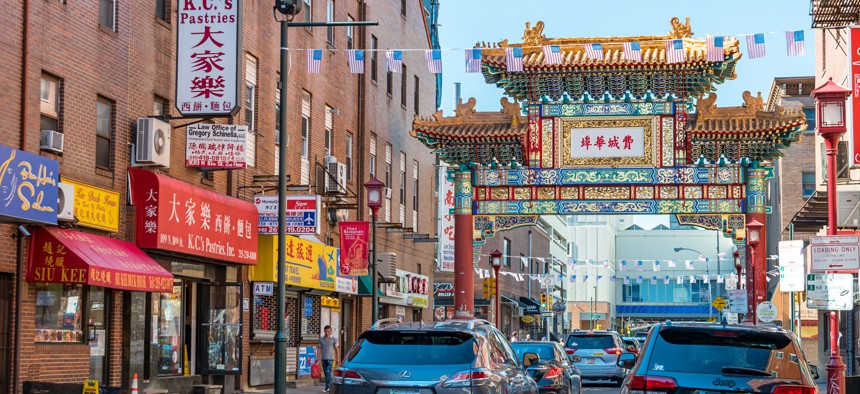
Philadelphia’s bustling Chinatown is an example of immigrant contributions to the region’s economic vitality. Benedek/Getty Images

How important has immigration been to Southeastern Pennsylvania’s economic dynamism, prosperity and workforce? An updated report released this week by The Welcoming Center – a Philadelphia-based nonprofit that provides job resources for immigrants – answers this question by quantifying new Americans’ impact – through the $724 million in property taxes that immigrant homeowners paid in 2024, for example, and their $60 billion in home equity.
Other key numbers in the “Building Collective Prosperity” report hint at a sobering possible future: Without immigration, Philadelphia’s population would have decreased by nearly 90,000 since 2020. Since “we have effectively stopped legal immigration to this country,” the region’s population – and, by extension, its workforce and overall economic dynamism – may be in peril, said Welcoming Center President and CEO Anuj Gupta.
“Our collective prosperity … is inextricably tied to immigration, and that’s for better or worse,” Gupta told City & State on Tuesday. “When you eyeball all the trajectories, economic and population, that the region has gone through over the last 15 years, the only reason we are still a large regional economy and that we are competitive with other regions is because of our emergence as an immigrant destination – which we were not 25 years ago.”
Gupta noted that immigration in the five-county Greater Philadelphia region peaked “much later” than in comparable cities like New York, and newcomers’ impact has contributed substantially to the area’s recent vitality. “Building Collective Prosperity” is based on research by University of Pennsylvania Wharton School Professor Zeke Hernandez, identifying five main areas of immigrant contributions: taxes, innovation, talent, consumption and investment.
Outside the city proper, according to the report, the region’s immigrant households out-earn native-born households, with higher workforce participation and higher median income. Throughout the region, immigrant households have nearly closed what for years was a homeownership gap with the native-born – and those households now boast an estimated $21 billion in collective spending power.
Much of that wealth comes from lucrative jobs in the STEM (science, technology, engineering and mathematics) sector, a cornerstone of Philadelphia’s economy. According to the report, immigrants make up 16% of the commonwealth’s STEM workforce, nearly double their share of the population; in Chester County, nearly one-third of STEM workers are immigrants, although they constitute only 12% of the county’s workforce.
With federal actions having effectively halted the flow of immigrants, Gupta warned that Southeastern Pennsylvania could face a shortage of STEM and other workers – especially since the commonwealth as a whole is rapidly aging, with declining birthrates and a projected population decline. He pointed out that while some places are able to bolster their numbers through reverse migration, that is not a realistic strategy for a state “where it’s cold a quarter of the year.”
“Right now, the (PA Chamber) and our whole economic development ecosystem is focused on promoting growth in life sciences, promoting growth in advanced manufacturing,” Gupta said. “You can’t do those without STEM professionals – and we don’t have enough STEM professionals that we are educating in this country to fill all those positions.”
“You will either have to choose another region to base your business in, or just go out of business altogether … To the extent data is available, you’re going to start to see some very concerning trends going in the wrong direction,” he said.
He added that only Congress can substantially alter the current trajectory around immigration. Since 2025, immigration levels have plunged, and thousands of residents – many of them holding legal status – have been detained or deported by federal agents.
“There’s going to be a long reverberation to this, and it will reach crisis levels in a lot of communities,” said Gupta. “I believe that that crisis may be enough to finally get the U.S. Congress to act and create an immigration system that meets the needs of the United States in this century.”
Gupta praised the City of Philadelphia for its welcoming stance toward newcomers, noting that it has an official designation as a Welcoming City – meaning it meets certain metrics around inclusivity.
He also said that state legislators from both parties have been “much more clear-eyed on this issue” than their federal counterparts, providing critical support to The Welcoming Center as it expands immigrant job training into Scranton, Kennett Square and, potentially, Pittsburgh.
One of those is state Rep. Joe Picozzi, a Philadelphia Republican who told City & State that the organization is “amazing, and a huge ROI (return on investment) for Pennsylvania.”