

Healthcare
‘A major step back’: With measles now endemic, PA has no clear path back to immunity
Pennsylvania appears closer to winning the battle against its measles outbreak – but the larger war appears lost against a virus that had previously been declared eliminated.
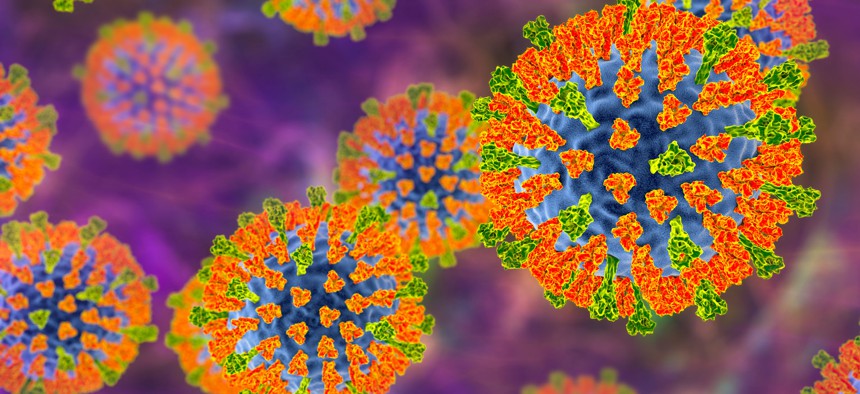
The measles virus Kateryna Kon/The Science Library/Getty

The good news about Pennsylvania’s seven-month-long measles outbreak is that it appears to be on the wane, with weekly case counts tapering markedly since a September peak. The state Department of Health recorded 61 measles cases over the past week, down from a high of 143 during Sept. 7-14.
But there’s plenty of bad news, too. This week, the commonwealth recorded its seventh death associated with the highly transmissible virus – just as the Pan American Health Organization, an agency of the World Health Organization, recognized what public health experts already know: The U.S. no longer qualifies for the measles elimination status it had held for over a quarter-century, due to declining overall vaccination rates and partisan controversy around public health measures.
Indeed, Pennsylvania’s historic 2026 outbreak appears to be the tipping point into a new, more dangerous era, where measles is endemic – and is, for the first time in human history, primarily a disease of adults, not children: More than half the 1,561 cases recorded in Pennsylvania have been in adults between the ages of 18 and 49. “It’s a marker that we have taken a major step back,” said Dr. Paul Offit, the co-director of the Vaccine Education Center at the Children’s Hospital of Philadelphia and a co-inventor of a routine childhood rotavirus vaccine.
“We’re going to be dealing with measles epidemics this year, next year, and the year after, until we get on top of this. And the only way to get on top of this is to vaccinate. And the only way to get on top of vaccinating is to make sure we vaccinate adults. And that’s much harder,” he added, noting that adults do not have a scheduled vaccination incentive like school entry.
Dr. Debra Bogen, Pennsylvania’s secretary of health, emphasized the importance of inoculation. “Measles is entirely preventable, and the path forward is clear,” she told City & State. “The only way we can successfully stop future outbreaks, protect our most vulnerable residents, and regain our elimination status as a country is for more people to choose to get vaccinated and rebuild our community immunity.”
The current outbreak began in April among the plain religious communities of Lancaster County, and has since spread to 46 of the state’s 67 counties, with nearly all cases occurring in unvaccinated people.
Meanwhile, the Pennsylvania Department of Health has won near-universal plaudits from the public health community for its aggressive statewide vaccination campaign: Nearly 11,400 Pennsylvanians have been jabbed this year with the measles, mumps and rubella shot, which offers 97% protection after two doses.
“The Shapiro administration has been on the ground in the communities where measles is actively spreading since this outbreak began in late April, working with local leaders and health officials to gain the public’s trust,” DOH Deputy Press Secretary Stephanie Nojiri told City & State. “That’s taken the form of face-to-face conversations, house calls, community events and hundreds of pop-up vaccination clinics.
“Earning public trust is not easy when dealing with an outbreak of this scale, but the Department’s staff has worked around the clock to meet Pennsylvanians where they are, while leading with facts and science.”
While cases are trending down, the state is not letting up: Some 300 Department of Health employees are involved in the measles response effort, and dozens of additional vaccine clinics are scheduled in the coming weeks.
Healthcare providers statewide have responded to a surge in demand by administering more than twice the usual number of doses – 56,000 and 61,000 in September and October, respectively, versus 25,000 doses in a typical month.
Nojiri said that community health education – about identification and treatment of a disease many had never seen previously – has also been a key component of the state’s measles response. “Those educational efforts have expanded in recent months to include discussions with coroners, midwives and county-focused roundtable discussions with local healthcare providers, school leaders and emergency responders in the hardest-hit communities,” she said.
The department would not comment on a report by The Philadelphia Inquirer that the response has so far cost taxpayers $16 million, but Nojiri said the federal Centers for Disease Control and Prevention recently provided $1.2 million for expanding epidemiology and measles testing capacity and $1.2 million for immunization efforts. In addition, the federal agency has authorized Pennsylvania health authorities to use $1.1 million remaining from an avian flu response fund to respond to the measles outbreak.
“The good news is (measles) does seem to be declining, and that is associated with the Department of Health doing as best a job as they can to get tens of thousands of doses of vaccine out there,” said Offit. “But measles is, for the most part, a winter-spring virus – and we’re heading into the jaws of winter, and kids are in school where they usually share their viruses. So I guess I’m cautiously optimistic.”