

Healthcare
‘Completely preventable’: Pennsylvania now has two fatal measles cases – the first in the U.S. this year
There are nearly 400 reported measles cases in 28 counties across the commonwealth
Courtesy of Commonwealth Media Services

Pennsylvania has its first two measles deaths in 35 years – and the first deaths reported in the U.S. this year.
Both individuals from Lancaster County were unvaccinated.
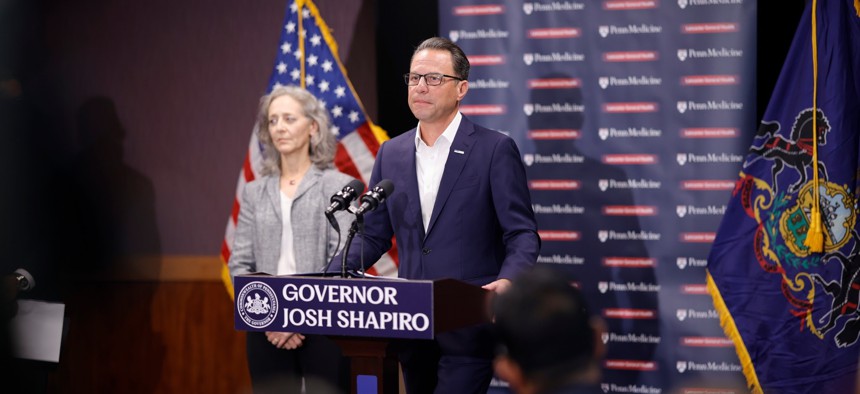
“This is a serious and a growing problem across the country, and right here in our commonwealth,” Gov. Josh Shapiro said Tuesday at a press conference inside Lancaster General Health's Women & Babies Hospital.
Shapiro, joined by Pennsylvania Health Secretary Dr. Debra Bogen and leaders from Lancaster area hospitals, said “we hope and pray those deaths will be the last.”
“I want to be clear: This illness and death from measles is completely preventable,” he added.
Since April, when Pennsylvania’s largest measles outbreak in recent history began, the commonwealth has recorded 393 measles cases. Shapiro noted that of the confirmed cases – now the highest number in the state since 1992 – nearly 20% of the individuals have been hospitalized. Every hospitalization involved an individual who was not fully vaccinated.
“The vaccine is the best tool we have for preventing the spread of this disease,” Shapiro said Tuesday. “This disease does not respect county lines or religious lines – it goes after all who are unprotected.”
Public health experts say the true number of measles victims is almost certainly many times higher, since the disease is highly contagious – nine out of every 10 people exposed will get sick within three weeks – and infected family members may not bother with testing.
And, according to the state Department of Health, the vast majority of cases in the commonwealth have been reported in Lancaster and Chester counties – areas where traditional Christian groups, such as Amish and Mennonites, constitute a significant share of those county’s populations.
But, Shapiro stressed, the outbreak in Pennsylvania is now in 28 different counties and is in multiple communities statewide.
“Both from a religious perspective and from a broader community perspective, it would not be fair for anyone here to conclude that this is just a problem in one particular community,” he told reporters.
Pennsylvania’s prognosis
While childhood vaccination rates have been falling steadily, Pennsylvania’s measles vaccination rates have been improving recently. Shapiro said providers across the state typically administer roughly 25,000 doses of the measles vaccine in a month, but last month that figure reached about 35,000.
“The most critical step we can take is making sure that those who are not currently protected receive the measles, mumps, and rubella vaccine, also called MMR,” Bogen said Tuesday. “The MMR vaccine is backed by decades of research and real-life, real-world proof that it is the best way to protect you and your family from measles, providing 97% lifelong protection after two doses.”
She noted that based on 2025-2026 school year data, the state estimates more than 93% of kindergarteners, more than 94% of 7th-graders and more than 96% of 12th-graders in the commonwealth have received both doses of the MMR vaccine. The state Department of Health will also roll out 40 additional vaccination and information clinics in the coming weeks to provide greater outreach.
Herd immunity – when a large part of a community becomes immune to a disease, making it hard for the infection to spread – requires more than 95% of a community to be vaccinated.
“Because the MMR vaccine essentially eliminated measles here in the United States decades ago, people have forgotten how serious it can be, especially for the very young, the pregnant, and the very old,” Bogen added.
In late July, the number of confirmed measles cases in the U.S. surpassed the total reported for all last year, according to data from the Centers for Disease Control and Prevention. Last year's total of 2,289 – which has already been surpassed in 2026 – was previously the highest number of recorded measles cases in more than 30 years.
U.S. Health & Human Services Secretary Robert F. Kennedy Jr. and his “Make America Healthy Again” movement ushered in a vaccine-skeptical approach at the federal level last year, including a recent push to dramatically pare back America’s childhood immunization schedule.
Five years ago, Kennedy spoke on a farm in Lancaster County and delivered a warning to the local Amish community about the nation’s public health agencies, downplaying the infectious disease and effectiveness of vaccination.
“The cure for measles is chicken soup and vitamin A,” Kennedy claimed at the event.
Before the measles vaccine became available in 1963, the disease killed 400 to 500 Americans annually. Symptoms typically appear one to two weeks after exposure; in addition to the infamous rash, they include high fever, cough, runny nose and red, watery eyes.
When taking questions from the media, Shapiro said Kennedy called him this morning and that he was “very blunt” with the secretary about the “negative impacts” he’s having on the misinformation front.
“I made very clear that his actions and the rhetoric that's coming from this administration are having a negative impact on communities across America, particularly right here in Pennsylvania. That there’s real-life consequences to spreading misinformation,” Shapiro told reporters Tuesday. “There’s real-life consequences to scaring people and not relying on actual doctors and actual medical professionals to provide unbiased information to parents, so that we can make reasonable decisions for our kids.”