

Transportation
SEPTA’s tumultuous 2025: Part II
Philadelphia’s public transit system had its share of twists and turns this calendar year.
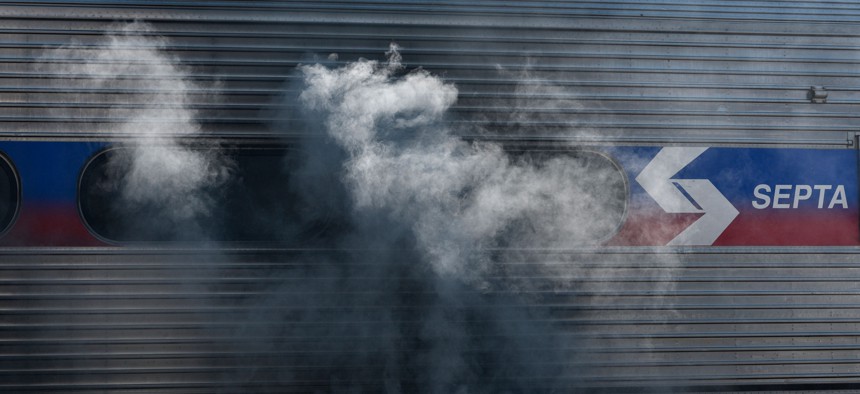
Firefighters battle a fire on a commuter train at SEPTA's Glenside station in Suburban Philadelphia on August 29, 2018. Bastiaan Slabbers/NurPhoto via Getty Images

2025 has been a memorable year for Pennsylvania public transit, for better – and for worse. While the state’s budget impasse – and ongoing financial struggles for transit systems – created a rocky road for public transit statewide, in the Philadelphia region, the Southeastern Pennsylvania Transportation Authority faced an unsteady fiscal situation and service cuts that would drastically impact the system’s operations in the region.
Here’s the second in a two-part series on SEPTA’s tumultuous track in 2025 – and how we got here. To read Part 1, click here.
September
The school year began with service cuts for the Philadelphia region. Following the legislative back-and-forth that delayed the state budget months past its June 30 deadline, SEPTA shifted to using capital funds to plug holes in its operating budget.
In early September, SEPTA announced it received approval from Gov. Josh Shapiro’s administration and the Department of Transportation to use up to $394 million in capital assistance funds for daily operations for the next two years. While SEPTA’s request appeared similar to the spending plan passed by the Republican-controlled state Senate in August, the use of nearly $400 million in capital funds, while not exactly the same as the GOP proposal, did seek to transfer critical capital funds to fund ongoing operations costs.
The short-term solution came with an agreement that no major capital projects will be delayed – and with an assumption that a long-term funding source will be established to replenish the capital project account.
PennDOT Secretary Mike Carroll said in a Sept. 8 letter that SEPTA must guarantee that its use of Public Transportation Trust Fund funds will not result in the deferral of existing capital projects, arguing the Senate GOP’s spending plan – which would draw dollars from the PTTF without such discretion – would fail to meet the needs of the commonwealth’s public transit systems.
With temporary funds in hand, SEPTA moved to restore service by Sept. 14, roughly three weeks after service cuts took effect.
Sauer said that while the service cuts were in place, the number of bus trips running late increased by 26% compared to normal operations.
“Over the last two weeks, we’ve seen the devastating effects the service cuts have had on our riders,” Sauer said, adding that the number of bus trips post-service reduction running late was up 26% compared to the same period in 2024. “Our riders deserve better, and they deserve stability.”
October
SEPTA’s situation only got scarier as the fall went on.
With an aging railcar fleet and no resolution in sight, federal officials intervened. The National Transportation Safety Board issued a warning to SEPTA on Oct. 1 to take immediate action to address fire risks in its fleet of Silverliner IV railcars. The move came after a series of railcar fires this year, including two in September.
U.S. Transportation Secretary Sean P. Duffy announced that the Federal Railroad Administration issued an emergency order to SEPTA, urging the agency to implement several safety measures to reduce the risk of fires and other malfunctions.
“At my direction, FRA is taking swift and immediate action to ensure the safety of all passengers and transit workers on SEPTA. This includes deploying our team of experts to SEPTA’s trains, repair shops, and dispatch center to ensure thorough safety precautions are being implemented,” Duffy said in a statement. “Recent fires and ongoing mechanical problems are unacceptable to such a critical rail line. Under President Trump, we will always put the safety of the American people first. SEPTA must take action to correct these persistent dangers.”
SEPTA officials pushed back, noting that the agency had developed mitigation measures and would continue to use its Regional Rail vehicles, as it remains confident in their safety.
Duffy claimed “gross mismanagement” at SEPTA was the cause of the agency’s safety and financial issues, a notion with which Shapiro and SEPTA took issue.
“The gross mismanagement and neglect of Pennsylvania’s rail and bus systems is alarming,” Duffy said in a statement, warning that his department could force SEPTA to stop using its aging fleet of rail cars due to fire risks. “As the head of the state, I’m calling on Josh Shapiro to oversee the safety of riders and transit workers. It’s time to get SEPTA’s fiscal house in order.”
Sauer said he remained confident the railcars are safe, while Shapiro shifted blame toward state Senate Republicans in his statement.
“I secured $46 million for SEPTA last year. I flexed $153 million from highway projects to keep SEPTA from going under,” Shapiro’s social media post read. “And I called for $165 million in new sustainable funding for SEPTA in my budget plan this year – but Harrisburg Republicans refuse to get it done.”
November
Even as budget negotiations began to heat up, it became clear that as the year was coming to an end, SEPTA’s financial woes wouldn’t. With no legislative resolution on the horizon, Shapiro announced in late November that his administration was directing $219.9 million in additional capital funding to SEPTA to address fleet safety issues and restore full Regional Rail service.
In a statement, Shapiro said the direction is for PennDOT to transfer funds from the PTTF's emergency reserve to support SEPTA's safety and infrastructure upgrades.
“My Administration is stepping up once again to provide SEPTA with the funding it needs to complete critical repairs, meet federal safety requirements, and restore full service – but we need a long-term solution,” Shapiro said in a statement. “I will keep fighting for additional recurring funding for mass transit in Harrisburg so that we can invest in mass transit systems, including SEPTA, all across the Commonwealth.”
The redirected funds were then utilized to help SEPTA meet its ongoing operational needs, including upgrading electrical systems, overhead wires, escalators and obtaining replacement parts for rail cars.
At the same time, Harrisburg lawmakers were finally coming together on a state budget deal. But the bipartisan fiscal plan, approved by the Democrat-led House and Republican-led Senate, failed to include any long-term funding solution for public transit systems statewide.
The $50.09 billion state budget, approved 135 days after the original deadline, fell below Shapiro’s initial spending plan figures and included an agreement that no money would be taken out of the state’s Rainy Day Fund – a critical point for Republicans.
Public transit advocates expressed disappointment at the lack of long-term funding and blamed both parties for kicking the can further down the road.
The transfer of PTTF funds “only underscores that the failure to pass new money for transit in this budget has consequences for all of our communities across the state,” Transit for All PA said in a statement in November. “Moving money around from pot to pot does not invest in our economy, our healthcare, our educational attainment, and our mobility, all of which depend on transit.”
December
The Center City Philadelphia trolley tunnel, closed since the beginning of November for repairs to its overhead catenary wire system, will remain closed through the remainder of the year, SEPTA announced on Dec. 17. The tunnel, damaged in two separate incidents in October, doesn’t have a reopening date, but officials say they’re hopeful service would resume in January.
A day later, SEPTA got a positive update on the labor front. Avoiding a strike, SEPTA’s board approved a new contract with the transit agency’s largest union, Transport Workers Union Local 234, as well as a second union representing vehicle operators in the region’s suburbs.
Members of TWU Local 234 approved a two-year contract the night before, with SEPTA officials giving the go-ahead to the 3.5% pay raise, bolstered pension funds and expanded health benefits that came with the new deal. SMART Local 1594, which represents approximately 350 operators, also reached a deal with the transit agency earlier in the month.
“These contracts are fair to our hardworking frontline employees and fiscally responsible to our riders and the taxpayers who fund SEPTA,” said Sauer.
While workers may be in place and services are still up in the air, SEPTA awaits a resolution in the New Year to address its precarious financial situation.