

News & Politics
To deal with surging detention of immigrants, Philly Defender Association launches new legal unit
Immigration and Customs Enforcement action in the Philadelphia region has more than doubled the office’s immigration referrals
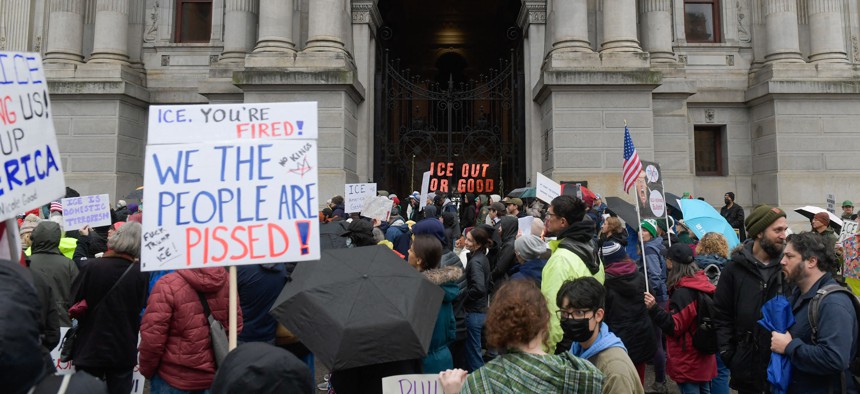
Protesters gather outside of Philadelphia City Hall during a protest against ICE and the killing of Renee Good on Saturday, January 10, 2025. Matthew HATCHER / AFP via Getty Images

Prior to 2025, Philadelphia immigration attorney Lilah Thompson had rarely seen a case like David’s.
Born in Nicaragua, David – an alias used to protect his safety – was detained by U.S. Customs and Immigration Enforcement last October during a routine appointment connected to his application for asylum.
For the previous three years, the 20-something David had worked as a restaurant cook in Philadelphia. His papers – a federally issued work permit and Social Security number, along with the asylum petition – were in order, and he had consistently appeared for appointments as requested.
Today, David remains one of nearly 1,900 other immigrants detained at the Moshannon Valley Processing Center in Central Pennsylvania, the Northeastern U.S.’s largest immigration detention facility. The Defender Association of Philadelphia – where Thompson is a Stoneleigh Fellow – has been representing David and many other immigrants who, like him, followed the rules but got detained anyway.
“For the second time, I’m deprived of my liberty. I feel helpless,” said David, whose asylum claim centers around his politically motivated imprisonment and torture for participating in the 2018 protests against the government of controversial Nicaraguan leader Daniel Ortega. “In this country that speaks of liberty and democracy, that this happens – it’s tragic.”
It’s also unprecedented in recent history. Until President Donald Trump took office last year and made the ongoing immigration crackdown a central part of his second term, “we were never seeing individuals detained at ICE check-ins, unless they had somehow violated their release or parole by, for example, being arrested or convicted of a crime,” explained Thompson.
“Over the last year, we have been seeing a new approach to immigration that involves reaching back into people’s … individual court histories – things that had been settled matters being unearthed … Settled matters of immigration law are now being upended.”
Today, the resulting surge in client referrals to the Defender Association – more than double the number from the pre-Trump era – has prompted the organization to launch a new, dedicated immigration legal unit, which Thompson is currently overseeing.
The seven-person division now includes two legal fellows and three immigration attorneys; Chief Defender Keisha Hudson said the association eventually plans to dedicate 11 employees to the unit, including three more full-time attorneys to the only such entity of its kind in the commonwealth.
The Defenders are required under a U.S. Supreme Court directive to advise non-citizen clients about how any contact with the criminal justice system might potentially impact their immigration status. But Thompson said that the Defenders’ practice goes beyond legal requirements and is a deeply human mission.
“We are seeing really atrocious things happen to our immigrant brothers and sisters … as individuals’ rights are infringed upon,” said Thompson. “The government is doing illegal things against immigrants; we’re seeing how that affects their lives in really dramatic ways. Increasing the capacity to be able to protect individuals’ rights is something that we care deeply about.”
With novel challenges such as third-country deportations and habeas petitions for lawfully present detainees, it’s also an increasingly complex task. Today, cases “require much more complex thinking, much more planning … different types of creative representation that we haven’t had to do in the past,” Thompson noted.
The Defender Association has long partnered on immigration defense cases with the Nationalities Services Center, sharing several attorneys; it also collaborates with HIAS Pennsylvania and the York-based Pennsylvania Immigration Resource Center, an arrangement that will continue.
About three years ago, Hudson said, negotiations began to formally consolidate immigration defense activities within her organization. Funding comes from a variety of grants and other sources – including, this year, $950,000 from the City of Philadelphia subawarded from the National Services Center, an allocation Hudson is relying on to continue her work.
“We would love to get foundational and/or city and/or state support to be able to expand the work – not just in Philadelphia, but around the entire commonwealth,” she noted. “Unlike other states and cities, we’re not funded to the level that we need to be.”
Thompson’s three-year fellowship is funded by the Stoneleigh Foundation; she was previously the supervising attorney of the NSC’s detained removal defense project, which has been folded into the defenders’ new immigration unit.
“That’s a model that you see in other public defense agencies around the country that have immigration defense as a unit within their larger organizational structure,” Hudson explained. By concentrating this service at a single office, the shared attorneys can work full-time on the association’s detention and removal cases in immigration court.
The skyrocketing number of people seeking representation makes clear the urgent need for the organization to expand. Prior to 2025, Thompson said, “we were contacted only a few times a year for habeas petitions” – the lawsuits that challenge the lawfulness of an individual's detention by immigration authorities. But over the past six months, her office has received 50 such requests.
Moreover, Thompson’s immigration unit received 214 referrals during 2025, up from just 82 referrals the previous year. The increase meant that the association was only able to offer full representation to 16% of last year’s referrals, versus 45% in 2024.
And in just the first three weeks of 2026, Thompson said that referrals were already triple the number from the entire month of January 2025.
That data belies the common perception that Philadelphia has not been a locus for ICE enforcement action, in contrast to the high-profile raids in cities like Minneapolis.
But ICE agents “have been in virtually every major community here in Philadelphia – not just the Hispanic community – we have (also) seen an uptick in the Asian community and the African community,” said Hudson. Venezuelan nationals, she added, appear to be a particular target of ICE.
The fear among foreign-born residents is widespread enough that, for the second year in a row, Philadelphia canceled its annual Carnaval de Puebla – a premier cultural event for South Philadelphia’s sizable Mexican community – due to concerns about potential ICE activity.
This week, Philadelphia City Councilmembers unveiled a package of legislation aimed at curbing ICE activity in the city – including banning agents from using facemasks or unmarked vehicles, from collecting personal data from the city, and from using public spaces as staging grounds for enforcement action.
“They have been showing up to businesses … while people are at work. They’re there when people go in for the required check-ins,” added Hudson. “It’s not getting (the) attention that you see in other jurisdictions, but there very much is an ICE presence here.”
David can testify to that reality. He spoke earnestly of his quest to remain in his adopted hometown, Philadelphia – a city he admires not only for its generous people, but also for its heritage as the birthplace of American democracy. “The Liberty Bell, the Constitution, even the first flag, all were created here,” he said. “So it’s contradictory, what’s happening right now.”
For her part, Hudson envisions the new immigration office not only as a way to assist clients, but also to combat widespread misinformation about the targets of ICE action. “A lot of people believe, ‘They are people who come in contact with the criminal justice system … who are designated gang members,’” she said. “What people are not seeing is that the vast majority of people coming into the system are people who have … built residences here, businesses here, families here.
“This is not just impacting individuals,” she concluded. “It’s ripping apart families – and it’s destabilizing communities.”