
Campaigns & Elections
Morgan Cephas’s millennial message in the PA-3 primary: Be bold
The chair of the state House Philadelphia Delegation wants to upend the status quo in Washington and the Democratic Party
Commonwealth Media Services

This is the latest in a series of interviews with Democratic candidates for PA-3. Other candidates interviewed include Chris Rabb, Ala Stanford and Sharif Street.
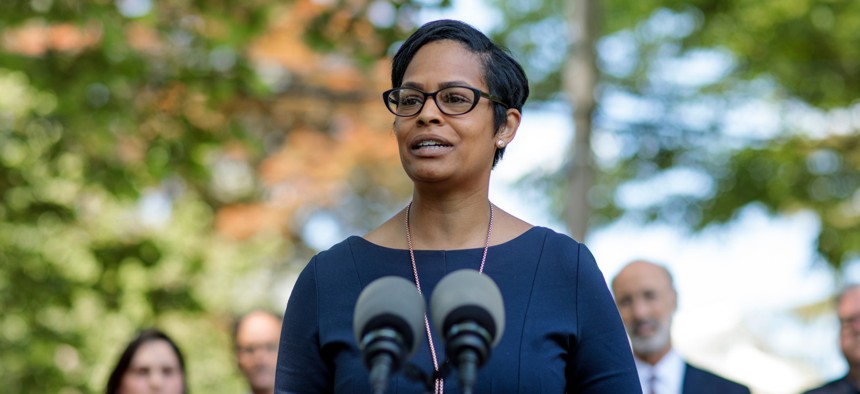
Morgan Cephas believes she’s the right millennial messenger to meet this moment.
“At 41, they refer to me as a geriatric millennial, but a millennial nonetheless,” Cephas told City & State in an interview, adding that the average PA-3 voter is in their 30s and looking for something new from their politicians. “Coming from a generation that potentially might not do as economically well as our parents, it’s deeply concerning,” referring to millennials as the “sandwich generation.”
The state representative-turned-congressional candidate is seeking the Democratic nomination for PA-3 in Philadelphia, a seat Dwight Evans has held for a decade.
According to the Cook Political Report, the North and West Philadelphia district is the most partisan – regardless of party – in the nation. Coming in at +40 in favor of Democrats, the district performed about 40 points more Democratic in two-party vote share than the nation as a whole in 2020 and 2024.
A number of progressives and party establishment Democrats threw their hats in the ring to fill in the deep-blue seat, knowing the winner of the primary is in place to succeed Evans on Capitol Hill. But as the primary election gets closer, the field is beginning to narrow.
Cephas entered the year trailing her opponents in fundraising. Campaign finance reports from 2025 show Cephas raised about $85,000 in the last three months of the year and collected about $156,000 in the previous quarter. She had more than $100,000 in cash on hand at the start of 2026, well below the likes of Stanford and Street, who had funds of upwards of $400,000 and $500,000 on hand.
Labor unions and progressive organizations have begun to back her opponents, but Cephas still boasts endorsements from the likes of the All* In Action Fund and several Philadelphia-area state legislators, including state Reps. Ben Waxman, Gina Curry, Greg Scott, Heather Boyd, Jason Dawkins and Joe Hohenstein.
Cephas, one of the younger candidates on the ballot and the youngest among those with legislative experience, sees this moment as the time for the next generation of changemakers to get a seat at the table.
“We’re trying to afford childcare, but we’re also concerned about taking care of our parents and those expenses … That is one thing that makes me fundamentally different” in the campaign, she said.
Cephas said voters are looking for someone who not only understands the challenges they face in their communities, but also has bold ideas – from universal childcare and healthcare to investments in public transit and workforce development – to bring to the table.
“With an affordability crisis, with (Philadelphia) potentially closing 20 school buildings, with us fighting tooth-and-nail just to keep our transit system running – it’s important to me when you come from a safe seat like this, that you are transformative when you get an opportunity and when you fight for a seat at the table when it comes to power,” Cephas said.
Cephas said her mother, who had previously retired, has returned to work “so she can afford her health care, her heating costs and her mortgage … That’s the direction that this country is going in.
“When we’re talking about what we need down in Washington, D.C., it’s a conversation about how we’re going to fight in this existing climate,” Cephas added. “We have to ensure that we have bold ideas that we're talking about, that we’re running on, and that we have a bolder vision than what we’ve had for such a long time.”
Track record
Born and raised in West Philadelphia, Cephas went to Central High School before earning a political science degree from the University of Virginia, where she ran track and field for the Cavaliers.
Her entry into Philadelphia politics came when she worked under Philadelphia City Councilmember Curtis Jones, serving as his deputy chief of staff. She also worked with the Philadelphia Youth Network to support summer youth jobs programs, and continues to serve on community organization boards, including the Pennsylvania Workforce Development Board, the Pennsylvania Infrastructure Investment Authority – known as Pennvest – board of directors and the Community College of Philadelphia Board of Trustees.
Cephas set her sights on Harrisburg in 2016, running for the state House against incumbent state Rep. Lynwood Savage in the Democratic primary. After defeating Savage in the primary and winning the general election for West Philadelphia’s 192nd legislative district seat, Cephas has become a strong voice within the now Democratic-controlled state House and a consistent advocate for improving healthcare outcomes, particularly regarding Black maternal health.
When asked about the country’s healthcare system, Cephas said it’s “almost becoming a monopoly.”
“When you see CVS, not only in the pharmacy (space), but having doctors at Oak Street Health, having pharmacy benefit managers that are negotiating with insurance companies, and having an insurance company themselves with Aetna Health – we are absolutely going in the wrong direction,” she said. “Our healthcare is a reflection of how good our economy is going to do.”
Tying healthcare and affordability back together, Cephas pointed to how “Washington dysfunction is impacting us …We are creating an economy (and) a democracy that is not going to be able to work for everyone.”
She said federal cuts to Medicaid will be detrimental not just to consumers but also to hospitals and rural systems that rely on Medicaid payments to cover most of their operations.
“We have close to 20 to 25 hospitals in rural areas that are going to close as a direct result of what is happening with Medicaid,” Cephas said, adding that she is focused on “not just shaping the politics of Philadelphia, the politics of Pennsylvania and the politics of this country, but also our ability to be able to hone in on issues that everyday people care about.”
As the region’s transit system treads water financially, Cephas, who was elected chair of the Philadelphia House Delegation during the 2023-2024 legislative session, said her top priority this budget season will again be public transit funding.
“I’ve been elected by 25 of my colleagues to represent (Philadelphia’s) policy, investment and legislative interests in Harrisburg, and my top priority for the last two or three years has been to save our transit system,” Cephas said.
Growing up in West Philadelphia, Cephas said she relied on public transportation to get to school, work and more. And regarding education and economic opportunities, Cephas added that the conversation must return to mobility and accessibility.
“I didn’t have quality education access in my ZIP code or in my backyard, so I literally had to travel an hour outside of my community to access a quality education. I also had to use it to not only get access to my first job, but my second and my third jobs,” she said, noting that transit impacts every county in the commonwealth. “Mass transit is how I move throughout the city and how you access education and economic opportunity.”
Outside of healthcare and transit, Cephas said, bold ideas and newfound energy are needed everywhere – from challenging current immigration enforcement to providing tangible economic opportunities to those in need.
Cephas discussed one such “bold idea”: a universal basic income pilot program in Philadelphia to support pregnant women. Through the Philadelphia Joy Bank, the pilot program provides 250 eligible pregnant residents with $1,000 per month for 18 months – a direct way to support mothers, families and children during a key time in their lives.
“That’s the type of energy people want right now,” she said, opining that a bold vision is necessary to challenge the current system.
“We also have to acknowledge again that we’ve been teetering on the margins,” Cephas said. “We need to finally have a full conversation about what Medicare for All actually looks like, what universal child care looks like, and what it looks like to have a mass transit system where (we can) keep our economy moving.”