
Philadelphia
Philly Mayor Parker’s $7B budget - by the numbers
Parker outlines her third annual budget in front of City Council Thursday morning
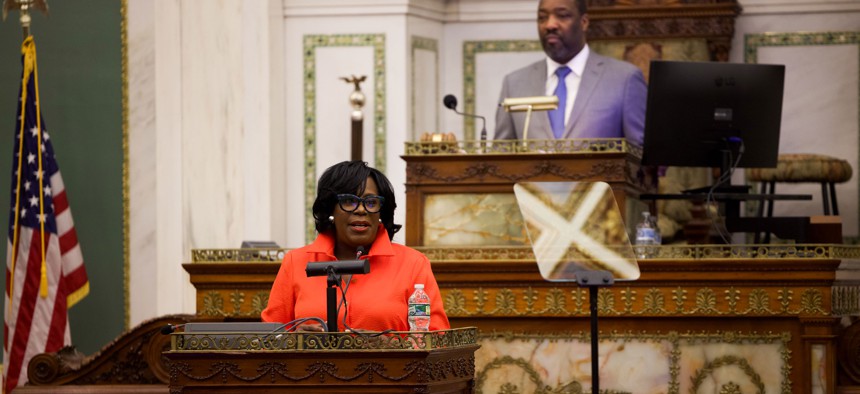
Philadelphia Mayor Cherelle Parker delivers her budget remarks to City Council on March 24, 2025 City of Philadelphia // Quinton Davis

Philadelphia Mayor Cherelle Parker’s third annual budget address took place Thursday morning, with the city’s 100th chief executive unveiling a roughly $7 billion budget proposal that includes plans to have new hotel and gig economy taxes to provide additional investment in homeless services, recovery facilities and public schools.
The plan includes new rideshare and delivery service fees that would generate additional revenue for the School District of Philadelphia, as well as investments to expand the city’s homeless shelter beds and addiction recovery services.
Last year’s $6.8 billion budget proposal included major changes to the business income and receipts tax and an ambitious plan to fund housing and homelessness initiatives. This year’s proposal again addresses housing and homelessness by seeking additional revenue for one of Parker’s top priorities. Significantly, the mayor’s plan does not include a property tax increase – though new assessments may cause property values to jump – and gradual decreases to the city’s wage tax.
Philadelphia City Council will host several formal hearings and public comment sessions for the fiscal year 2027 budget, which must be agreed upon by the end of the fiscal year on June 30. Upon final approval, the budget will take effect on July 1. Here are some key figures:
Tax adjustments
- 2% percent increase in hotel tax, bumping the tax rate from 15.5% to 17.5%
- 25-cent-per-order retail delivery tax
- 20-cent-per-ride fee on ride shares, including Uber and Lyft
- Increased fees for zoning hearings, commercial trash and cell tower occupancy
Workforce development and education
- $25 million investment in community-based anti-violence grants
- $10 million investment in workforce development training
- $1.9 million expansion to Extended Day/Extended Year schooling
- $7 million to establish a municipal employment fellowship program
- $850,000 to establish a student loans help center
- $3.3 million to support small and local business contracting initiatives
- $14.7 million over five years to create an additional 1,000 summer jobs
- $13.9 million over five years to support economic opportunities initiatives, including financial counseling and low-cost banking options
- Creation of an Economic Mobility cabinet
SEPTA savings to stay
- Nearly $900 million to SEPTA over the next five years
- $25 million in funding for the Zero Fare program, which provides free SEPTA rides to low-income residents
- Maintaining the Key Advantage program, which covers SEPTA fares for city employees
Public safety and recovery
- $200 million investment over five years for the Riverview Wellness Village, a city-owned recovery house opened last year in Holmesburg
- Addition of 1,000 beds to the city’s homeless shelter network, funded by the hotel tax increase
- $22 million in 2027 and $110 million over five years to support homelessness services
- $211 million in opioid settlement funds to further support addiction and recovery services
- Creation of Quality-of-Life Assurance officers to be deployed in every police district
- $7.1 million to create a One Philly Pothole Squad, dedicated to roadway maintenance
- $30 million to Vision Zero programs
Housing and Parks
- $10 million investment to move forward with modular housing manufacturing
- $179 million in capital investments to parks and recreation, including $3 million for Lemon Hill’s FIFA World Cup FanFest
- $33 million in capital investment for HVAC upgrades in city libraries
- Continuation of $50 million commitment announced in 2022 to support relocation of the African-American Museum
- $50,000 boost for the Dell Music Center, and $1 million for the center’s capital projects