

Philadelphia
Report: Center City Philadelphia is ‘on a roll’ despite concerns with taxes, transit and homelessness
The Center City District released its annual report on Wednesday showing growth in multiple areas
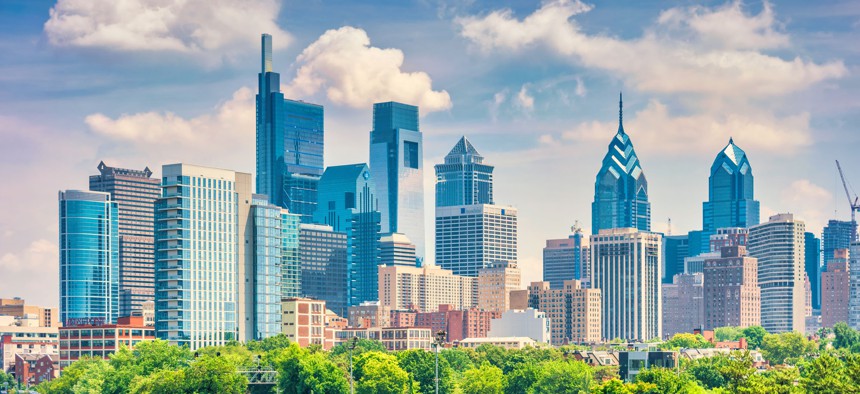
benedek/Getty Images

Much like its famed cheesesteaks, Philadelphia’s Center City is on a roll – at least, that’s what the Center City District says in its annual report released Wednesday morning.
The Center City District’s new report showed that Philadelphia’s core is growing in some key metrics: Center City sees as many as 343,000 pedestrians a day, and office and residential leasing activity is up.
The “State of Center City Philadelphia 2026” report showed that the area, which stretches from Vine Street to Pine Street and from the Schuylkill River to the Delaware River, is home to roughly 250,000 jobs across all sectors and education levels, with that number bumping to 309,000 when extended to Greater Center City, which runs from Girard Avenue to Tasker Street.
CCD, a private-sector business improvement district founded in 1991, has served as a nonprofit management organization for all things downtown Philadelphia.
Prema Katari Gupta, president and CEO of CCD, made the case that Center City is the “economic and civic engine of the region” in addition to being the “heart of the city.”
“This is what makes Center City categorically different from every other jobs hub in the region,” Gupta said. “It’s not a campus, it’s not an office park, it’s not built for one industry or one type of worker – it’s a place in this metropolitan area where accessible opportunity currently exists for everyone.”
Commercial and residential stability
Much like many cities, Center City Philadelphia is still adjusting to the post-pandemic market and labor force.
The report found that the office market is stabilizing, with leasing activity going up 10% from 2024 to 2025, reaching a six-year high. At the same time, more than 2 million square feet of office space – roughly 5% of the office inventory – is on a path to residential conversion, meaning more housing in the already-dense district.
CCD said about 8,240 residential units were either completed or under construction in 2025 and that Center City’s population grew by 4% in 2025 alone. The city’s core accounted for 44% of Philadelphia’s housing production in 2024 and 28% of its population growth.
“The office district is becoming a more mixed-use place with each passing year, and this creates sort of a virtuous circle that feeds on itself,” Clint Randall, vice president of economic development at CCD said. “You can attract more residents into these former office buildings, and that, in turn, makes for a better retail environment.”
The report showed that Center City’s retail occupancy reached 84% and that the Greater Center City area’s apartment occupancy reached 90%, while hotel occupancy improved slightly – to 66.5%.
It also showed a 12% year-over-year increase in SEPTA ridership in 2025 – a statistic that CCD coattailed into its pitch for reliable transit funding.
Policy problems
Gupta said Center City is strong and can get stronger, but three specific policy issues need addressing to put the city in a better position: tax reform, transit funding and homelessness.
“I want to be very direct about (the policy challenges) because they matter, not just for downtown, but for the entire city,” she told reporters regarding the three policy issues listed in the report. “Each of these is a citywide challenge, and demands new partnerships and serious attention.”
Randall added that the total number of office spaces, and the area’s share of jobs relative to the rest of the region, hasn’t changed much in decades. The city’s tax structure, he argued, keeps Center City from attracting major new employers because it’s the “most challenging” on the city’s “most vulnerable entities.”
“Philadelphia’s tax burden disproportionately affects things that can move, aka people, and does not place as big of a tax burden on things that cannot move, aka property taxes,” Randall told reporters. “If you look at other dynamic cities that we in some ways might like to emulate, they have much higher property taxes, particularly commercial property taxes, but lower or nonexistent wage taxes … (they have) corporate taxes that are higher, while (their) small business taxes are not as onerous.”
Gupta also emphasized the importance of public transit, saying SEPTA “undergirds how this whole thing around us works.”
“What makes Center City accessible to 3.3 million people in the region is having different ways of getting here,” Gupta said. “Of course, some people can walk, some people can bike, some people drive, but certainly, SEPTA is a huge part of that — and we really feel very strongly that protecting SEPTA is one of the most important things for downtown.”