

Campaigns & Elections
Candidate questionnaire: Ala Stanford
Stanford answers our questions about her policy priorities, politics and more
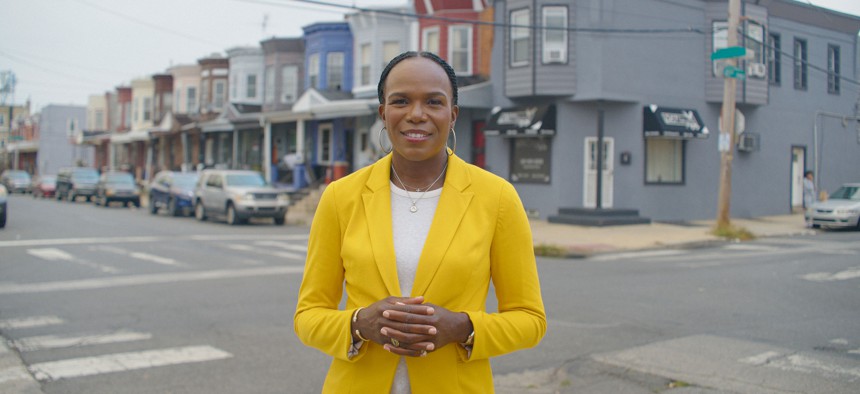
Stanford for Congress

The final week of the primary election season is upon us. In Philadelphia's 3rd congressional district, Democrats are vying for the chance to succeed Dwight Evans and represent a deep-blue seat in Congress.
City & State shared questionnaires with each of the leading candidates to get a final in-depth look at the players in the PA-3 Democratic primary and where they stand on specific issues, from housing to healthcare and more.
First up in the series: Dr. Ala Stanford, who has tried to position herself as both a political newcomer and an experienced public health expert able to work with local, state and federal officials.
Some responses have been edited for length and clarity.
Here’s what Stanford had to say about:
Housing policy
On housing, the first thing I would do is go after the Wall Street landlords who are buying up homes in this district and turning whole neighborhoods into investment portfolios. That is not the market working; that is the market being weaponized against the people who live here. I support expanding housing vouchers into a real entitlement because 40,000-person waitlists are not a housing policy. That is a cruelty. And we have to build more. You cannot talk about affordability without talking about supply. I support the ROAD to Housing Act because it addresses the problem from multiple directions at once: zoning reform, converting vacant buildings into homes, and updating FHA loan limits so developers can secure financing to build. Philadelphia has thousands of empty properties, while families cannot find a place they can afford. That is solvable. We just have to decide to solve it.
Healthcare policy
I grew up on Medicaid. I practice medicine today at 21st Street and Lehigh Avenue, in the ZIP code with the lowest life expectancy in Philadelphia. I see every single day what happens when people cannot afford care. They wait. They get sicker. They end up in an emergency room that costs 10 times what a primary care visit would have cost. I will fight to empower Medicare to negotiate drug prices directly, cap out-of-pocket costs, and push hard for a public option. At my health center, we take care of everyone who walks through the door, regardless of what they have in their wallet. That is the model I am taking to Washington.
Education policy
When I got placed in the mentally gifted program and started riding that bus to University City once a week, something happened to me. I started walking those campuses and began to believe, for the first time, maybe that world could be mine, too. That experience showed me that my mind could be my way out. My congressman (Chaka Fattah) championed the federal GEAR UP grant (for a program designed to help Philadelphia students prepare for college careers via academic support and mentorship) and, because I was poor enough and smart enough, it helped send me to college. Someone invested in me, and that investment changed everything. In Congress, I will fight for full funding for IDEA (the Individuals with Disabilities Education Act) and Title I to provide every child in every public school the resources they deserve. In addition I will advocate to double the Pell Grant and index it to inflation. In Congress, I will fight for more federal funding to improve our crumbling school infrastructure and to preserve the Department of Education, to begin to undo the harm that this administration has enacted on our entire education system.
Public transit funding
SEPTA did not just move me across the city; it put me on a path to become the first African American woman pediatric surgeon fully trained in the United States – and hopefully, the first African American woman to represent this city in Congress. To me, transit funding is not just about buses and trains; it’s about giving residents from across the district access to opportunities for education, for jobs and to be able to dream bigger than their ZIP code. SEPTA’s crisis is not about capital. It is about operating dollars. You can buy all the new buses you want. If you cannot afford to run them on a schedule people can count on, none of it matters. I will fight for a federal operating assistance program because for most people in this district, SEPTA is not a choice. It is how they get to work, get to the doctor, get their kid to school.
Campaign donors and corporate interests
This is really a question about trust. And trust is not something you declare. It is something you earn. I do not take corporate PAC money and I never will. But a donor policy alone does not build trust with communities that have every reason to be skeptical of anyone asking for their vote. I know that firsthand … I am a doctor. When I took my oath, I made a commitment to my patients – not to the insurance companies, not to the hospital system and not to anyone writing a check, to my patients. That is how I run my health center. Everyone who walks through that door gets the same care, regardless of what they have in their wallet or what their insurance card says. I do not have a two-tiered system; I never have. The person who can barely afford the bus to get there gets the same care as anyone else. That is just how I operate.
That is exactly how I will govern. My constituents are my patients. Every single one of them gets the same representation, the same fight, the same commitment from me regardless of how much they donated or whether they donated at all. People have lost faith in the federal government – and I understand why. They have been promised things and then forgotten. That is part of why I am running. I have spent my career proving that you can earn trust back by showing up. Someone has to go to Washington and actually do that. That is what I am running to do.
Meeting the needs of a diverse district
I grew up in North Philadelphia, spent time in Germantown; I live in Chestnut Hill now. I have lived in this district. As a child I grew up relying on Medicaid, SNAP, and Health Center 9 just to get by. And I know what it means to have opportunities because of your earned success as a public school educated person. Both of those things are my life.
What that taught me – and medicine confirmed it – is that you have to listen before you open your mouth. Every patient who comes through my door is different: different story, different circumstances, different needs. You cannot walk in assuming you already know. You have to ask. And then you have to actually hear what they tell you. The things that connect every neighborhood in this district are not complicated. People want to afford where they live. They want to see a doctor when they are sick. They want good schools and safe streets. What changes from neighborhood to neighborhood is how far people are from those things and how long they have been waiting. During COVID, I started by taking care of those with the least, the communities that had been left behind the longest, and that is exactly what put me in a position to take care of the whole city when it needed it most. I named my book “Taking Care of Them Like My Own” because that is not a slogan. It is how I approach every patient, every community, and every person I serve. That is how I will approach being your congresswoman.
An underdiscussed issue
Mental health. Not as an add-on to another conversation and not as a footnote in a gun violence discussion, but as a standalone crisis that is reshaping every neighborhood in this city and getting almost no serious policy attention.
I helped lead the national rollout of 988 (the national suicide hotline) at HHS, and I can tell you the need is staggering. We have a generation of young people who came through a pandemic in isolation – who watched their communities destabilized by violence and economic insecurity, who have nowhere near enough support available to them. We have seniors dealing with loneliness and depression at rates that are killing them as surely as any disease. We have people cycling through emergency rooms with mental health crises because there is no community based alternative anywhere near them. 988 was a step – an important step. But we have massively underfunded its implementation, and we have done almost nothing to build the workforce and the community infrastructure that would make it actually work at scale. I will tell you something else: I see it in my clinic every single day. People come in for a physical, and what they really need is someone to talk to. They come in for a prescription and what they are carrying is grief, or trauma, or a level of stress that no medication is going to fix. The body keeps score. And when we ignore mental health we end up paying for it everywhere else – in emergency rooms, in prisons, in children who cannot learn because they are not okay. This is personal to me. I helped build 988 because I believed that when someone is in crisis, they deserve a counselor, not a cop. I still believe that. And I am going to keep fighting to make it real not just on paper but in every community in this district.
Bringing personal experience to Washington
The people closest to a problem are almost always closest to the solution, and the government is usually the last to figure that out. During COVID, I did not wait for the federal government to tell me what North Philadelphia needed. I went into the community. I listened. I built something that worked because it was built by people who understood the problem from the inside. At HHS, I learned the flip side of that lesson. I learned that federal systems have enormous power to help people when they are designed well, and enormous power to harm people when they are not. I helped lead the rollout of 988. I worked to extend postpartum Medicaid coverage. Those were not just policy wins; they were decisions that changed whether people lived or died. What I am bringing to Congress is pretty simple: Listen before you talk. Do the work before you take the credit. And never forget that every decision made in Washington lands on a real person. I have spent my entire career looking those people in the eye. That does not change when I get to Congress.
Combatting D.C. power dynamics
I will be honest with you: Democrats do not have a tactics problem. They have a credibility problem. People do not believe we will actually fight for them. And until we fix that, no strategy matters. The way you take on this administration is not complicated. You decide what you stand for and you stand there – every time, not just when it is easy. You show up in your district and you tell people the truth about what is happening, even when the truth is hard. You force votes that make people go on the record. You use every platform you have to make sure nobody can pretend they did not know what was at stake. I am not naive about Washington. I worked there. I know how that building operates, who has power, how relationships get built, and how things actually get done when the environment is hostile. I did not sit on the sidelines at HHS. I got in the room and I delivered. What I will not do is trade my values for a seat at a table that was never built for someone like me. The daughter of a teenage mother who grew up in public housing, relying on SNAP and Medicaid, was never intended to be the profile of a congressperson. It’s that lived experience that will inform how I show up every day and fight for the values and programs that help me do more than survive. Those values will never be compromised, will never be up for negotiation. You earn respect in that place by being consistent and by being right. I intend to be both.
If Democrats take control of Congress
The first thing I want is real oversight – not press conferences, not strongly worded letters – real oversight with subpoenas and consequences. Congress has the constitutional authority to check this administration, and too many of my future colleagues have been acting like they forgot that. Committees were built to do this work. I want them to do it from Day 1.
Second, I want us to stop playing defense and go on offense on the issues where the American people are already on our side – healthcare, Medicaid, Social Security. People are not confused about what this administration has done to these programs. They are furious. We should be in every district in this country making that case loudly and relentlessly and then writing legislation that forces people to go on the record about where they stand. But here is the thing I feel most strongly about, and I want to say it plainly: We cannot just be the people who are against Trump. That is not a governing vision. That is not what people are going to show up and vote for. People need to believe that when Democrats regain the majority, we are actually going to do something for them. That means coming in with a clear agenda, saying what we mean, and then doing what we said. No more hedging. No more playing it safe.
NEXT STORY: Meet the longshot in the PA-3 Democratic primary