
News & Politics
7 takeaways from debate between Gov. Josh Shapiro and Treasurer Stacy Garrity
The incumbent governor and the GOP nominee met for the first and only debate of the 2026 election cycle.
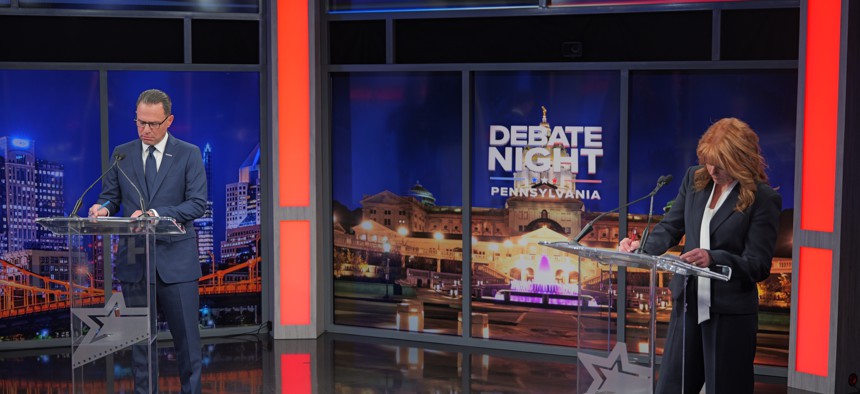
Gov. Josh Shapiro and state Treasurer Stacy Garrity met on the debate stage Wednesday night in Harrisburg. WHTM / ABC27 News

Gov. Josh Shapiro and Treasurer Stacy Garrity met Wednesday night in the first and only debate of the 2026 election cycle, where they made their respective cases to voters ahead of Pennsylvania’s gubernatorial election on Nov. 3.
The debate, hosted by Nexstar Media Group at the WHTM ABC27 News studio in Harrisburg, saw the two candidates offer contrasting views on the economy, data centers and the impacts of federal policy decisions in Washington, D.C., while outlining competing visions for how they would grapple with the state’s biggest challenges.
City & State breaks down the biggest takeaways from the lone gubernatorial debate between Shapiro and Garrity.
Talking AI and data centers
Both candidates were asked about their shifting positions on AI and data centers, including a question for Shapiro on why his executive order on data centers stopped short of instituting a moratorium on data center development.
Shapiro – who once said Pennsylvania is “all in on AI” – said he listened to Pennsylvanians’ concerns about data centers and drafted “the strictest guardrails in the nation” in response.
Shapiro said that under his executive order, data center projects must pay for and supply their own power and commit to protecting the environment. “Most importantly, you have to earn the support of the local community first. They have to pass an ordinance or a resolution. It’s got to include local labor, and it must include a local benefits agreement. Only then, if a local community supports it, will the commonwealth even consider the permits,” Shapiro said.
The governor said Pennsylvania doesn't need a moratorium on data center development. “A moratorium is a timeline to get to a policy. I put in place the strictest policy, the strictest guardrails in the nation to ensure that our communities are protected,” he said. “Again, just putting it very simply, if a local community does not want that data center to be built in their community, it will not be built.”
Garrity said she had held listening sessions with state residents concerned about data centers and that a moratorium on development would allow local officials to update zoning ordinances to protect their communities from unwanted development.
“I actually held five listening sessions across the commonwealth. I talked to township supervisors, commissioners, local solicitors, community leaders, and I heard the same thing: They're not against data centers, but they want time to get their zoning updated,” she said.
Bringing down costs
With Pennsylvania voters listing affordability and the economy as their primary concerns in this year’s election cycle, Shapiro and Garrity each outlined how they would make life more affordable for state residents.
Garrity said she would support policies that promote natural gas and energy development in Pennsylvania. “We need to unleash the energy that we have right under our feet. We are the Saudi Arabia of natural gas, so we should be producing affordable energy, and that would create 200,000 good-paying jobs and generate $5-6 billion in revenue,” she said. Garrity also proposed eliminating the state’s gross receipts tax on electricity and said she would prevent “tax stacking” on electricity bills.
Shapiro, who touted his own efforts to cut taxes as governor, blamed the ongoing war in Iran as a primary driver for increased costs. “The reason why gas and diesel is at a record high is because of President Trump’s war in Iran – a war that I oppose and a war that my opponent supports,” he said. The governor said he is open to a suspension of the state’s gas tax but that such a policy decision must be advanced by lawmakers in the General Assembly.
Starkly different interpretations of the One Big Beautiful Bill
Shapiro and Garrity had divergent views on President Donald Trump’s “One Big Beautiful Bill” on Wednesday night. The domestic policy bill made several expiring provisions in the 2017 Tax Cuts and Jobs Act permanent, and delivered on a key campaign promise of Trump’s by creating tax deductions for tips and overtime pay. It also made significant changes to Medicaid spending and the Affordable Care Act, which critics have feared would jeopardize insurance coverage for hundreds of thousands of Pennsylvanian residents. Shapiro said Wednesday that the law will result in more than 500,000 Pennsylvanians losing access to their healthcare and lead to a loss of food assistance benefits for 143,000 state residents. He said the Medicaid provisions will also hurt rural hospitals.
“That was a bill that I strongly opposed. I urged each member of our congressional delegation to vote against it. My opponent campaigned for it. She called on lawmakers in Washington to pass it – said it would be fantastic,” the governor added.
Garrity touted the bill for extending the 2017 tax cuts and for the deductions for tips, overtime income and seniors. “Let’s talk about the bill that the governor is referencing: It is no tax on tips, no tax on overtime, no tax on Social Security, expanded Child Tax Credit. So the governor opposes all of that,” she said.
Shapiro defends handling of sexual harassment allegations against former staffer
At one point during Wednesday’s debate, Garrity criticized Shapiro’s handling of sexual harassment allegations made against his longtime aide and former secretary of legislative affairs Mike Vereb. The treasurer condemned the administration’s move to settle the claim by using $295,000 in taxpayer dollars, as well as the confidential nature of the settlement.
The governor defended his handling of the controversy, noting that his office immediately investigated the claim and that Vereb promptly resigned.
“At the conclusion of that independent investigation, the individual in question immediately resigned. Following that, my team and I came together to review the policies in place should a complaint ever be made again – which none have – to determine what, if anything, we would change in our policies and procedures,” Shapiro said. “One of the things we recommended is that, should it involve a high-ranking official, the governor would be brought into that process earlier.”
Shapiro added that he has sided with victims of sexual harassment and abuse throughout his career, dating back to his time as attorney general when he oversaw a sweeping investigation into sexual abuse within the Catholic Church in Pennsylvania.
“With all due respect to the treasurer, I have spent my career standing up for victims as attorney general, as governor,” he said. “I have prosecuted pedophiles; I prosecuted predators.”
Sparring over skill games
Shapiro and Garrity were both asked how they would deal with skill games – the unregulated gaming machines found in bars, restaurants, social clubs and convenience stores that have become a financial lifeline for small businesses, veterans organizations and volunteer fire departments. The gaming machines are set to become illegal after Oct. 13, thanks to a Pennsylvania Supreme Court ruling that classified them as illegal slot machines.
Garrity criticized Shapiro’s proposal to tax gross terminal revenues from skill game machines at 52% – a rate that Shapiro’s administration estimates could generate $2 billion in annual revenue for the state. “The governor wants to tax American Legions, VFWs, fire halls, and small businesses by 52%,” she said. Garrity said she supports a $500-per-month fee per terminal, which she suggested could generate roughly $300 million in annual revenue.
Shapiro said taxing the machines at a 52% rate would bring them in line with the state’s existing tax on regulated gaming machines. “I’ve been consistent on this issue for the last four years. I’ve urged lawmakers to pass my legislation, which would allow roughly 45,000 of these machines to be regulated,” he said. “Right now, they are illegal. Tax them at a rate of 52%, which is the traditional tax rate we have on other gaming in Pennsylvania.” Shapiro added that he would direct skill game revenue into the state’s General Fund and use a portion of it to fund mass transit.
“Lawmakers need to come back to Harrisburg. They need to stop campaigning and start focusing on their work – and they need to get this bill to my desk,” the governor said.
Opting in to the federal Education Freedom Tax Credit
Trump’s sweeping tax bill also created a new federal education scholarship program, the Education Freedom Tax Credit, which provides a $1,700 individual tax credit for contributions to eligible scholarship organizations.
Eligible families may use scholarship funds for public or private education costs, including private school tuition, tutoring services, books and more. More than 30 states have opted in to the program to date – and the state must opt in to the program by the end of 2026.
Shapiro wouldn’t commit to opting in to the program Wednesday night, but said he remains open to it. “We’re continuing to digest the federal regulations, but I’ve also expressed my openness to this. A number of governors have shut the door on it. Look, I believe in giving parents an opportunity to put their kids in the best position for them to succeed.”Garrity said she would opt in to the program if she were in Shapiro’s shoes. “Day 1,” she said. “These are hundreds of millions of dollars of educational opportunity for our kids.” Garrity added that other blue-state governors have opted into the program, including Colorado Gov. Jared Polis and New York Gov. Kathy Hochul. “This governor is just trying to score cheap political points against the administration because that’s what he does,” she added. Shapiro disagreed. “We received dozens and dozens of pages of specific federal regulations that we now need to marry up with our rules here in the Commonwealth of Pennsylvania,” he said, adding that the state must ensure that the federal program doesn’t interfere with the state’s existing school choice tax credit programs. “I think prudence here makes the most sense. We’re looking at it carefully, and in the next few weeks, we’ll make our announcement.”
Closing statements
Garrity concluded the debate by casting Shapiro as a political insider who hasn’t positioned the state for success, and encouraged voters to choose change at the ballot box.
“Pennsylvanians deserve better. If you’re happy with high taxes, a weak economy, and backdoor deals in Harrisburg, he’s your guy,” Garrity said. “But if you believe, like me, that it doesn’t have to be this way, (and that) Pennsylvania’s best days are ahead, then please vote for me on Nov. 3.”
Shapiro touted his first-term record, including his securing major economic deals and funding student teacher stipends, and asked voters to send him back to Harrisburg for another four years.
“I’m proud of what we’ve gotten done together. I’m mindful that we have a lot more work to do, and tonight I respectfully ask you for your vote for another term as your governor,” he said.