

The colonial DNA behind Pennsylvania’s purple complexion
At Philadelphia’s Carpenters' Hall, the birthplace of the commonwealth, historian Colin Woodard explained how a pluralistic legacy birthed a perpetual swing state
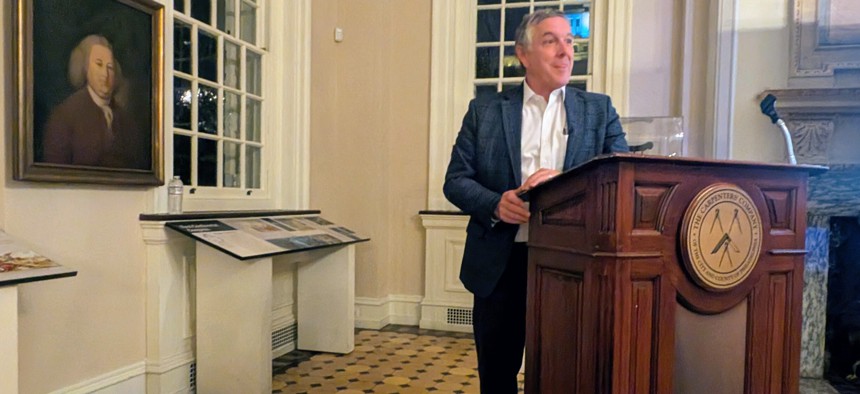
Historian Colin Woodard discussed the roots of Philadelphia politics at Philadelphia's Carpenters' Hall Hilary Danailova

In the rectilinear brick edifice where the commonwealth was born, historian Colin Woodard laid out his theory for why Pennsylvania became the purple heart of America’s political swing region.
Woodard, the bestselling author of “American Nations: A History of the 11 Rival Regional Cultures of North America,” spoke at Philadelphia’s Carpenters’ Hall as part of the historic institution’s series highlighting Pennsylvania’s political history ahead of the midterm elections.
While territories to the north and south were dominated by distinct communitarian or individualistic cultures, Woodard explained, Pennsylvania has been, since its inception, a kind of liminal zone, a region where pluralistic communities have developed a unique and enduring political fluidity. That culture has roots going back even before the commonwealth declared independence from Great Britain and drafted its first state constitution in Carpenters’ Hall, at the Pennsylvania Provincial Conference.
“It’s an honor to be here … in the city where this country was created and first governed – and in a state which, in historical terms, has been … the quintessentially pluralistic colony, the quintessential swing state,” said Woodard, who is also the director of the Nationhood Lab at Salve Regina University’s Pell Center for International Relations and Public Policy, where he studies how America’s historical cultures shape our modern politics and sociology.
At the heart of that scholarship is a region he dubs “the Midlands” – a horizontal swath extending west from Philadelphia into Ohio that, wedged between Northeastern Yankees and the Deep South and Appalachia, has evolved into what he calls “the most critical political bellwether in our federation.”
The key to understanding modern-day Pennsylvania, Woodard explained, is to remember that it was originally a meeting ground for “two of the massive cultures which dominate our national life – and whose clashing values and influence have shaped the character of this country.” Those cultures are Puritanism, the scolding Yankee conviction that humans are “innately depraved and cannot be trusted,” and Quakers, whose pacifistic utopian vision, promoted by commonwealth founder William Penn, emphasized essential human goodness.
Woodard explained that the tension between those competing visions lies at the heart of the regional divides that have characterized Pennsylvania for more than two centuries. To this day, while neighboring regions have clear and consistent philosophical leanings – in the Northeast, “communitarian,” with a deep sense of civic responsibility; in the Deep South, defiantly individualistic – Pennsylvanians are historically more willing to be persuaded in one direction or the other, including on Election Day.
The roots of that flexibility, explained Woodard, trace back to William Penn, whose faith in humans’ essential decency led to “a surprisingly open immigration policy from the beginning,” in contrast to colonies with strict protocols about who was allowed to enter.
Colonial Pennsylvania, he said, welcomed “people from all over the place … Right from the beginning, it was this multicultural and multiethnic place where no one group was in charge,” he added. And while Quakers today represent a vanishingly small percentage of the region’s population, their values persist, because “cultures can be transmitted in the absence of the people themselves,” Woodard said.
Once the pacifist Quakers lost formal control of the colony, “all sorts of people streamed in: Amish, Mennonites, Brethren, Doctors, Moravians, Pietist and Palatinate Germans, Irish Catholics, Ulster Protestants, Welsh, Scots, Dutch, African Americans,” he added. And ever since, the corridor extending from Pennsylvania to the lower Great Lakes has been “the Great Swing Region.
“It’s always highly contested. It’s almost always the bellwether of the national consensus, because it’s communitarian, and yet skeptical of top-down government solutions.”
In presidential elections, Pennsylvanians voted for the abolitionist Republican Abraham Lincoln; the New Deal and Great Society Democrats Franklin Delano Roosevelt and Lyndon Johnson; the Cold War Republicans Nixon and Reagan; and, in the last two elections, Democrat Joe Biden and Republican Donald Trump.
“In tight elections, it’s always on the edge. It’s always close … and then it’s almost unanimous in these big omnibus elections, switching over from one party to the other, along with the rest of the country,” mused Woodard. “And in many ways, Pennsylvania has also been the keystone that can hold our nation together.”