

Campaigns & Elections
Touting domestic accomplishments, Ryan Mackenzie fights for a second term repping PA-7
The first-term Republican is considered extremely vulnerable in polls that show a toss-up race against Democrat Bob Brooks, the state firefighters’ union chief, in a Lehigh Valley swing district
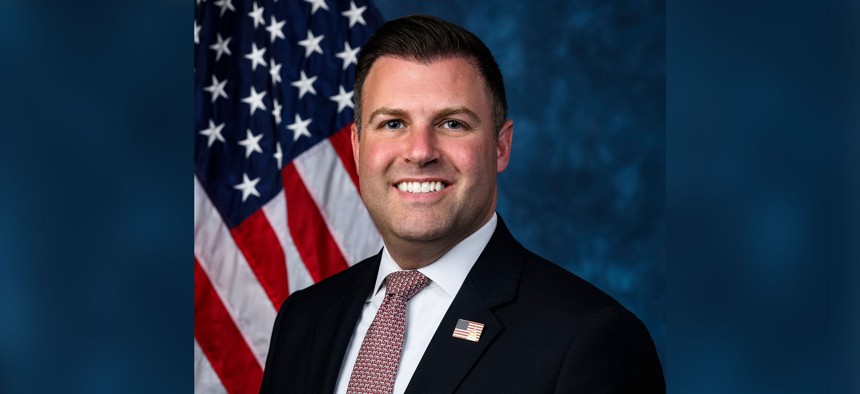
Ryan Mackenzie Provided

This is part of a series of interviews with candidates in key congressional races.
After six terms representing his native Lehigh Valley in the state House of Representatives, Republican Ryan Mackenzie headed to Washington two years ago – and quickly discovered that a member of Congress has a dual role: “There’s what we do legislatively in Washington,” he said, “and then also what we do here in the district.”
In the final days of one of the nation’s tightest midterm races, the Allentown native says his work in both arenas has earned him reelection to represent Pennsylvania’s 7th congressional district. “On the legislative front, the things that we ran on two years ago were securing the border and providing tax relief for all Americans – and we delivered on both,” he said.
At home in the district, Mackenzie said his office has resolved 12,000 cases for constituents, returning about $21 million to people owed money from Social Security, IRS refunds or veterans’ benefits. He also touts securing $160 million in federal funds for manufacturing, first responders, affordable housing and healthcare – including $100 million to reimburse local hospitals for COVID-era services.
“We’ve been extremely successful in helping our constituents, and very successful in securing federal dollars coming back to the district,” he noted.
But in the final stretch of his race against Democratic challenger and state firefighters’ union chief Bob Brooks, Mackenzie is considered one of the most vulnerable Republican incumbents, and Brooks has identified his foreign policy record as a weak spot. The Democrat, a first-time candidate handpicked by Gov. Josh Shapiro, has hammered Mackenzie for his support of President Trump’s unpopular war in Iran, which has driven up both fuel prices and overall inflation.
In turn, Mackenzie has gone after Brooks with television ads, accusing the retired Bethlehem firefighter of lying on COVID-19 grant applications and of violating state requirements around worker’s compensation, both for his lawn care business; some ads have targeted Brooks’ relationships with various family members.
The avalanche of negativity prompted Brooks to announce he was canceling his appearance at what would have been the candidates’ only debate, originally scheduled for Oct. 21, and to send a cease-and-desist letter to Mackenzie and Republican campaign officials over what Brooks called “defamatory” and false accusations.
For his part, Mackenzie stands by the assertions, repeatedly offering this reporter what his campaign said was evidence of his opponent’s criminality. “That is a very big problem for a candidate for Congress, to say that you lied on a COVID grant application,” he told City & State. “We have not seen him answer that question anywhere.”
The heated rhetoric reflects a district that is nearly evenly divided in terms of partisan leaning – a rarity nationally, and unusually swingy even for the purple commonwealth. Cook Political Report, which had long rated the race a tossup, changed its assessment to “leaning Democrat” as of early October.
Asked about the electoral disadvantage of party ties to a statistically unpopular president, Mackenzie pointed to the fluid and highly localized nature of Lehigh Valley politics. “We’re a swing district within a swing state,” he said, “and so what I see is that people do actually want to go race by race, look at the individual candidates.”
Mackenzie noted that he was one of four congressional Republicans to break with his party over the expiration of Affordable Care Act tax credits this year, and referred to his record of working on bipartisan healthcare legislation – including around stroke care and maternal mortality – in Harrisburg.
He also emphasized his local roots. A ninth-generation Lehigh Valley resident, “I’m born and raised right here in the community,” he said. While studying finance and international business at New York University, he took an internship with then-U.S. Rep. Pat Toomey that “sparked a new interest” in politics, leading to post-graduation roles with the Pennsylvania Department of Labor and Industry and, later, at the U.S. Department of Labor.
Shortly after earning an MBA from Harvard, Mackenzie won a 2012 special election for the state House; a few years later, he and his mother, Milou Mackenzie, made history as the first mother-son duo to serve simultaneously in the state House of Representatives. Then in 2024, Mackenzie narrowly defeated incumbent Democrat Susan Wild and vaulted into Congress.
In both Harrisburg and Washington, he has taken a lead on labor and workforce issues. He currently serves on the House Committee on Education and Workforce and chairs its Subcommittee on Workforce Protections; he also serves on the Foreign Affairs and Homeland Security committees, and in the state House, he was the Republican chair of the Labor & Industry Committee.
Now he hopes to bring together these areas of expertise as he tackles America’s affordability issues. One way to do that, he said, is by bolstering domestic supply chains, especially around energy. “We have to send a lot of our oil out of the country to be refined, and we end up buying gas on the global stage and being dependent upon those prices,” Mackenzie explained. “Same with fertilizer; we can’t supply enough of our fertilizer for this country.”
Whether through measures to increase American energy independence or laws that expand access to healthcare, Mackenzie said affordability would be a key priority going forward. “It’s continuing to deliver for our community,” he said. “I have been so honored and privileged to represent my home area, both in the state House and now in Congress … I’d like to be able to do that for another two years.”