

health policy
PA measles outbreak continues to roil pols, policymakers, physicians
The virus's spread has metastasized into a rapidly expanding partisan controversy.
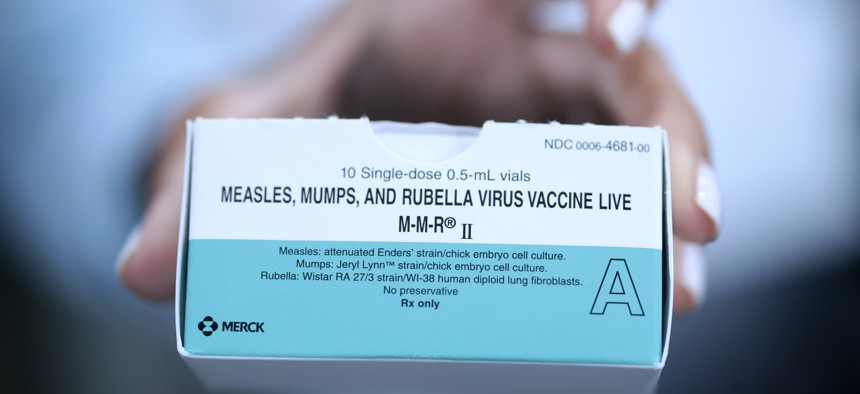
Joe Raedle/Getty Images

At the beginning of last week, the story of Pennsylvania’s measles outbreak was primarily of statewide concern. But since the state’s report of its first two deaths from the virus, the outbreak has gone viral nationally, metastasizing into a partisan controversy over whether measles actually caused the Lancaster County deaths – and casting a harsh spotlight on Gov. Josh Shapiro, whose administration has come under fire for what is being perceived by some as a lack of transparency.
Over the weekend, the social media site X buzzed with commentary on the measles deaths from doctors and public health experts around the country, many of whom speculated over the higher-profile case: a newborn who died of what was diagnosed as a “lacerated spleen” and who tested positive for the contagious virus. Every major American newspaper carried the story of Pennsylvania’s measles outbreak – with nearly 500 cases reported so far – and the controversy it has engendered; The Atlantic, a national magazine, garnered attention for its interview with the family of the dead newborn.
Meanwhile, Dr. Stephen Diamantoni, the Lancaster County coroner at the center of the controversy, has refused to attribute the baby’s death to measles and maintains that his office has yet to certify a single measles death in the county. The board-certified family physician told Lancaster Online that “we want to determine the cause of the laceration. And we may not be able to,” adding that as of Tuesday, he was also investigating a second case of a Lancaster resident who had died while positive for measles.
In a Sunday op-ed in The New York Times, “How Not To Announce A Measles Death,” physician and contributing opinion writer Dr. Rachael Bedard criticized not the state’s medical determination around the measles patients’ causes of death, but its communication strategy. “The stakes of this moment – measles transmission is high, confidence in government and public health is low – require a standard of engagement, clarity and transparency that the initial Pennsylvania response failed to meet,” she wrote, citing the governor’s failure to provide basic details around both victims.
In a widely circulated Substack column promoted on X, Dr. Paul Offit, the co-director of the Vaccine Education Center at the Children’s Hospital of Philadelphia and a longtime critic of Kennedy’s medical pronouncements, noted that “Dr. Diamantoni is in a tough spot. He is dealing with an unusual case.
“So, it’s easy to understand his caution in assigning a cause,” wrote Offit. But he noted that the coroner’s public statements had shifted from “measles was not the cause of death” to the virus being a “contributing factor,” exacerbating the confusion around a highly politicized case.
“Although the press and public have grown increasingly frustrated with Governor Shapiro and the Pennsylvania Department of Health for failing to make the cause of this child’s death clear, the confusion lies with Dr. Diamontoni,” Offit wrote. “If Dr. Diamantoni is going to claim that measles wasn’t the precipitating cause of this child’s death, he is going to have to do a much better job of explaining why it wasn’t.”