

Dave Sunday
‘These are changes that matter’: Pennsylvania will receive over $500 million from Meta settlement
Pennsylvania Attorney General Dave Sunday said the settlement agreement marks a new beginning for the social media industry.
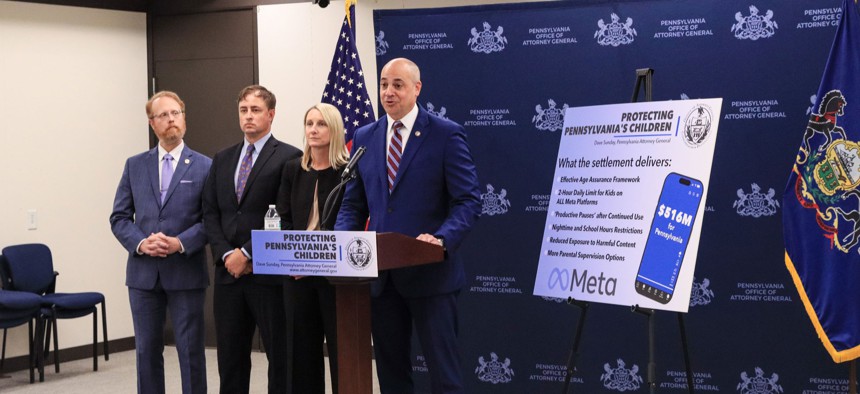
Pennsylvania Attorney General Dave Sunday said a landmark settlement with Meta will bring at least $500 million to Pennsylvania – and important changes to social media platforms. Pennsylvania Attorney General Dave Sunday’s Office

Pennsylvania Attorney General Dave Sunday revealed that Pennsylvania is expected to receive at least $516 million as the result of a landmark settlement between Meta and a coalition of states that sued the social media giant, alleging that it intentionally designed its social media apps to attract and addict children and teens.
The $17.1 billion settlement, which is still pending and awaits court approval, will also usher in major changes to how content on Facebook and Instagram is presented to younger users. Sunday said the settlement will bring “a complete transformation” to how children and teens experience Meta platforms.
Under the terms of the settlement, Meta has agreed to do the following:
- Establish a two-hour daily time limit for teens that can only be turned off with a parent’s permission
- Restrict teen use of its platforms during school and nighttime hours
- Provide the option of a non-algorithmic feed for teen users
- Implement regular prompts and pauses to prevent excessive use
- Disable the visibility of likes and reactions, as well as cosmetic and makeup filters, for teen users
- Adopt and implement an age assurance framework with age verification measures
- Give parents additional information about teen app usage, interactions with suspicious accounts and attempts to change protective settings
Sunday said at a press conference that the settlement will bring significant financial resources to the commonwealth and major changes to how young users interact with Meta-owned apps like Facebook and Instagram. The attorney general said that Pennsylvania will receive at least $516 million, and potentially up to $729 million, under the terms of the settlement.
“This money will remediate social media harms for youth across the commonwealth,” Sunday said. “But to be very clear, this settlement is not just about money – it includes meaningful protections aimed at addressing the harms that social media can cause young people.”
Meta said the agreement will build on existing efforts the company has undertaken to protect teens on its platforms. The company also encouraged other social media platforms, including TikTok and YouTube, to follow its lead.
“We want to ensure teens benefit from this new industry standard, but we cannot do it alone,” the company said Wednesday in an open letter. “These protections will only be truly effective if we work with our peers – TikTok and YouTube – to put the same measures in place.”
C.J. Mahoney, Meta’s chief legal officer, said in a statement that the agreement’s terms will empower parents to manage how their children use Meta platforms, while underscoring the need for other social media platforms to adopt similar changes.
“Our new Time Limit commitments, Night Mode features and usage limits during school hours set the right path forward for our whole industry, but this framework will only work if all our peers join us,” Mahoney said. “As a parent, I’m proud of both the work Meta has done to protect kids historically, and of this new groundbreaking agreement. But its success depends on all other social media platforms following Meta’s lead.”
Matthew P. Bergman, a founding attorney with the Social Media Victims Law Center, said in a statement that the settlement agreement “is a watershed moment in holding the tech giant accountable for designing products it knew were harming children and fueling a nationwide youth mental health crisis.”
“Over the past year, Meta has suffered overwhelming defeats in courts across the country as expert testimony and its own internal documents revealed that senior executives ignored repeated warnings that its products were addictive and harmful by design,” Bergman said. “They chose profit over the lives of our children.”
“Today is a day that we honor the memories of the children who have been lost or harmed because of social media,” he added. “We honor the families who have worked tirelessly over the last five years to seek justice for their children, and to educate other families and young people about the dangers of social media so that no parent ever has to experience the heartbreak they have lived through. What began with a single lawsuit has grown into a national movement that is now sweeping across the world to protect children.”
Bergman said the work to protect children from harms presented by social media platforms is far from over: “We will continue fighting for the individual families whose children will never come home, and for those still struggling with mental health crises caused by these platforms. Accountability to the public is important – but accountability to the families harmed must remain our focus.”
Throughout his first term, Attorney General Sunday has focused heavily on the impacts of social media and the broader tech landscape. He told City & State in an interview earlier this year that technological innovations should not come at the expense of protecting children: “Innovation and technology are not mutually exclusive from protecting children,” he said. “We can do both, and we must do both.”
This month, Sunday announced separate lawsuits against TikTok and Snapchat. In a press conference announcing the suit, he said TikTok “intentionally designed” its app to be addictive to young people, and made similar claims against Snapchat, accusing the platform of breaching the state’s consumer protection laws.
The attorney general said Wednesday that the $17 billion settlement “marks a new beginning for the social media industry.”
“These are changes that matter because they directly address how young people interact with these platforms, how long they use them, when they use them, what they are exposed to on these platforms and the role that parents can play in keeping them safe – and that’s the point,” Sunday said.
“We can’t simply tell parents to do better while allowing technology companies to design platforms that are engineered to addict children and keep them coming back,” he added. “Parents deserve better. Children deserve better. And today shows that Big Tech can do better – some just chose not to. Today is the first step in forcing Big Tech to do better.”