

Dave Sunday
Snap decision: AG Sunday files lawsuit against social media giant over lack of teen safeguards
The announcement on Tuesday against Snapchat follows the attorney general’s salvo against TikTok earlier this month
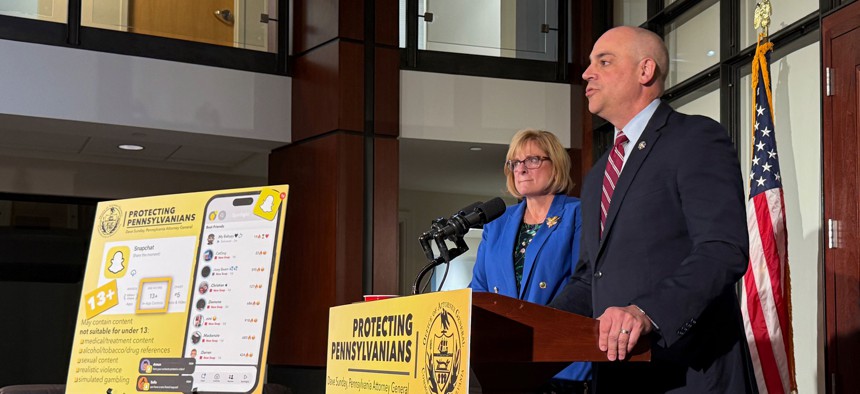
Pennsylvania Attorney General Dave Sunday was joined by state Sen. Tracy Pennycuick at his press conference announcing a lawsuit against Snapchat on Aug. 25, 2026. Greg Salisbury

If the legal teams at Instagram and X weren’t paying close attention to Pennsylvania Attorney General Dave Sunday before Tuesday afternoon, they are now.
For the second time this month, Sunday filed a lawsuit against a social media company. After targeting TikTok on Aug. 11, Sunday announced Tuesday that he was filing suit against Snapchat for what he said were breaches of the commonwealth’s consumer protection laws, especially regarding how the company handles young users of its app.
“This is a very serious legal action with the end goals of being an overhaul of how Snapchat markets and advertises its app; design changes to discourage compulsive use; and safeguards so that families can decide what their children can access online,” Sunday said. He pointed out the similarities between this suit and the one against TikTok as well: “That lawsuit also alleges violations of Pennsylvania's consumer protection laws. It also regards dishonesty in marketing, and that its addictive design harms users, particularly young people. Both of these actions reflect my priority as attorney general to protect our young people from tech giants who are choosing growth at all costs over the mental wellness of its users.”
The 49-page complaint seeks to protect the youngest Snap users from a host of issues, including what it says are the app’s addictive design, its content, and the unauthorized screenshotting and sharing of posts they mistakenly think will just disappear, as the app says.
“A simple screenshot can turn what they thought was a temporary photo into a permanent nightmare,” Sunday said, adding that “Snapchat’s ephemeral component also harms children in other ways. We allege it encourages predators online to be even more aggressive in contacting and grooming kids … I can’t think of anything more concerning than predators having access to kids in arenas where they feel even more free to act deviantly, and that same feeling of freedom could also apply to cyber bullies who might think that they can get away with posting more on Snap, where their threats, their insults, and their destructive commentary will simply disappear.”
The lawsuit could have wide-ranging implications for the state’s teens. According to a December 2025 report from the Pew Research Center, 55% of American teens use Snapchat – a statistic that means roughly 450,000 of the state’s 807,000 teenagers are on the app – and, Sunday said, those users open the app an average of 30 times a day.
Sunday was joined by state Senate Communication & Technology Committee Chair Tracy Pennycuick, who introduced Senate Resolution 244, establishing the Task Force on Child Protection in the Digital Age, chaired by Sunday. The occasion was supposed to be a bipartisan showing – state House Communication & Technology Committee Chair Joe Ciresi couldn’t attend, but provided a statement of support that Sunday read in his absence.
Pennycuick seconded Sunday’s rationale for filing the lawsuit, emphasizing that the company “downplayed the prevalence of mature content on its platform while deliberately using features designed to keep young people scrolling, watching, and coming back. When a company places engagement and advertising revenue ahead of a child’s well-being, Pennsylvania has a responsibility to act.”
Pennsylvania is far from the first state to try to bring Snap to heel. Seven other states – Arkansas, Florida, Kansas, Nevada, New Mexico, Texas and Nevada – have brought legal action against the company for what they have alleged is the failure of the company to protect young users, including for its failure to protect minors from sexual exploitation and sextortion, child sex abuse material and deceptive practices.
Sunday’s focus on bringing accountability to social media companies – his office is also part of a multi-state lawsuit brought against Meta by numerous attorneys general – hews closely to how he explained his priorities to City & State in an extensive interview earlier this year, highlighting the need for a balance between innovation and public safety. “Innovation and technology are not mutually exclusive from protecting children. We can do both, and we must do both. It’s that simple,” Sunday said.
In response to a request for comment, a company spokesperson stated: “The allegations against Snap fundamentally misrepresent our platform and our approach to teen safety.”
“We share the Attorney General’s commitment to protecting young people online and are disappointed they have chosen litigation rather than working with us toward that shared goal,” the spokesperson continued. “We remain focused on strengthening and enhancing the safeguards, tools, and educational resources that support the safety, privacy, and well-being of all Snapchatters.”
While Sunday refused to get into specifics about which social-media companies he would target next, he made it clear that more lawsuits could be on the horizon. “I don’t want to go into great detail on that, but I will tell you that we are actively looking at other companies as well,” he said. “Any company that’s using their product to harm children is something we’re looking at.”