

Politics
Four years later, the Dobbs decision metastasizes into four new battles
The forces behind the stripping of reproductive rights for millions of Americans are now focused on taking even more healthcare options away from even more people.
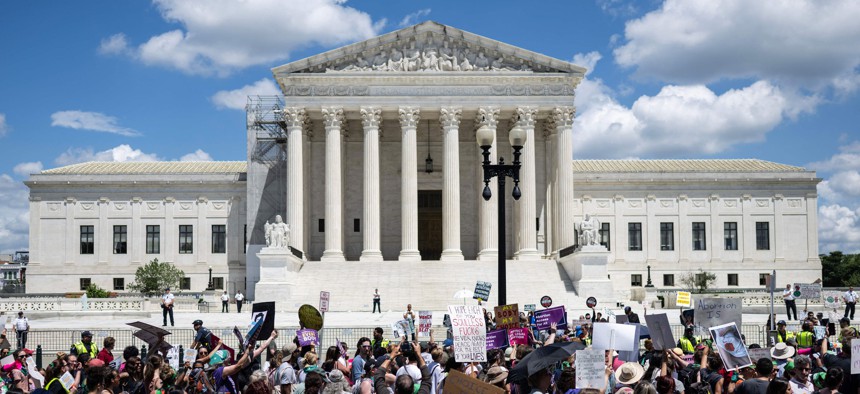
Abortion rights demonstrators rally to mark the first anniversary of the US Supreme Court ruling in the Dobbs v Women’s Health Organization case in Washington, D.C., on June 24, 2023. Andrew Caballero-Reynolds/AFP via Getty Images

Four years ago this month, the U.S. Supreme Court told millions of Americans that a right they had held their entire lives no longer existed.
In Dobbs v. Jackson Women’s Health Organization, the court erased nearly half a century of constitutional protection for abortion and handed state-level politicians unprecedented power over some of the most personal healthcare decisions people will ever make.
Anniversaries usually invite reflection. This one demands more. Because four years after Dobbs, we are fighting many battles for our freedom. Today, I’m highlighting four of them.
Consider what those four years have already cost us. Since Dobbs, more than a dozen states have enacted total abortion bans, while others have imposed near-total bans that prohibit care as early as six weeks of pregnancy, before someone even knows they are pregnant. Millions of Americans now live in states where abortion is effectively out of reach. Patients have been forced to travel hundreds of miles for care, delay or forgo time-sensitive and essential care, or continue pregnancies against their will.
Pennsylvania has become a lifeline for those patients, a critical access point for care that should never have been denied in the first place. But Planned Parenthood health centers are operating beyond their capacity with limited support. While the commonwealth has not enacted an abortion ban, we know our rights remain vulnerable. As long as abortion access depends on biannual election outcomes and court decisions, no one can afford to be complacent.
Abortion was only the beginning. The movement that toppled Roe has spent four years opening new fronts in a much larger war on our healthcare. Four fronts, to be exact.
First, extremists are targeting gender-affirming care. Across the country, lawmakers continue to propose restrictions on lifesaving and essential care for transgender people and insert politics yet again into decisions that should only be made between patients, families and healthcare providers. The same politicians who claimed Dobbs was about “returning decisions to the states” are now working to dictate private medical decisions nationwide. If the government can come between a patient and one form of care, it can come between a patient and any form of care.
Which is exactly the goal of the second fight: the relentless campaign against mifepristone, one of the safest and most studied medications in America. Medication abortion now accounts for the majority of abortions nationwide, and opponents know that restricting access to mifepristone is one of their clearest paths toward a national abortion ban. These attacks aren't based on science or medicine. They’re based on ideology and they’re playing out in our court system with a roller coaster of an appeals process that leaves patients confused and limited.
And when attacking the medicine is not enough, they attack the people who provide it. The third fight targets providers themselves. Efforts to defund Planned Parenthood and other community health centers threaten access to cancer screenings, birth control, STI testing and treatment, wellness exams and preventive care for millions of patients. For the past year, a federal ban has barred patients from using Medicaid at reproductive health centers like Planned Parenthood’s nationwide network. When lawmakers attack trusted providers, patients pay the price.
Increasingly, they pay it in dollars, which brings us to the fourth fight: what advocates have begun calling “sexflation”: the rising cost of simply having sex.
Condom prices have increased alongside the cost of everyday goods, exacerbated by supply chain problems in the war with Iran. Insurance coverage for contraceptive care is not guaranteed, let alone protected. Federal and state restrictions continue to limit abortion coverage through Medicaid, forcing low-income patients to shoulder costs that many simply cannot afford. At a time when healthcare costs are already straining family budgets, basic sexual healthcare is becoming increasingly expensive and increasingly out of reach.
Four fights. One pattern. Each is an attempt to take decisions that belong to you, about your body, your health, your future, your family, and hand them to politicians. People face more barriers, fewer providers, higher costs and greater uncertainty than they did just a few years ago. For young people, working families, rural communities, LGBTQ+ Pennsylvanians and those already struggling to make ends meet, these barriers cut the deepest.
The promise of reproductive freedom has never been just about the legal right to abortion. It is about the ability to make decisions about your body, your health, your future, and your family without political interference. Rights on paper mean little if care is unavailable, unaffordable or inaccessible.
That is why this anniversary cannot be a moment of mourning. It must be a call to action.
Lawmakers pay attention when constituents speak up. They notice when voters call their offices, attend their town halls, submit testimony, and show up at the ballot box. The policies shaping access to healthcare are not inevitable. They are choices made by elected officials and elected officials can be held accountable by all of us.
So Pennsylvanians should answer four fights with four demands: Defend gender-affirming care. Preserve access to medication abortion. Reject every effort to defund our healthcare providers and work to fund them instead. And make contraceptive and abortion care affordable and accessible for everyone.
Four years after Dobbs, we know exactly what is at stake.
The question before us is whether we will allow politicians to continue chipping away at our healthcare and our freedoms, or mark this dark anniversary by standing together and insisting that every person deserves the ability to access the care they need, when they need it, without barriers or political interference.