

Policy
Congress needs to stamp out the intoxicating hemp products loophole
The executive director of the PA Chiefs of Police Association explains how the 2018 Farm Bill’s inadvertent green light to allow the manufacturing and sale of products offering marijuana-like effects has led to a host of unintended consequences that need to be remedied through legislation.
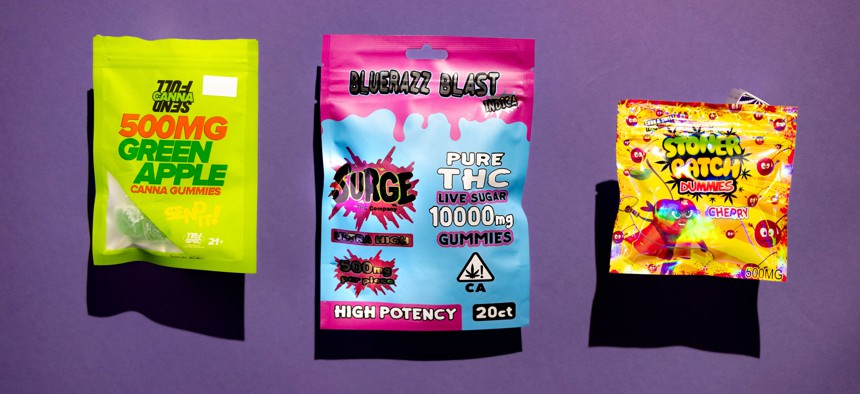
An assortment of pseudo-legal hemp products sold at corner stores and gas stations, like these found in Massachusetts, are often mislabeled and pose public health concerns. Brett Phelps/The Boston Globe via Getty Images

For Pennsylvania’s police chiefs, the debate over intoxicating hemp products is not an abstract discussion about agricultural policy or federal law. It is a public safety issue affecting our communities, schools, roadways, businesses, and the officers responsible for enforcing the law.
That is why the Pennsylvania Chiefs of Police Association supports Pennsylvania Attorney General Dave Sunday and the bipartisan coalition of attorneys general urging Congress to preserve the federal hemp reforms enacted in November 2025.
Those reforms addressed a problem that had grown steadily since passage of the 2018 Farm Bill.
The 2018 law was intended to legalize legitimate hemp production and create opportunities for American agriculture and industry. But an unintended loophole allowed highly intoxicating products derived from hemp to enter the marketplace under a regulatory framework never designed for products capable of producing marijuana-like effects.
Products containing delta-8 THC, delta-10 THC and other intoxicating cannabinoids became widely available as gummies, candies, beverages, vaping products and other consumer goods, sometimes in packaging easily mistaken for ordinary products.
Law enforcement has seen the consequences firsthand.
Officers encounter these products during traffic stops, impaired-driving investigations, incidents involving juveniles, school-related calls and retail enforcement matters. Police departments, prosecutors, laboratories, businesses and consumers have also had to navigate a confusing legal environment in which a substance can produce significant intoxicating effects while still being marketed as federally lawful “hemp.”
Police officers need laws that can be understood and consistently enforced. Prosecutors need clear standards. Businesses deserve to know which products can lawfully be manufactured and sold. Parents and consumers should have confidence that intoxicating substances are subject to meaningful safeguards.
The reforms enacted in November 2025 moved federal law toward that clarity.
Rather than focusing narrowly on one form of THC, the revised federal definition addresses total THC and other intoxicating cannabinoids, establishes limits for final hemp-derived cannabinoid products, and addresses cannabinoids synthesized or manufactured outside the plant.
The objective is straightforward: preserve legitimate industrial, agricultural and nonintoxicating hemp while preventing the federal definition of hemp from becoming a pathway for the largely unregulated sale of intoxicating cannabis products.
Law enforcement is not seeking to interfere with Pennsylvania farmers, responsible hemp businesses or consumers using lawful nonintoxicating hemp products. Those industries deserve a predictable regulatory environment in which legitimate businesses can compete fairly.
What concerns police chiefs is a marketplace where intoxicating products can be sold without safeguards comparable to those governing other intoxicating cannabis products.
Youth access is particularly troubling.
Police departments across Pennsylvania work with schools, parents, prevention organizations and community groups to reduce young people’s access to intoxicating substances. Products presented as colorful gummies, candies or flavored beverages create an obvious concern when they contain psychoactive cannabinoids but are sold outside the regulatory controls the public reasonably expects for intoxicating products.
Roadway safety is another concern.
Impaired driving remains one of the most serious threats encountered by law enforcement. Whether an intoxicating substance originated from marijuana or hemp does not change the danger an impaired driver poses to families traveling Pennsylvania’s highways. The law should recognize that reality.
Consistency also matters. Pennsylvania and other states have spent years developing laws, regulations, and enforcement practices in response to the growth of intoxicating hemp products. Reversing the federal reforms would renew uncertainty and invite litigation over where lawful hemp ends and intoxicating cannabis begins.
That serves neither law enforcement nor responsible businesses.
Attorney General Sunday has correctly framed this debate around consumer protection and public safety. Pennsylvanians should know what they are purchasing, and parents should not have to wonder whether a product resembling ordinary candy or a beverage contains an intoxicating cannabinoid.
Regulation and prohibition are not the same thing. Closing an unintended loophole does not mean eliminating legitimate hemp. It means establishing a clear boundary between industrial and non-intoxicating hemp products and products manufactured to create intoxicating effects.
Congress took an important step toward establishing that boundary in 2025. Changing course before those reforms are fully implemented would recreate uncertainty for police officers, prosecutors, businesses, regulators and consumers while risking a return to the marketplace Congress sought to address.
Pennsylvania’s police chiefs understand that effective public policy must balance legitimate commerce, individual choice and public safety. That balance is best achieved through laws that are clear, consistent and enforceable.
Our message is simple: Legitimate hemp agriculture should flourish; responsible businesses should have clear rules; consumers deserve transparency; children deserve protection from easy access to intoxicating products; and law enforcement deserves a regulatory framework that makes sense.
Congress closed the intoxicating hemp loophole for a reason; let’s keep it that way.
Scott L. Bohn is executive director of the Pennsylvania Chiefs of Police Association.
NEXT STORY: Justice Delayed Is Justice Denied: Helping Solve Unsolved Crime