
Interviews & Profiles
The City & State Q&A: Michael Newmuis
The director of Philadelphia 2026 has left nothing to chance during a two-year sprint that has made the city’s semiquincentennial efforts into the envy of every other planning entity in the country.
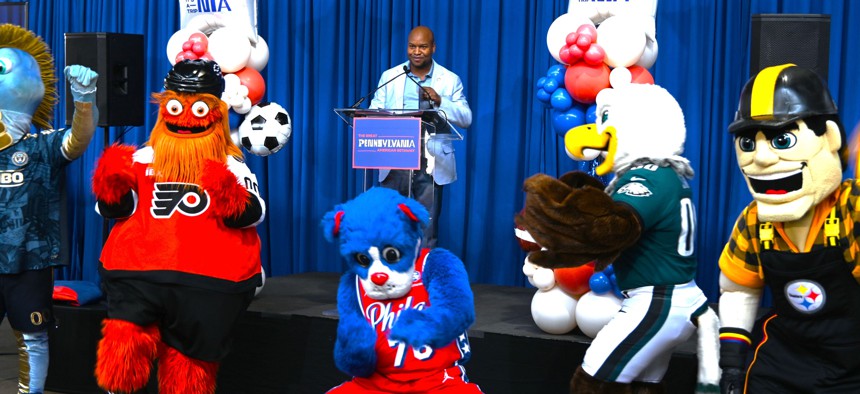
Philadelphia 2026 director Michael Newmuis and local sports mascots take part in a Pennsylvania pep rally. HUGHE DILLON

In early 2024, when Philadelphia Mayor Cherelle Parker offered Michael Newmuis the position of director of Philadelphia 2026 – a role that would make him the point person for a year that would include the nation’s semiquincentennial, the World Cup, the MLB All-Star Game, a joint session of Congress and more – there was no guarantee he would say yes. Newmuis took a leap of faith by signing on to lead an effort lagging in numerous key areas – including a severe shortfall in funding – for a city so tough on itself that a civic booster group once ran a campaign touting that “Philadelphia isn’t as bad as Philadelphians say it is.”
Barely two years later, Newmuis has led a turnaround so notable that Philadelphia 2026 has become the standard by which all other cities’ semiquincentennial efforts are being measured – and found wanting.
This interview has been edited for length and clarity.
Note: Michael Newmuis is the chair of City & State’s Executive Advisory Board.
Was there anything that gave you pause before taking on this role?
Expectations for projects of this magnitude and visibility are high. Preparations for Pennsylvania and Philadelphia had had quite a few starts and stops over the years leading up to when Mayor Parker arrived, so we were tasked with bringing a lot of interested parties into the same tent, auditing the plans and sorting through how to best use public funds and public resources to execute this. It was not an easy undertaking with such a short window of time to get it all done. So, while it gave me pause, the exhilaration of being part of a truly unifying message and of helping community voices get heard was too exciting to pass up.
How did you ensure this would be a citywide effort and experience?
Mayor Parker was really intentional about ensuring that no one would feel left out of the celebration; one way to do that was to create opportunities for people of all ages, of all backgrounds, to have a role. For many cities and states across the United States, their America250 plan includes a major tentpole event. Obviously, we have quite a few in Philadelphia, right? But we really did work intentionally to spread this celebration across our neighborhoods to make sure that everything from the 23 replica Liberty Bells spread across the city to the tours that you take in, to the activations across our neighborhoods – these were built from our community levels up, not from the City Hall tower-down. That involved a lot of late-night Zooms to understand what people do and don’t want to see, a lot of stakeholder engagement across every single City Council district. It's been intense, but it's been a labor of love and joy.
What have been some of the more interesting challenges you and your team have faced?
If you'd asked me that two years ago, I would have said funding. Not a dollar had been allocated to the effort. We've not only made a $120 million investment, but we've also provided $30 million in grants for infrastructure and capacity building. The other early challenge we faced was premature Philadelphia pessimism. There was a narrative before we even began that didn't create a sense of wonder but a sense of fear – and now we've mitigated that by not only getting resources, but also educating folks about what is in our plan. As Meryl Levitz (the former longtime CEO of Visit Philadelphia) would always say, nothing quite changes the mental like the physical. I think now that people can physically see the lights turning on for the celebration, they can mentally understand what's happening and what went into it.
Tourists will come in force; how are you getting locals interested in what Philadelphia 2026 has to offer?
We were really intentional about making sure this celebration represents the best of our democracy's founding principles. One of the first groups I met with was the Welcoming Center. It has this beautiful program called Breaking Bread, Breaking Barriers that creates civic dining series in neighborhoods with the highest concentration of immigration, bringing out folks who are new Americans and having them sit down for a meal with folks who have been here all their lives; it’s a way of making sure that we all realize that we're connected. We have been working with our Native American population to make Indigenous sources a central anchor through We Are the Seeds and the Native Nations Dance Theater, as well as with folks like Joan Myers Brown and Philadanco.
-inline.jpg)
But what's been really exciting for me is looking at the ways in which the voices of youth can be empowered. There was such a fun moment during Sing That Jawn, the citywide vocal competition that places youth voices at the center of the celebration. There was a young girl in the audience watching her sister perform for a chance to land professional development arts funding for the school, and she just kept saying, "That's my sister, that's my sister!”
I think that's the spirit that we're seeking to amplify in all of our initiatives: that we're welcoming everyone – like the first LGBTQ+ visitors’ center that just opened, brand-new statues of Black female historical figures Harriet Tubman and Sadie Mosell Tanner Alexander, and the Young People's Continental Congress. These are just some of the examples of the work that we're doing to make sure that folks across every single City Council district can see themselves in the celebration.
What initiatives from this year do you see having a lasting impact? Which initiatives do you hope will have a lasting impact?
I think one of the key game changers that will pay dividends is the work we've done with the Commerce Department to take a hard look at neighborhoods and commercial corridors that have never really benefited from the economic impact of tourism. I think by working so intentionally to create anchors across Philadelphia through the commercial corridors that are serving high concentrations of jobs, the 250th has provided a real opportunity to set a standard for the ways in which we can leverage these big moments to bring folks out and spend in our neighborhoods and support those jobs. But even more important than that is the civic pride that is being generated by personally inviting neighborhoods to show up and to be a meaningful part of the celebration. People don't always feel included; if they feel that they are, that not only builds civic pride, but also increases a sense of ownership in their city for them and, hopefully, for the next generation.
How do you inspire spiritual celebration at a time when the country is so divided in so many ways?
We can't lose sight of the immense privilege of living in this country and how far we've come as a society. There's so much power in being in the United States of America, and in being in Philadelphia – particularly when every step you take on these cobblestone streets, you can see a mural that reflects someone's hopes and aspirations. There's a perfect reminder continually echoing about who we are, where we come from, and where we're heading as a society. And for Philadelphia, the answer is quite simple: We're looking to unify people. So, though we can't lose sight of the reality that we are in a polarizing time, we also can't let it be a reason not to celebrate all that brings us together. We've had great successes across both sides of the aisle. I've worked with the White House to secure critical funding. I've worked with Congress. I've worked with every member of Philadelphia City Council to ensure that the neighborhoods and the people are represented, and that their voice is amplified.
Are there any sleeper events/attractions you want to draw attention to?
On July 11, we're celebrating the 100th birthday of the Ben Franklin Bridge by closing it to have a huge party – that will be a once-in-a-lifetime experience.
One thing that happened recently that has not gotten a lot of coverage excites me because of what it means for the future. We unveiled a historical marker at Third and Market streets in honor of Miss Dalley’s Boarding House. Miss Mary Dalley was a Quaker abolitionist who housed three signers of the Declaration of Independence – Alexander Hamilton, Gouverneur Morris, and Eldredge Gerry – but she also hired three Black servants, including a gentleman named Henry. Through the research that led up to that marker, more has been discovered about this young, free legal servant. It is truly exciting to be able to amplify stories that allow for further exploration of folks who are meaningful to history, but don't always have their names as part of history books.
What metrics will you use to measure Philadelphia 2026’s success?
So much of what we've done has not been about the bunting on the stage; it’s been about making strategic investments to position the people of Philadelphia and our businesses for a very successful future. Short-term metrics would obviously be hotel rooms and visitation numbers that are easy to track, but long-term, we want to attract increased investment into Philadelphia. That's why, for example, you're seeing the transformation of our highways, because you only get one chance to make a first impression. I hope over time we'll be able to see the dividends pay off through increased investment, but I think one of the greatest stories will be about how Philly came together in a very short amount of time, and we were able to pull together a celebration that has become the envy of other 250th destinations.
NEXT STORY: This week’s biggest Winners & Losers