

Budget
9 things to know about Josh Shapiro’s $53.3B budget proposal
Shapiro revisited past priorities and eyed new goals in an hour-long budget address.
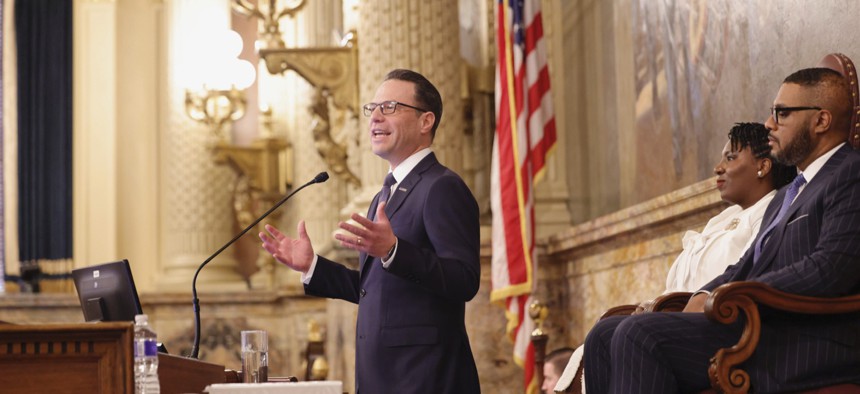
Gov. Josh Shapiro delivers his fourth budget address to members of the General Assembly. Commonwealth Media Services

Gov. Josh Shapiro pitched his fourth executive budget proposal to state lawmakers on Tuesday: a $53.3 billion spending plan that calls for continued funding for education and law enforcement, new reforms on issues like housing and data center development, and renewed calls for recurring revenue sources such as recreational marijuana and skill gaming machines.
Lawmakers may have only wrapped up the previous year’s $50.09 billion budget in November, but the governor’s speech kicks off the annual budget process once again. Lawmakers will now scrutinize Shapiro’s newest spending plan in a series of budget hearings over the coming months.
Below, City & State takes a look at what you should know about Shapiro’s latest budget proposal for the 2026-27 fiscal year.
Focusing on education, economic development and law enforcement
During an hour-long address to state lawmakers in Harrisburg, Shapiro outlined a $53.3 billion General Fund budget proposal that calls for continued increases in education funding, new and repackaged initiatives to spur infrastructure and economic development, and new revenue sources.
His budget proposes a $50 million increase in Basic Education Funding, bringing the total BEF line item to $8.31 billion, and a $50 million increase in special education funding, bringing that line item to $1.58 billion. It also proposes a $565 million allocation for adequacy and tax equity supplements for public schools.
Shapiro’s budget also calls for $16.2 million to fund four additional Pennsylvania State Police Cadet classes, and $30 million to go toward grants for fire companies.
The proposal also seeks to establish a program called Innovate in PA 2.0, which would provide money for venture funds that invest in early-stage companies in Pennsylvania, and support efforts to grow the life sciences and biotech industries in the state. The program would also support clinical trials for emerging technologies in the life sciences sector and would be funded through the sale of Insurance Premium Tax Credits.
Proposing new revenue sources
Speaking to lawmakers on Tuesday, Shapiro renewed calls to legalize recreational marijuana, regulate and tax skill gaming machines, and raise the minimum wage – all things he said could generate much-needed revenue for the state.
His 2026-27 budget estimates that legalization of recreational marijuana for adult use would generate roughly $200 million in annual sales tax revenue once fully implemented, and that raising the state’s minimum wage from $7.25 to $15 an hour beginning on Jan. 1, 2027 would result in an additional $80 million in annual tax revenue once implemented.
Shapiro also said raising the wage will save the state money – something lawmakers need to consider.
“Let me give you one more reason why we need to do this, because raising the minimum wage to $15 an hour will save this commonwealth $300 million a year on entitlement programs like Medicaid,” he said. “We can put more money in their pockets so they don’t need Medicaid anymore.”
The biggest revenue generator in Shapiro’s budget is his proposal to regulate and tax games of skill in a manner identical to how the state regulates existing Video Gaming Terminals, or VGTs. The budget calls for a 52% tax on gross terminal revenues from skill games, which the administration estimates would generate more than $2 billion annually.
More money for mass transit
Last year, a debate over mass transit funding derailed budget negotiations; this year, Shapiro is revisiting his call to increase the amount of Sales and Use Tax revenue designated for mass transit.
His budget calls for transferring an additional 1.75% of Sales and Use Tax revenue to the Public Transportation Trust Fund, which would begin on July 1, 2027. That increased transfer would result in more than $300 million in annual funding for local transit agencies, according to the administration.
Calling for a slate of housing reforms
Housing was a major focus of Shapiro’s budget speech, with the Democratic governor touting a new initiative called the Pennsylvania Program for Critical Infrastructure Investment that he said could help spur the development of new housing and other infrastructure projects. That program would be funded through the sale of general obligation bonds, with the proceeds placed in the state’s Capital Facilities Fund.
He also asked the General Assembly to pass a raft of reforms to the state’s housing laws, including legislation that would set a statewide cap on rental application fees, allow tenants to terminate a lease due to domestic violence, and seal eviction records for people who haven’t actually been evicted, among other changes.
AI protections and data center standards
Throughout his first term, Shapiro has celebrated new data center development slated for Pennsylvania as a result of the rapidly growing AI economy. He said Tuesday that the state needs to be selective about which projects get built, and announced new data center development standards.
“I know Pennsylvanians have real concerns about these data centers and the impact they could have on our communities, our utility bills, and our environment. And so do I,” Shapiro said. “So today, I’m announcing GRID – the Governor’s Responsible Infrastructure Development standards – developed by my administration, in consultation with the community, to hold data center developers accountable to strict standards if they want our full support.”
According to Shapiro administration officials, the GRID standards that the administration will follow are centered on four main principles that developers must adhere to:
- Bringing their own power generation to projects
- Committing to strict transparency standards and direct community engagement
- Hiring and training local workers
- Committing to high standards of environmental protection and water protection
“If companies adhere to these principles, they will unlock benefits from the Commonwealth, including speed and certainty in permitting and available tax credits,” Shapiro said, while encouraging lawmakers to codify those principles in state law.
Shapiro also encouraged lawmakers to come together and pass legislation to protect against the risks posed by AI tools and chatbots. He suggested laws that would: require age verification and parental consent to use AI tools; require companies to detect when children mention self-harm or violence against others and notify authorities; require companies to remind users that AI chatbots are not human; and prohibit AI chatbots from producing sexually explicit or violent content featuring children.
Pitching a new Federal Response Fund
The Shapiro administration is proposing a $100 million transfer from the state’s Budget Stabilization Reserve Fund – also known as the Rainy Day Fund – to a new Federal Response Fund designed to mitigate the effects of federal government actions and the potential loss of federal funding.
Citing a pause in Supplemental Nutrition Assistance Program payments resulting from last year’s federal government shutdown, Shapiro administration officials said a Federal Response Fund would provide the state with a flexible pot of money to respond to unexpected circumstances caused by federal decisions and policy changes.
Officials said potential uses for the money could be to backfill lapses in federally funded food programs and to supplement emergency response efforts if the state were to receive less Federal Emergency Management Agency assistance than expected.
During his budget address, Shapiro said the federal government has attempted to withhold funds designated for plugging abandoned wells, improving school infrastructure, providing health care for rural communities, and providing food benefits through SNAP.
“Now is a time when we need to stand up together for our commonwealth – and be prepared should they try to take away more of what is owed to us,” Shapiro said, later adding: “We need to prepare ourselves should they continue to walk away from those commitments.”
Using Rainy Day Fund dollars
In addition to the proposed $100 million transfer for the Federal Response Fund, the governor’s budget proposal includes a $4.5 billion transfer from the Rainy Day Fund to the General Fund for the purpose of balancing the budget.
If the transfer ultimately occurs, the Rainy Day Fund balance would be $3.3 billion at the end of the 2026-27 fiscal year.
When asked by reporters about the proposed transfer of funds from the Rainy Day Fund, Senate Majority Leader Joe Pittman said it’s important that leaders in state government try to stretch existing tax dollars as much as possible before dipping into the Rainy Day Fund.
“Practically speaking, it's going to be a difficult task to not have any conversation about the Rainy Day Fund,” Pittman told reporters. “We do believe before we have a Rainy Day Fund type of conversation, we have to make sure we're again stretching every taxpayer dollar we can and bring the cost of government down as much as possible.”
Democrats praise the plan, while Republicans proceed with caution
Democrats and Republicans alike shared their thoughts on Shapiro’s fourth budget proposal after his speech concluded – and, as you might expect, the governor’s pitch drew a range of responses.
Democrats had high praise for the governor’s budget.
“I'm proud of the governor today because he put forth a budget that works for Pennsylvania, and protects Pennsylvania, and gives the people of Pennsylvania reassurance that regardless of all of the other things that are going on, that this commonwealth, these legislators, these leaders are invested in you and making Pennsylvania and our government work for the people,” said state Rep. Jordan Harris, the majority chairman of the House Appropriations Committee.
“What I saw today was a governor who has taken the time to listen to everyday Pennsylvanians,” he added.
Senate Democratic Leader Jay Costa lauded Shapiro’s critical infrastructure program, and said the program, if enacted, is “going to generate resources to be able to make investments in housing programs – building houses, improving housing stock in this commonwealth, but also taking a look at infrastructure investments along the lines of critical infrastructure that we need.”
Republicans said Shapiro’s themes of tax cuts, energy production and making government more efficient sounded familiar. “What we heard today sounded an awful lot like the agenda that the Senate and House Republicans have advocated for years – slicing through bureaucracy, through red tape, permitting reform, cutting taxes,” said Pittman. “We welcome his embracing of our priorities.”
However, Pittman also said that Shapiro’s proposed budget spends more than the state can handle. “The governor simply wants to spend too much money in this budget, period. Full stop.”
Senate Appropriations Committee Chair Scott Martin said Republicans will continue to prioritize fiscal responsibility and keep the state’s spending in check.
“I will say that this budget is rinse and repeat, and we're going to stand for the same things we've been fighting for along the way, and try to deliver a budget that's fiscally responsible and keep this Commonwealth on a path to growth,” he said.
Let the budget cycle begin
Pennsylvania’s budget is due at the end of the fiscal year on June 30.
The House and Senate Appropriations Committees will soon meet for regular budget hearings to scrutinize and review Shapiro’s budget proposal in more detail. The committees will meet with various state agencies and departments to review their individual budget requests and get a better understanding of their fiscal needs and constraints.
However, before the budget hearings begin in earnest, Shapiro invited the leaders of all four legislative caucuses to meet with him on Wednesday to begin this year’s budget process on a collaborative note.
“We’ve shown what’s possible when we all work together. Even when it takes longer than it should,” he said on Tuesday. “We all recognize it took too long last year – and that had real impacts on Pennsylvanians. But we learned some valuable lessons through that process. We learned that we all need to be at the table, and that we all need to be at the table sooner.”
Pittman, speaking to reporters, said he had previously suggested the idea of meeting earlier in the year to begin budget talks, and said he was glad Shapiro took his advice.
I'm glad the governor took my advice and is engaging much sooner in the process,” he said. “That's what I had suggested we do months ago, and I'm glad that he is following up on that suggestion.”
“At the end of the day, we're going to go through a very complicated and difficult process again, but we're committed to working together to make sure, as the pro tem said, the people of Pennsylvania and their needs are addressed in the budget that's in front of us,” he added.