

Capitol Beat
House passes bill that would enshrine LGBTQ nondiscrimination protections in state law
Tuesday’s vote is the latest attempt to advance LGBTQ nondiscrimination protections in Pennsylvania.
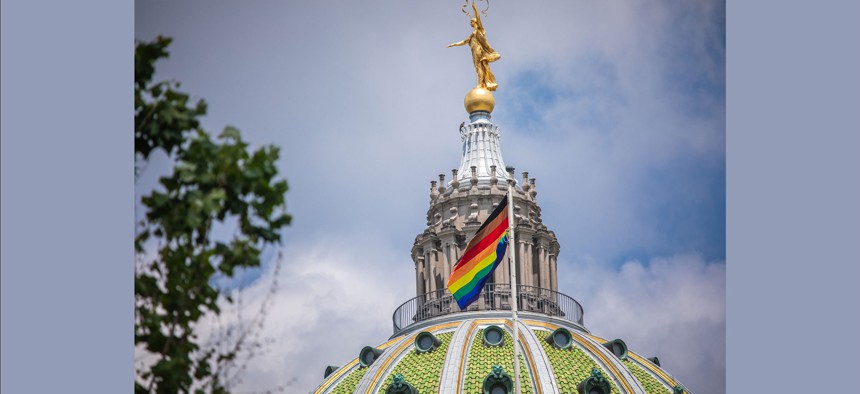
A Pride flag flies at the Pennsylvania Capitol. Wikimedia Commons

Lawmakers in the Pennsylvania House passed legislation on Tuesday that would add the commonwealth to the growing list of states that have enshrined nondiscrimination protections for LGBTQ individuals into state law – a vote that came despite Republican concerns that the bill would jeopardize fairness in women’s sports and infringe upon religious liberties.
The House voted 101-100 on Tuesday to pass House Bill 2103, which would make it unlawful under the state’s Human Relations Act for someone to be denied housing, employment or access to public accommodations based on their sexual orientation or gender identity.
The legislation sparked a contentious debate on the House floor over whether the nondiscrimination protections are written in a way that would allow transgender women to access women’s bathrooms and locker rooms, and that would also infringe upon religious liberties.
Proponents of the bill argued that the legislation is ultimately about fairness and the protection of LGBTQ Pennsylvanians from discrimination.
“Today, at its core, is about fairness – the right to exist as your full self without fear that you’ll lose your job or your apartment,” said Democratic state Rep. Jessica Benham, who said she has experienced discrimination firsthand as a queer woman. “I believe that Pennsylvania is better when it’s fairer, and I know that most Pennsylvanians believe that, too.”
Democratic state Rep. Malcolm Kenyatta, the prime sponsor of the Fairness Act in the state House, said bills seeking to enshrine nondiscrimination protections into state law have been routinely introduced because LGBTQ Pennsylvanians have been experiencing discrimination firsthand.
“If you want to understand why we’ve offered this bill, why it has been offered and reintroduced for 20-plus years, it is because Pennsylvanians are experiencing this discrimination and they want it to end,” he said. “Pennsylvanians are recognizing that they don’t have full access to their God-given inalienable right to be treated with dignity and respect – to have full access to this American Dream.”
According to the Human Rights Campaign, 23 states currently have laws on the books that prohibit housing and employment discrimination based on sexual orientation and gender identity, while 22 states have laws that outlaw discrimination pertaining to public accommodations.
Republican lawmakers feared that the definitions included in the bill are too broad and that they could infringe upon religious beliefs.
Many of the arguments against the bill centered on the definition of public accommodations and whether that definition would extend to bathrooms and locker rooms in schools, as well as to girls’ sports teams. “The definition of gender identity or expression … most definitely means that if you identify as a female, you get to get on a female sports field,” said GOP state Rep. Craig Williams. “If the whole point here is to protect people in special classes, we just denigrated all young women.”
“This bill shifts power away from elected representatives and places it in the hands of judges who will decide over time how far these definitions reach,” state Rep. Charity Grimm Krupa said in remarks on the House floor. “And while that plays out, it will not be large institutions that carry the burden, it will be the small business owners, it will be the faith-based organizations, it will be the individuals, people of faith, forced to choose between their beliefs and the threat of litigation.”
“We’ve heard these arguments before,” noted GOP state Rep. Scott Barger. “They may be subtle, they may be emotional, but we reject them because we know that what you’re really doing is weaponizing degeneracy against our faith communities.”
Benham, in response to Barger, said: “As a queer woman, I know what it’s like to experience discrimination, to be told I’m ‘less than,’ that I’m a degenerate, that I am perverse – and treated like that too … I believe that both the right to be free from discrimination and to practice one’s religion can coexist.”
Democrats noted that the bill includes protections for religious liberty, stating that nothing in the bill shall be interpreted to require an individual or religious entity “to engage in conduct that constitutes a substantial burden on the free exercise of religion.”
Despite passing in previous legislative sessions with bipartisan support, the legislation was approved along party lines on Tuesday, with one Democrat, state Rep. Frank Burns, joining Republicans in opposing the bill.
Prior to being amended with the nondiscrimination language on Monday, the original version of HB 2103 sought to prohibit the development of white nationalist communities and housing developments by not allowing private clubs and members-only organizations to discriminate based on race or other protected classes.
The bill’s prime sponsor, Democratic state Rep. Ben Waxman, said he introduced the bill after an organization called Return to the Land created a “whites only community” in Arkansas, with plans to build additional locations.
Waxman said Tuesday that the amended version of his bill “further protects people all over this Commonwealth.”
“I’m so thrilled that it’s a part of my bill,” he said.