
Philadelphia
Philadelphia City Council passes ‘ICE OUT’ legislation out of committee
Council can get the legislative package across the finish line as early as April 23
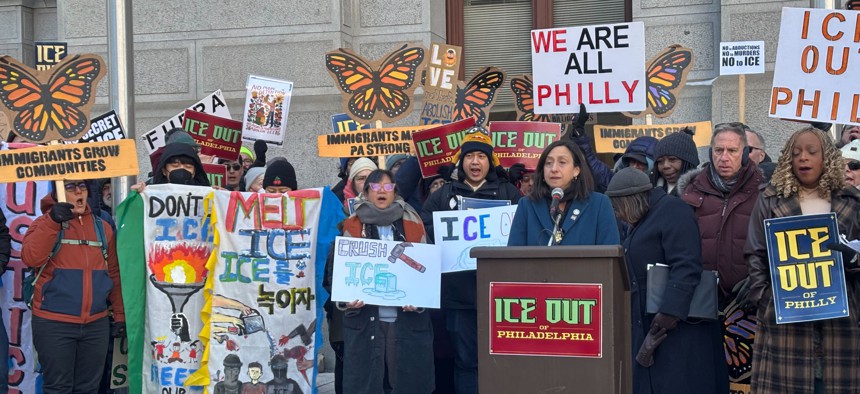
Philadelphia City Councilwoman Rue Landau introduced "ICE OUT" legislation at City Hall. Harrison Cann

Philadelphia City Council’s efforts to restrict federal immigration activities took a step forward Monday.
An energetic crowd packed Council chambers Monday morning for a marathon public hearing on ICE and a legislative package aimed at combatting both ICE’s enforcement in the city and the city’s ability to work with ICE officials.
After a lengthy discussion with members of Mayor Cherelle Parker’s administration, and emotional public testimony, Council gave initial approval to amended versions of the “ICE OUT” legislative package – a seven-bill measure seeking to restrict federal immigration enforcement activities in Philadelphia.
Testimony from the Parker administration, while supportive of the legislative intent, noted that several of the bills present “legally problematic language” – a response that was immediately met by boos from the advocates in attendance. At the same time, the administration assured it is doing everything it can to protect the civil rights of vulnerable residents with city services.
“The Parker administration wholeheartedly supports (legislation to create a new protected class based on immigration or citizenship status), and the Philadelphia Commission on Human Relations stands ready to enforce this legislation,” Charlie Ellison, director of the city’s Office of Immigrant Affairs, testified on Monday, adding that the Parker administration has taken actions that support the intent of the legislative package.
Ellison said that while the Parker administration largely supports the bills’ intent, many contain “legally problematic language” and address situations already covered by existing executive orders and city policies.
An example, he said, is legislation introduced by City Councilmembers at-large Kendra Brooks and Rue Landau that would prohibit the use of publicly owned spaces for certain immigration enforcement actions. Ellison said that the bill’s signage requirements, which would mandate that the city clearly display what immigration enforcement is prohibited at a given site, would present a legal challenge for non-city public properties, such as schools and courts.
“We do not have jurisdiction over these separate governmental entities,” Ellison said.
City Solicitor Renee Garcia shared similar sentiments, noting that there are existing executive orders that address some of the legislative package’s intentions.
Garcia said executive orders from 2009, during the Nutter administration, and 2016, during the Kenney administration, remain in place. Collectively, the measures ensure that people within the city have access to city services regardless of immigration status, and prohibit police from inquiring about immigration status or assisting immigration officials with detainers.
Even a Right-To-Know request “is something pursuant to the executive orders … We do not collect immigration information. We do not disclose immigrant information without the consent,” Garcia said, clarifying the administration’s protocols regarding data collection and sharing.
Another major part of the legislative package, Brooks’ proposed ban on the use of face coverings and unmarked vehicles, and to require ICE agents to display their badge and identifying information, comes with legal questions as well.
“Notably, this bill applies to all officers at the local, state and federal levels, and similar bills are in litigation in other states,” Ellison added.
Background on bills
Earlier this year, Brooks and Landau introduced an “ICE OUT” legislative package seeking to restrict immigration activity in the city.
The legislation includes measures that prohibit ICE agents from using face masks or unmarked vehicles or otherwise concealing their identities; bar ICE activity on City of Philadelphia property, including using public spaces as staging grounds for raids; restrict the agency’s access to Philadelphians’ personal data; and codify existing practices restricting collaboration between ICE and City of Philadelphia employees, including law enforcement.
Another provision bars discrimination based on immigration status, adding specificity to Philadelphia’s existing anti-discrimination laws.
The legislation also pointedly shores up Philadelphia’s status as an immigrant-friendly refuge at a moment when the city appears on a U.S. Department of Justice list of so-called sanctuary jurisdictions that are targets for potential federal defunding – places “identified as having policies, laws, or regulations that impede enforcement of federal immigration laws,” according to the DOJ website.
Other Pennsylvania cities, including Allentown and Reading, have sought to implement similar local restrictions around ICE activity within their boundaries, something Brooks noted.
“Our neighbors in (Bucks, Montgomery and Delaware) counties all passed policies to limit ICE powers. Cities like Reading and Allentown are stepping up across the commonwealth, peer cities like Chicago and New York City are putting in new policies,” Brooks said Monday. “There is no more need for silence or delay. Let’s get this done for our city.”
In a statement to City & State, ICE said Philadelphia will be “less safe as a direct result of these policies.
“When politicians bar local law enforcement from working with us, we must have a more visible presence so we can find and apprehend the criminals let out of jails and back into communities,” an ICE spokesperson said in a statement.
"America’s brave ICE law enforcement put their lives on the line every day to enforce U.S. law and arrest criminal illegal aliens — including gang members, rapists and murderers. The vilification of ICE must stop. This type of rhetoric and fearmongering is contributing to a more than 1,300% increase in assaults against them as they put their lives on the line.”
Mayor Parker’s part in the matter
Parker’s rhetoric around the city and federal immigration enforcement has been ambiguous in the past – a sore spot for many attendees on Monday.
In May 2025, Parker said Philadelphia would shed its longtime designation as a “sanctuary city” – a term without an official definition that has long been understood to imply refuge for immigrants and local non-cooperation with federal immigration authorities. And since last year, Philadelphia has called itself a “welcoming city,” a term that highlights inclusivity rather than legal protection. Part of the “ICE OUT” package is a bill that would codify into law Philadelphia’s status as a sanctuary city.
City Councilmember Jamie Gauthier, representing the 3rd councilmanic district, opened up about what she described as a lack of movement coming from the mayor’s office to better support the city’s immigrant communities.
“I have to be honest, I’ve been very disappointed to not see the administration take a more proactive role in supporting and affirming support for such a critical part of our population,” she said Monday. “I’m proud to be part of a Council that is stepping in the gap and stepping into what has essentially been a vacuum in our city around protecting our immigrant population.”
The package of bills would need to pass out of City Council as a whole before making its way to Parker’s desk. The earliest the bills can go up for final vote would be April 23.
If passed, the legislative package would put Parker in the spotlight and force her to weigh in on the moves by a federal administration she’s largely avoided. The bills would also face legal challenges, which could delay implementation even further.
This story has been updated to include a statement from ICE.
NEXT STORY: Poll: Pennsylvanians across party lines support a regulated cannabis marketplace