

sponsor content What's this?
Sponsored Content
We can deliver electrons to the grid and savings to consumers now
The president and chief legal officer of Solar Landscape explains how commercial rooftop solar can bring energy prices down for Pennsylvanians
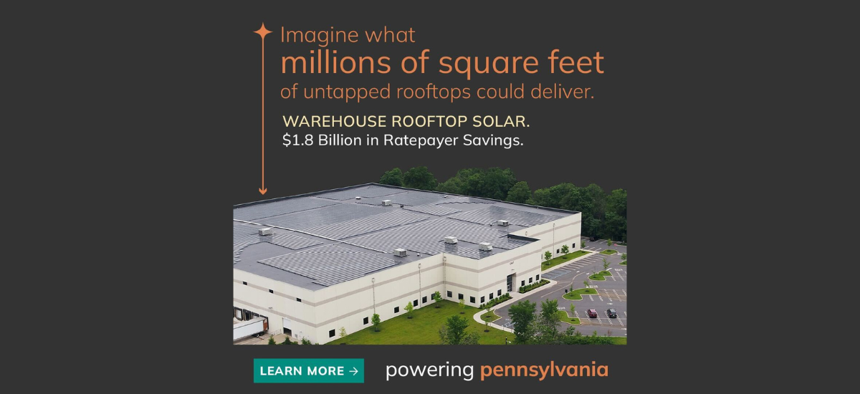

We can deliver electrons to the grid and savings to consumers now.
Every Pennsylvanian agrees that their energy costs are too high. Conflicts overseas, growing industry demand, and a lack of prior investment in capacity have left the grid stretched and prices skyrocketing. Everyone from the state officials to your local business leader agrees that we need more electrons on the grid, and we need them now.
Thus far, there has largely been an untapped potential for energy right above the heads of every warehouse technician, storage facility user, and grocery store customer: commercial rooftop solar. Commercial rooftop solar is one of the quickest ways to bring new power onto the grid, as it does not have to use any green space and it’s able to quickly connect to the grid. Unlike other forms of power generation, it connects at the distribution level, so it does not need to wait years for large-scale transmission upgrades to bring energy to the market. We can deliver electrons to the grid – and savings to consumers – now.
Those savings are real: The Brattle Group, an energy research company, found in an independent study that expanding commercial rooftop solar in Pennsylvania could save ratepayers up to $1.8 billion over the next five years. That would meaningfully lower energy bills for families and businesses while also supporting thousands of good-paying jobs across the state.
But at the exact moment when Pennsylvania needs more energy supply, a recent court decision has effectively halted progress.
As energy demand rises and supply tightens, this ruling has disrupted many Pennsylvanians' ability to affordably generate their own electricity through net metering. The consequences have been immediate and severe. At least 3 gigawatts of planned energy development – enough to power nearly a million homes – have now evaporated. That represents billions of dollars in lost private investment, along with fewer options for consumers who are already grappling with rising costs.
Most people do not care about the legal arguments or regulatory frameworks that got us here; they just want energy they can afford. More power in the marketplace now creates downward pressure on prices and gives families and businesses the ability to manage their energy costs.
Pennsylvania is moving in the wrong direction, and the path forward is clear. We need to stabilize the market quickly and prevent the reliability challenges that we have seen in other parts of the country, both to ensure that we remain competitive as the manufacturing and innovation hub of the nation and to keep families safe from dangerous brownouts. That means acting with urgency to undo the immediate damage caused by the court decision, while also taking a thoughtful look at long-term market design.
This is why the legislation introduced by Pennsylvania House Energy Committee Chair Elizabeth Fielder is so important. Her bill recognizes that the current trajectory is unsustainable and takes meaningful steps to restore balance to Pennsylvania’s energy market. Just as importantly, it sends a clear signal that the Commonwealth is open to investment and supports the competition necessary to lower consumer costs.
Pennsylvania has an opportunity right now to move in the right direction. Expanding access to commercial rooftop solar means more power on the grid, more jobs in local communities, and lower electricity bills for consumers. It also strengthens the state’s competitiveness at a time when businesses are looking for reliable, affordable energy. And it keeps the electricity generated in Pennsylvania within Pennsylvania, rather than exporting it to other states.
Anything that stands in the way of rapidly getting low-cost energy onto the grid is a risk to consumers, our economy, and our future.
We are ready to invest in Pennsylvania. We are ready to deliver gigawatts of new energy and create thousands of good-paying jobs. Now, we need the policy environment to make that possible.
Learn more here.
Mark Schottinger is the president and chief legal officer of Solar Landscape.
NEXT STORY: Playing To Win: Pennsylvania's Broadband, AI and Emerging Technology Future