
Capitol Beat
Advocates say skill game revenue could be lifeline for aging Pennsylvanians
Lawmakers continue to debate whether to regulate and tax games of skill.
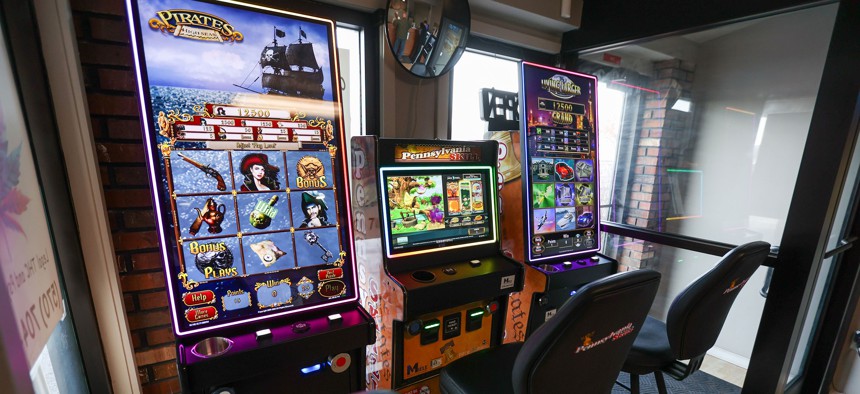
Lawmakers say taxing skill game machines could generate millions of dollars in annual revenue for the state. Jason Ardan/The Citizens' Voice via Getty Images

The debate over taxing and regulating skill game machines is receiving renewed attention in Harrisburg, this time from lawmakers and advocates who believe that revenue from the unregulated gaming machines could help fund services for older adults.
And with the commonwealth anticipating rapid growth in the number of residents over the age of 60, coupled with existing financial constraints experienced by local agencies that support older Pennsylvanians, there’s a growing push in Harrisburg to tax the games and use the funds to bolster support for the state’s aging residents.
“Pennsylvania is really at a crossroads,” said Rebecca May-Cole, the executive director of the Pennsylvania Association of Area Agencies on Aging, who argued that skill games have drawn money away from the Pennsylvania Lottery, which funds programs for older adults.
“These essential programs are really in jeopardy,” May-Cole said at a news conference this week, noting that 1 in 3 Pennsylvanians will be over the age of 60 by 2030. “We need to make sure that we are able to provide services to our older adults so that they don't face the brunt of these funding shortfalls that are being caused by the skill games.”
May-Cole’s organization represents the 52 Area Agencies on Aging in the commonwealth, which connect older adults with legal services, meals, health information, transportation, senior centers and in-home services. She said directing skill game revenue to the state’s Lottery Fund would help Area Agencies on Aging reduce wait lists and prevent senior centers from closing or reducing hours.
But before Pennsylvania can use any potential revenue generated from a tax on skill game machines, state lawmakers will have to reach agreement on a regulatory framework.
What are skill games?
Over the last several legislative sessions, lawmakers in the Pennsylvania General Assembly have introduced numerous proposals to tax and regulate gaming machines, which resemble video slot machines but differ in that winnings are based on a player’s skill rather than chance.
Because of that distinction, courts in Pennsylvania have determined that skill games fall outside of the state’s Gaming Act, and are thus not subject to the same regulations and taxes as slot machines.
In his 2026 executive budget proposal, Gov. Josh Shapiro proposed a 52% tax on gross terminal revenues from skill games, which his administration estimates would generate more than $2 billion annually.
Democratic state Rep. Maureen Madden, who chairs the House Aging & Older Adult Services Committee, said the 52% figure may be too high and that lawmakers will likely have to compromise on a final tax rate.
“I think we need to come to a number that everybody can live with so we can start seeing this revenue,” she said.
The Shapiro administration estimates that there are as many as 70,000 skill game machines across the state. The machines have become a common sight at convenience stores, bars and fraternal clubs, among other locations.
Pace-O-Matic, the developer behind the Pennsylvania Skill brand of skill machines, supports legislative efforts to tax and regulate the gaming machines. A spokesperson for the company said in a statement that the company agrees that programs for aging Pennsylvanians need a consistent source of financial support, though the ultimate use of tax revenue generated from skill games is up to state lawmakers.
“We absolutely agree that programs serving older adults deserve reliable funding and support,” Mike Barley, the chief of public affairs for Pace-O-Matic, said in a statement. “We have consistently supported legislation that would regulate and fairly tax skill games, creating hundreds of millions of dollars in new annual revenue for the Commonwealth.”
May-Cole said the state’s Lottery Fund has taken a $170 million hit due to skill games, and said at least $170 million from skill game tax revenue should be directed back into the fund.
However, Pace-O-Matic pushed back against characterizations that skill games are to blame for the financial constraints faced by Area Agencies on Aging, citing March 2026 financial data showing the Pennsylvania Lottery’s traditional game sales increased by approximately 4% over the previous year.
“The financial pressures facing Area Agencies on Aging are real, and they are being driven by changes to federal funding, rising costs, and a rapidly growing senior population,” Barley added.
What comes next?
Pennsylvania’s Independent Fiscal Office estimates that the number of Pennsylvanians between the ages of 65 and 79 increased by 13.5% from 2020 to 2025, and will grow by an additional 3.8% by 2030. Meanwhile, the number of Pennsylvanians aged 80 and above is expected to grow by 22.4% between 2025 and 2030 and by another 18.2% by 2035.
With a looming demographic shift, lawmakers and advocates alike say older Pennsylvanians need to remain a priority at the state Capitol.
“We must ensure that the state budget our legislature is working on now addresses key concerns like affordability, safe and accessible housing, reliable transportation, and other resources that enable older and disabled Pennsylvanians to remain safe in their homes and in their communities,” said state Sen. Maria Collett, the Democratic chair of the Senate Aging & Youth Committee.
Regardless of the rate lawmakers set for taxing skill games, Madden said more funding for Area Agencies on Aging is essential.
“The increasing demand for services, for operational costs, workforce shortages – the strain placed on providers and caregivers alike is dire right now,” she said. “The only thing that’s going to fix that is money, because we’re done being able to do more with less.”
Barley noted that the skill game industry has been pushing lawmakers to pass a regulatory framework for skill games for over a decade.
And as the state’s June 30 budget deadline nears, that push continues, he said.
“We remain committed to working with lawmakers from both parties to pass legislation that protects small businesses, supports fraternal and veterans’ organizations, and creates substantial new revenue for important Pennsylvania programs,” said Barley.