

Energy
Burgum, Perry tout importance of nuclear energy in visit to Three Mile Island
The U.S. Secretary of the Interior said the Trump administration’s policies have led to a “renaissance” for nuclear energy.
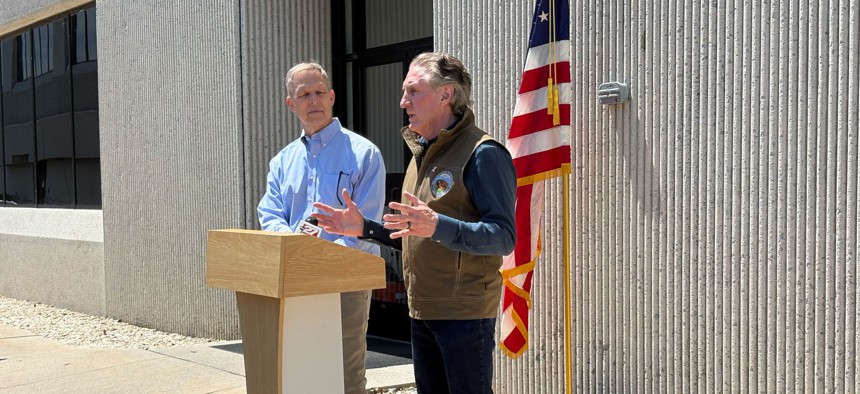
U.S. Interior Secretary Doug Burgum and U.S. Rep. Scott Perry tour the Crane Clean Energy Center in Middletown on Friday, May 1. Justin Sweitzer

Two high-profile Republicans visited the rebranded Three Mile Island nuclear power plant in Middletown on Friday, where they touted the Trump administration’s energy agenda and emphasized the importance of nuclear energy amid growing electricity demand driven by rapid advances in artificial intelligence.
U.S. Secretary of the Interior Doug Burgum joined U.S. Rep. Scott Perry for a tour of the Crane Clean Energy Center ahead of the highly anticipated relaunch of Three Mile Island Unit 1, a move Burgum said would help make the nation’s energy grid infrastructure more reliable and make electricity more affordable.
“This is an example of the private sector taking steps to make investments to help make our grid more reliable, make our power more affordable – to make our country and Pennsylvania more competitive. It’s exciting to see what’s going on,” Burgum said.
TMI Unit 1 is operated and owned separately from TMI Unit 2, the reactor that experienced a partial nuclear meltdown in March 1979. The Unit 1 reactor shut down in 2019, but could reopen as soon as 2027 under a power purchase agreement between Constellation, the reactor's owner, and Microsoft, which has sought carbon-free energy sources to offset the electricity use of its data centers.
Constellation is spending $1.6 billion to bring the retired reactor back online to add 835 megawatts of baseload power to the grid. Once fully operational, the Crane Clean Energy Center is expected to employ more than 600 full-time workers. The revival has earned the support of elected officials across the political spectrum, regional business organizations and organized labor groups.
The U.S. Department of Energy announced last November that it would back the Crane Clean Energy Center with a $1 billion loan and partially finance the reactor's restart.
Perry, in remarks to the press following a tour of the Crane Clean Energy Center, said it’s important that the state establish a more collaborative relationship with PJM Interconnection, the regional transmission operator that serves Pennsylvania, 12 other states and Washington, D.C. He also advocated for permitting and regulatory reforms, which he said would encourage more investments in nuclear energy.
“We need to open it up so that the private sector can do its job,” Perry said. “I think Crane provides that example about what can be done, when the capability exists, when the government gets out of the way.”
Burgum agreed, arguing that domestic energy regulations have “strangled the nuclear industry” and that costly regulatory burdens contributed to TMI Unit 1’s 2019 retirement.
“A lot of those costs were driven by what I call strangulation by regulation,” Burgum said. He praised President Donald Trump for signing a set of executive orders in May 2025 to promote nuclear energy production, reform nuclear reactor testing, reform the Nuclear Regulatory Commission and its regulations, and deploy advanced nuclear energy technology like small modular reactors.
Burgum said public-sector efforts to help the nuclear industry flourish will fuel a nuclear energy renaissance in Pennsylvania and across the country – and that the Crane Clean Energy Center can serve as a blueprint for other projects.
“This is gonna be coming back online and it’s great for the community, great for jobs, great for the grid, great for Pennsylvania,” he said. “I think it can be an example for the rest of the country in terms of this renaissance for nuclear.”