

data centers
Gov. Josh Shapiro’s new data center standards reflect new reality
The announcement underscores the year-long evolution in the governor’s approach to what has become an energy and environmental flashpoint in Pennsylvania.
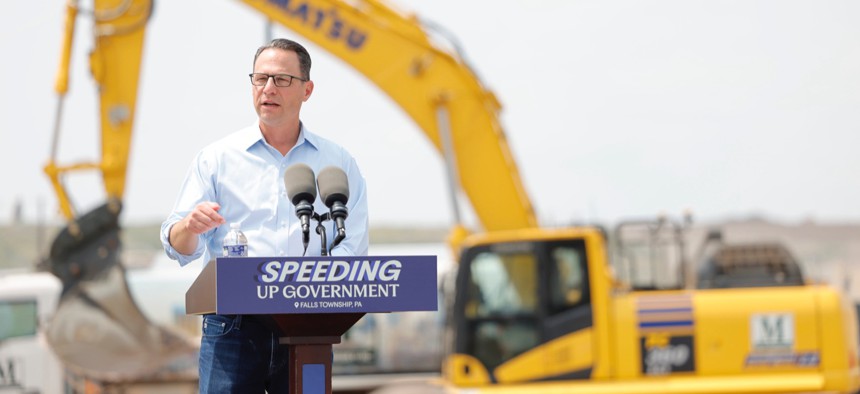
Gov. Josh Shapiro speaks at the site of a future Amazon data center in Bucks County. Commonwealth Media Services

Data centers are among the hottest topics of the summer – and many officials want Pennsylvania to be at the forefront of future developments.
On Wednesday, Gov. Josh Shapiro unveiled a list of standards for potential data center developers, aiming to create guardrails for an industry whose energy needs have quickly outpaced public sentiment.
On the topic of data centers and artificial intelligence development, Shapiro has gone from being Pennsylvania’s head cheerleader to a cautiously optimistic fan – a change that coincides with public concerns about the environmental and energy impacts of such infrastructure and the level to which public investment should contribute to these projects.
The newly released standards drew a mix of praise and concerns. Katie Blume, the chair of the Clean Power PA Coalition, a group made up of energy, environmental and business stakeholders, said the standards are “an important step toward ensuring data center growth in Pennsylvania happens responsibly.” However, the Data Center Coalition, an industry group advocating for data center developers, said it has “strong concerns” that the standards will create a “complicated framework that would present significant challenges for future development and operation of data centers in the commonwealth.”
The latest standards and statements show Shapiro’s rapidly evolving embrace of the industry over the past year – and the potential economic gains for Pennsylvania – while taking a measured approach to address community concerns.
Here’s a look at Shapiro’s timeline of takes on data center development:
June 2025: Shapiro and Amazon announce $20 billion data center investment
On June 9, 2025, Shapiro joined leaders from Amazon to announce a $20 billion investment to build two data center campuses in the commonwealth – the largest private-sector investment in state history. Shapiro said the investment would “power our global economy and the future of artificial intelligence” – and proclaimed that Pennsylvania was “all in on AI.”
“We are already all in on AI,” Shapiro said. “Here in Pennsylvania, we have the energy resources to support this technology. We’ve got the brains to be able to drive innovation forward. We have the workforce ready to build and maintain these critical data centers. We’ve got elected leaders from every single level ready to roll up their sleeves and continue to work together for the common good – for our commonwealth. This is what a united front looks like to win the battle of AI supremacy.”
July 2025: Shapiro joins Sen. Dave McCormick’s energy and AI-focused summit
The Democratic governor and Republican officials seemed to be in lockstep on making Pennsylvania an AI powerhouse during a summit hosted by McCormick.
Both Shapiro and McCormick touched on the importance that Pennsylvania’s workforce, educational institutions and energy assets could play in the AI economy.
“I think this deal with Amazon is an indicator of all that we can be … we have government and the private sector working together, not at odds, and we pull in our educational institutions in a way that really helps move Pennsylvania forward,” Shapiro said during the day’s third panel.
February 2026: Shapiro outlines GRID standards for data center developers
During his 2026 budget address, Shapiro once again showed support for leading the way in data center and AI development, while outlining a set of “responsible development” guidelines that he said would “hold data center developers accountable to strict standards if they want our full support.”
These guidelines, known as the Governor’s Responsible Infrastructure Development (GRID) standards, include requiring data center developers to:
- Bring their own power generation to projects
- Commit to strict transparency standards and direct community engagement
- Hire and train local workers
- Commit to high standards of environmental protection and water protection
“If companies adhere to these principles, they will unlock benefits from the Commonwealth, including speed and certainty in permitting and available tax credits,” Shapiro said during his budget address.
Shapiro also acknowledged that while data centers have the potential to bring new jobs and new tax revenue to the state, Pennsylvania residents “have real concerns about these data centers and the impact they could have on our communities, our utility bills, and our environment.”
Lawmakers on both sides of the aisle expressed interest in Shapiro’s GRID standards. “The notion that data centers should bring their own supply to the market seems to make a lot of sense,” Senate Majority Leader Joe Pittman said in February.
May 2026: Shapiro unveils full GRID standards
Shapiro unveiled his full GRID standards on Wednesday, calling for regulations to establish “clear guardrails to hold data centers developers accountable while still supporting responsible growth of AI and technology infrastructure in Pennsylvania.”
The GRID standards include protections for energy affordability and ratepayers, transparency and community engagement, workforce development initiatives and environmental protection and sustainability measures.
Under the standards, developers must build, bring or buy the electric capacity needed to meet data center energy demands, and they would be required to develop a community outreach plan designed to inform community stakeholders about data center projects.
Shapiro’s office said it’s also proposing legislation that would, in an effort to create additional enforcement, tie eligibility for state tax benefits to GRID certification, meaning businesses would have to meet the aforementioned guidelines in order to receive additional public dollars.
“If companies want the Commonwealth’s full support – they must meet strong standards on energy affordability, clean energy generation, transparency, workforce development, community impact, and environmental protection,” Shapiro said in a statement Wednesday. “This is about setting a higher bar for projects and ensuring development happens responsibly and in a way that benefits Pennsylvanians.”