
Philadelphia
Philly Council rejects Mayor Parker’s tax proposals, gives initial approval to $7.1B budget
Parker wanted to increase taxes on rideshare, retail delivery and short-term rentals, but failed to receive Council approval
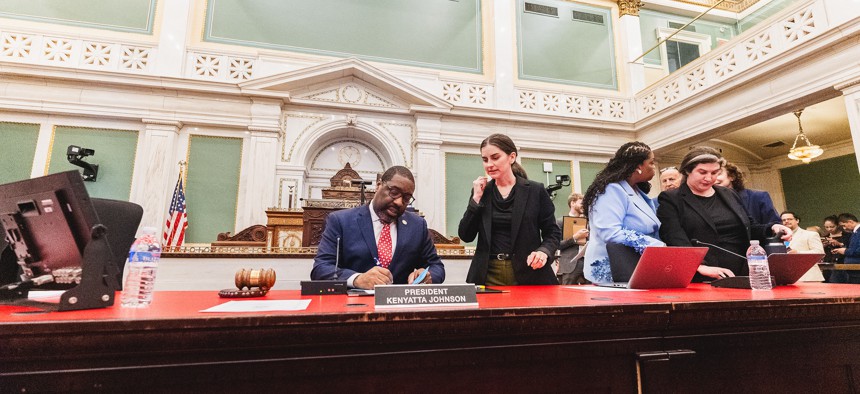
Philadelphia City Council President Kenyatta Johnson, seated, during the Committee of the Whole on June 4, 2026. Chris Mansfield | PHL City Council

A Philadelphia budget back-and-forth featuring last-minute negotiations between Mayor Cherelle Parker and City Council concluded Thursday when the legislative body gave initial approval to a more than $7.1 billion budget.
Parker’s proposed taxes on rideshare apps, retail delivery services and short-term rentals – all three targeting the gig economy and Big Tech companies – were rejected after weeks of debate among lawmakers in City Hall.
A major sticking point in negotiations, the $1-per-ride tax on rideshare services like Uber and Lyft, intended to generate nearly $50 million a year for the School District of Philadelphia, failed to garner enough support. Members of the Philadelphia Federation of Teachers union were hopeful that those funds would prevent the school district, which faces a $300 million budget deficit, from closing 17 schools and moving 340 teachers and support staff to new schools.
“(We did) the best we could with what we had with this budget,” Parker said in a press conference on Thursday, adding that she would be “coming back to make sure these billion-dollar, big tech companies are forced to pay their fair share.”
With both Councilmembers and industry representatives questioning the hotel and delivery taxes, in addition to reports that Harrisburg lawmakers wouldn’t agree to any tax hike, Parker’s proposals to tax hotels and deliveries were tabled and not included as part of Thursday’s agreement.
Councilmembers, who’ve shown a willingness to find alternative funding sources for the school district, had become increasingly frustrated with school district leadership during budget hearings, citing concerns about transparency, community input and the potential impact of a facilities plan that includes 17 school closures approved April 30 after public protest. Council will instead amend the city budget to identify additional savings across various departments to support the school district.
“We heard loud and clear from Philadelphians that raising taxes is not an option right now. Residents are concerned about the cost of living and with good reason. Many Philadelphians are struggling financially, and, as a body, we could not in good conscience move forward with the proposed taxes,” City Council Majority Leader Katherine Gilmore Richardson said in a statement. “At the same time, we recognize we must address the deep, systemic and long-standing issues with the School District of Philadelphia and its structural deficit.”
Parker admitted that the tech companies “won Round 1” in the funding negotiations, but the battle won’t end Thursday. She also assured that her administration and City Council are “not at war over public education” but that there continues to be a “disagreement here about who should pay,” said Parker, who added that she is awaiting a “second round” of negotiations.
On top of the school district’s financial woes, Council’s disagreements over short-term rentals, such as those offered by Airbnb, put the proposed funding for Parker’s housing and homelessness initiatives in jeopardy.
“My North Star throughout this budget process was making sure Philadelphia students did not bear the cost of a growing school funding crisis, while considering many options for short- and long-term revenue generation,” at-large City Councilmember Rue Landau said in a statement. “The underlying challenges facing our schools remain, and we must continue pursuing sustainable, recurring revenue sources to ensure students are not back in the same position next year.”
The $7.1 billion budget is an increase from Parker’s roughly $6.9 billion budget proposal and includes new taxes on cell phone towers – one win for the mayor.
Under Council rules – where legislation must be read twice and passed out of the Committee of the Whole before getting final approval by Council – Thursday was the deadline for taxing and spending legislation for the fiscal year beginning July 1 to receive committee approval.