

Technology
What the Flock? 8 things to know about automated license plate readers in Pennsylvania
ALPRs have drawn scrutiny from lawmakers and civil liberties groups, while proponents tout them as an important law enforcement tool.
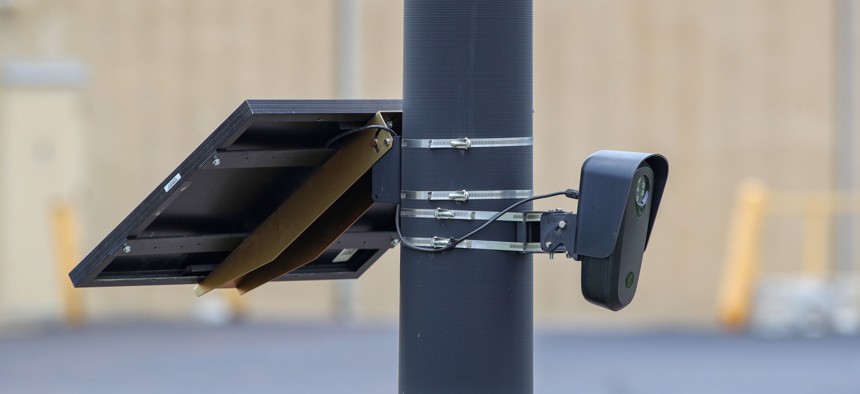
A Flock Safety camera is seen at the Buckhorn Plaza shopping center near Bloomsburg, Pennsylvania. Paul Weaver/SOPA Images/LightRocket via Getty Images

Automated license plate readers may soon rival data centers as the rage-inducing boogeyman created by Big Tech. The AI-assisted cameras, also known as ALPRs, have drawn scrutiny from lawmakers and civil liberties groups alike who fear that the data collected by ALPRs – and fed into a national database used by law enforcement – present privacy concerns.
Public concerns stem from law enforcement’s ability to capture a vehicle’s license plate, make, model, color, bumper stickers, dents, exact location, and timestamp.
One lawmaker who has led the charge against ALPRs and Flock Safety – one of the chief manufacturers of the automated license plate readers – is U.S. Rep. Scott Perry, who wrote in a recent Facebook post that Flock’s vehicle scans amount to “mass collection and surveillance – not safety.”
Below, City & State examines eight major things to know about Flock cameras and ALPRs.
- Flock Safety says more than 5,000 law enforcement agencies and 6,000 communities use its automated license plate readers, which document license plate numbers and vehicle information and provide access to a national network of data collected by ALPRs. The company estimates that roughly 10% of reported crimes in the U.S. are solved using Flock technology, amounting to more than 700,000 crimes each year.
- There are roughly 1,752 ALPRs in Pennsylvania and the surrounding areas, according to DeFlock, an open-source project and crowdsourced database that maps the location of ALPRs, particularly Flock surveillance cameras. Of those, 59% are Flock Safety cameras, largely grouped in urban and suburban areas around cities like Allentown, Harrisburg, Philadelphia and Pittsburgh.
- Currently, the Pennsylvania Department of Transportation only allows ALPRs to be used on non-PennDOT structures, and the installation of new structures for deployment of ALPRs is not permitted.
- Last year, there were a couple pieces of legislation in Harrisburg targeting the use of ALPRs, though none saw any movement. Former state Rep. Josh Siegel introduced legislation to direct PennDOT to establish a permitting process for ALPR technology, while state Rep. Nate Davidson sought to restrict the use for healthcare purposes, introducing a bill to prohibit law enforcement agencies from sharing ALPR information for the purpose of investigating or enforcing a law that denies or interferes with a person’s right to obtain healthcare services.
- Organizations that oppose ALPRs estimate that Flock Safety operates more than 80,000 AI-assisted cameras across 49 states, according to a letter signed by the American Civil Liberties Union and a host of other organizations. “These cameras photograph every vehicle that passes, regardless of any suspicion of wrongdoing. All the data collected – license plate data, vehicle descriptions, location, and time – are stored, and a majority of that data is in a centralized, searchable national database that is accessible to law enforcement on demand without court approval,” the letter reads.
- Americans for Prosperity Senior Regulations Policy Analyst Molly Powell wrote in a policy brief that ALPRs present privacy concerns: “Anyone with access to an ALPR system knows who visits churches, mosques, gun ranges, abortion clinics, pro-life advocacy organizations, divorce lawyers, addiction treatment centers, or health care specialists.
- The cameras have earned the ire of U.S. Reps. Scott Perry and Chuy García, who sponsored a bipartisan amendment to a federal highway bill that would have banned recipients of federal highway dollars from using ALPRs “for any purpose other than tolling.” The amendment ultimately did not survive the House committee markup process.
- Flock has pushed back on claims that its cameras track Americans. Josh Thomas, the company’s chief communications officer, said in a video that its ALPRs only obtain license plate numbers and public information about the vehicle. “There’s a common misconception that Flock tracks you wherever you go – and that’s just not the case,” Thomas said. “The reality is that Flock LPRs will take a picture in a single point in time from a single location, and the only information that’s there is the back of the car – the public information that you would see with your own eyeballs.”