

News & Politics
City & State’s 2025 Year In Review
A look back at the year that was – and wasn’t – in politics.
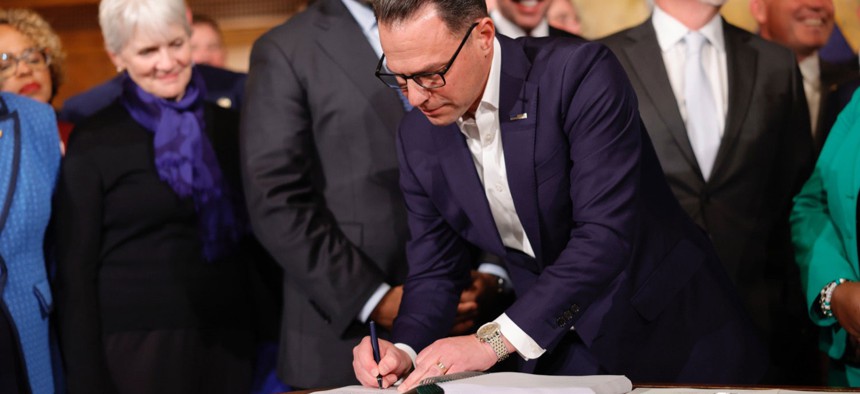
Gov. Josh Shapiro signed the 2025-26 state budget into law on Nov. 12, 2025. Commonwealth Media Services

As a purple state in an increasingly divided nation, Pennsylvania spends plenty of time in the national spotlight – and this year has been no exception.
The commonwealth’s three retention elections for seats on the state Supreme Court were watched closely as a bellwether for how voters would react to the first year of President Donald Trump’s second term in office. The state’s four-and-a-half-month budget impasse overlapped with the nation’s longest-ever federal government shutdown, leaving many Pennsylvanians concerned about how political gridlock would impact their day-to-day lives. And in a year when the U.S. was marred by political violence, the commonwealth narrowly avoided tragedy when an arsonist lit the Governor's Residence on fire in a failed attempt to kill Gov. Josh Shapiro and his family.
As 2025 comes to a close, City & State recaps the year in Pennsylvania politics, examining what transpired and which agenda items remain outstanding heading into 2026.
Budget Brouhaha
In a year that produced an endless amount of headlines, lawmakers at both the state and federal levels struggled to produce on-time budgets – and Pennsylvanians felt the consequences.
At the state level, Pennsylvania blew through the state’s June 30 budget deadline, resulting in a 135-day budget impasse that had school districts, county governments, rape crisis centers and other entities sounding the alarm as state payments went delayed. In Washington, D.C., a federal government shutdown – the longest in the nation’s history – disrupted food assistance programs and air travel.
The federal shutdown ultimately lasted for 43 days, while the state budget impasse stretched past four months.
Lawmakers and Gov. Josh Shapiro ultimately reached agreement on a $50.1 billion budget package that sent more money to public school districts, created a new tax credit for working-class Pennsylvanians and reformed how cyber charter schools in the state are funded. As part of the negotiated budget, Shapiro agreed to withdraw the commonwealth from the Regional Greenhouse Gas Initiative – a regional pact aimed at limiting carbon emissions from the power sector that drew criticism from Republican lawmakers and labor unions.
Shapiro framed the agreement as a bipartisan win for all parties involved. “I said at the outset of this process … to pass a budget, everyone was going to have to give a little and understand the perspectives of others a little bit better,” he said during the November press conference where he signed the budget into law. “We did that here and, as a result of our collective work, the good people of Pennsylvania are better off.”
“This is a balanced budget that cuts taxes, that makes critical investments, that protects 100% of Pennsylvania’s Rainy Day Fund – and still leaves us with $8 billion in reserves.”
State Senate President Pro Tempore Kim Ward echoed Shapiro’s sentiments on having to compromise given the political dynamics in the General Assembly.
“This budget is a direct result of a divided government. We had two different approaches and two different ways of governing. So there is something … called compromise. We on the Republican side had to compromise on spending much more than we would have preferred,” she said in remarks on the Senate floor in November. “We were able to, working with our colleagues across the aisle, get some great policy that will put Pennsylvania in the driver’s seat when it comes to economic growth.”
Transportation Situation
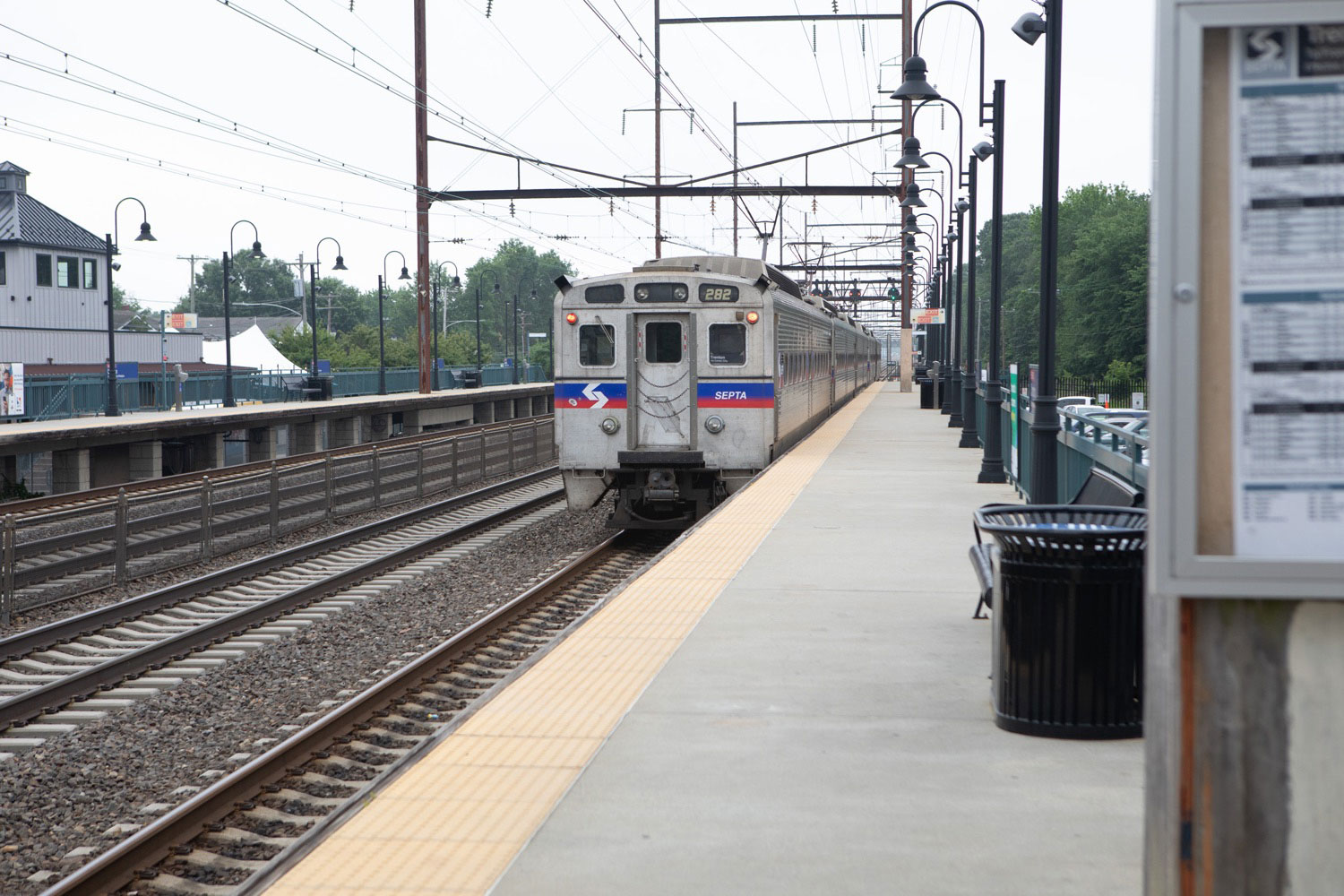
A key point of disagreement in this year’s state budget negotiations was how to balance funding for mass transit with other transportation infrastructure needs. Adding fuel to an already combustible issue was the fact that the Southeastern Pennsylvania Transportation Authority, more commonly known as SEPTA, has been grappling with a $213 million budget shortfall that had the system – and the riders in the greater Philadelphia area that it serves – bracing for fare increases and severe service cuts.
For months, SEPTA General Manager Scott Sauer requested that state legislators find a long-term funding solution for the agency, warning that service cuts were looming on the horizon.
In his 2025-26 executive budget proposal, Shapiro proposed a 1.75% increase in funding for transit systems statewide, bringing in nearly $300 million, including an additional $161 million for SEPTA. Throughout state budget negotiations, Senate Republicans pushed for any mass transit funding solution to also include funding for road and bridge repairs.
Without a state budget (and an accompanying funding solution) in place, SEPTA began implementing service cuts in late August. The agency ultimately received a short-term reprieve when the Pennsylvania Department of Transportation approved SEPTA's request to use up to $394 million in capital assistance funds to fund daily operations over the next two years.
The Shapiro administration, which approved the funds, said the agreement is contingent on no major capital projects being delayed.
Shapiro said in November that while transit funding wasn’t addressed in this year’s state budget, it remains a priority for both his administration and Democratic state lawmakers.
“We’re going to continue to work on transit and other priorities that aren’t in this budget. I know we all had to accept compromise. Transit remains a critically important priority for me and each and every member who's standing up here,” he said.
SEPTA’s woes have caught the eye of federal officials, too. Shapiro and federal officials have gone back and forth over a series of fires that took place on the agency’s fleet of Silverliner IV railcars, with U.S. Secretary of Transportation Sean P. Duffy and the National Transportation Safety Board issuing a warning to SEPTA in October to take immediate action to address fire risks and its aging fleet of regional rail cars.
A month later, Shapiro directed $219.9 million in additional capital funding to SEPTA to address the fleet safety issues and restore full Regional Rail service. But even with the boost in funds, SEPTA ran into a supply chain issue before the end of the year, preventing the agency from meeting the latest federally mandated deadline to repair its aging fleet. The agency now awaits a crucial component of the repair work to get back on track.
Political Violence Persists
In 2024, Pennsylvania was home to one of the most shocking instances of political violence in recent memory when a gunman attempted to kill then-candidate Donald Trump during a campaign rally in Butler. Trump survived after a bullet grazed his ear; another rallygoer, firefighter Corey Comperatore, was killed. The incident, unfortunately, served as a prelude to more political violence that would occur in 2025 – in Pennsylvania and beyond.
Top of mind for most Americans in 2025 is the assassination of conservative political activist and Turning Point USA founder Charlie Kirk, who was murdered during an event at Utah Valley University. Kirk’s murder sent shockwaves through the nation and once again cast a spotlight on political violence in the United States.
In the year following the Butler assassination attempt against Trump, Pennsylvania has seen additional cases of political violence. Chief among them was an arson attack at the Pennsylvania Governor’s Residence on April 13, which saw the arsonist, Cody A. Balmer, scale a fence, break into the residence with a hammer and set fire to the building using homemade Molotov cocktails.
Balmer fled the scene and later turned himself in, telling police that he would have beaten Shapiro with his hammer if he had encountered the governor inside the residence. Balmer pleaded guilty in October to charges of arson, terrorism and attempted murder – a result that the governor said is a “just outcome.”
“It’s hard for me to stand before you today and utter the words ‘attempted murder’ when it’s your own life – to know that someone tried to kill me,” Shapiro said following Balmer’s plea. “It’s especially hard to know that he tried to burn our family to death while we slept.”
In 2025, political violence in Pennsylvania wasn’t confined to either party.
In mid-November, the Delaware County GOP headquarters in Media was vandalized; images shared showed the office's glass front door shattered. The incident prompted Republican leaders to denounce growing political violence.
“This is yet another disturbing example of the rising hostility directed at Republicans in communities across Pennsylvania and the nation,” the Pennsylvania Republican Party said in a statement. “There is absolutely no room for violence in our political discourse. Disagreements are part of democracy. Smashing windows is not.”
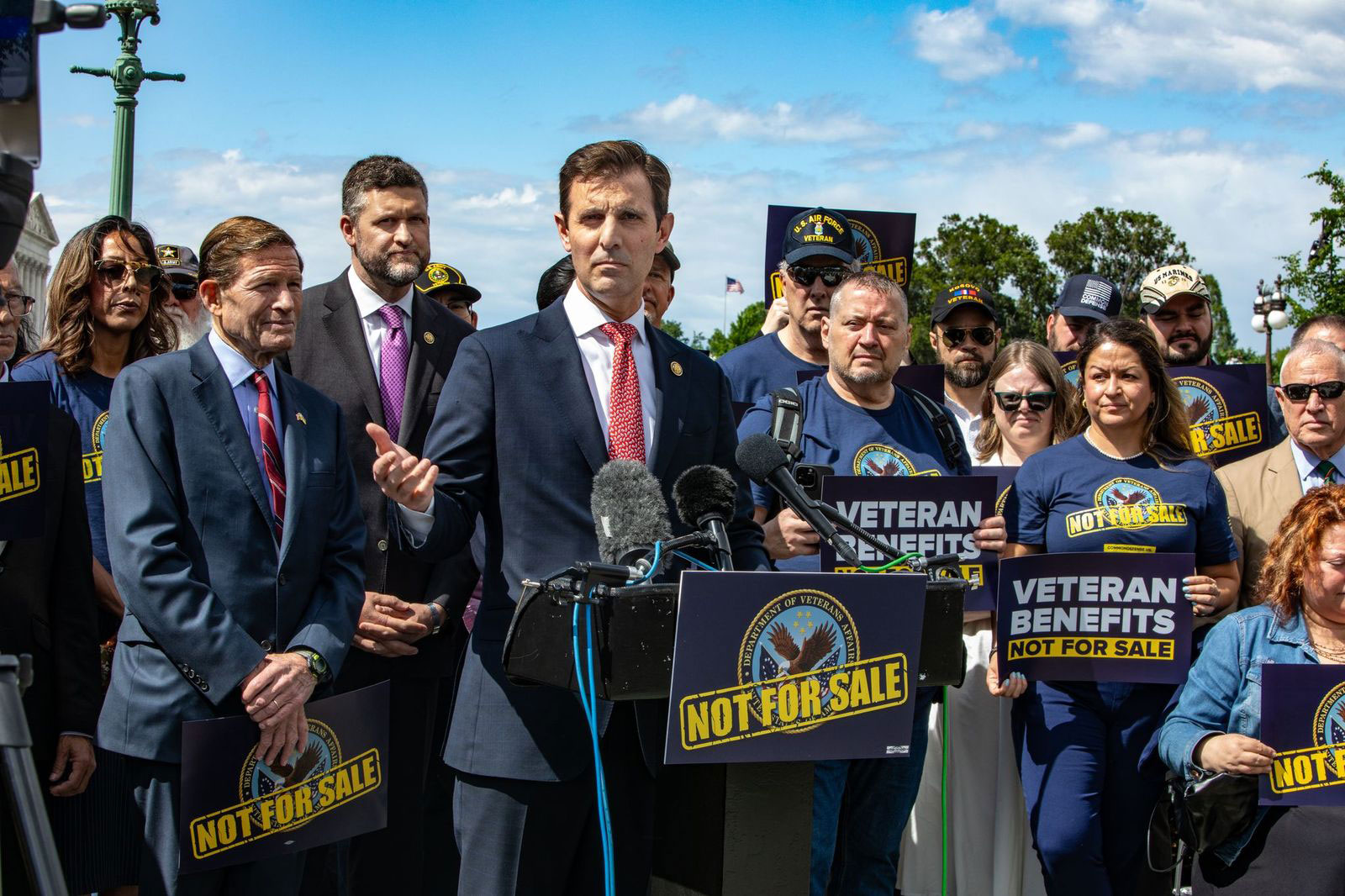
Additionally, after two members of Pennsylvania’s congressional delegation were featured in a November video urging members of the U.S. military and intelligence communities to “refuse illegal orders” from the Trump administration, Trump suggested that the members – which included U.S. Reps. Chris Deluzio and Chrissy Houlahan, both of whom are veterans – had engaged in seditious behavior. “SEDITIOUS BEHAVIOR, punishable by DEATH!” Trump wrote in a Nov. 20 post on Truth Social.
Following the release of the video and Trump’s subsequent comments, Houlahan said on Nov. 21 that her office was the target of a bomb threat. Deluzio said he has received death threats and that two of his western Pennsylvania offices have been the target of bomb threats.
“Political violence threatens the foundational principle that we can govern ourselves and live with liberty in our noble pursuit of happiness,” he said in a series of posts on X. “Everyone must be clear in saying all forms of political violence are wrong. That should not be hard to do.”
Off-year, on notice
This year’s election season was widely seen as a bellwether for the 2026 midterms – and it did not disappoint in that regard.
Up for grabs in November were numerous mayoral offices across the commonwealth, the Philadelphia District Attorney’s Office, and three seats on the Pennsylvania Supreme Court, the latter of which drew millions of dollars in spending from both sides of the aisle.
Philadelphia District Attorney Larry Krasner cruised to victory, besting former Judge Patrick Dugan to become just the second DA in city history to serve more than two terms since the city’s Home Rule Charter was adopted in the 1950s. On the opposite side of the state, Democrat Corey O’Connor won an election to become the city’s next mayor after defeating incumbent Mayor Ed Gainey in the Democratic primary in the spring.
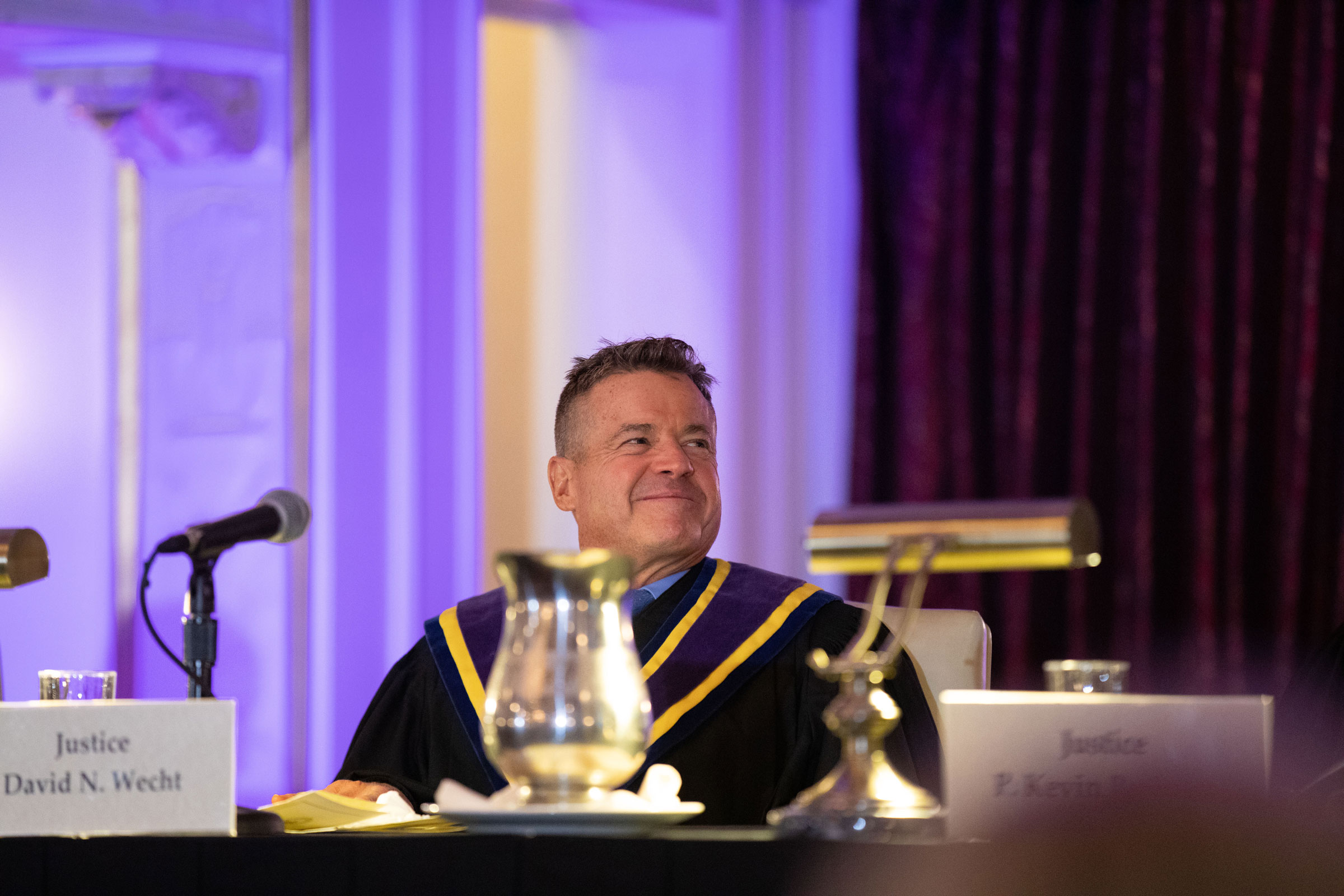
The commonwealth’s three elections to retain state Supreme Court Justices Christine Donohue, Kevin Dougherty and David Wecht – in which voters overwhelmingly decided to keep the three justices on the bench for new 10-year terms – arguably attracted the most attention.
Political organizations spent more than $9.2 million in independent expenditures to influence the Supreme Court retention races through mailers, TV ads, digital ads, emails and text messaging.
Conservative megadonor Jeffrey Yass spent upwards of $3.5 million on several political committees to encourage voters to reject the justices’ bids for another term on the bench.
Some of the biggest spenders urging voters to retain Donohue, Dougherty and Wecht include the American Civil Liberties Union, which spent more than $917,000 in support of retention, as well as Pennsylvanians For Judicial Fairness, which spent at least $732,000 on ads, production and mailers. Groups advocating for abortion access and reproductive rights, including Planned Parenthood Votes and Reproductive Freedom For All, spent $348,858.84 and $127,517.20 in support of retention efforts, respectively.
When it came time to cast ballots, 61.8% of voters chose to retain Donohue, 61.79% voted to retain Dougherty and 61.46% voted to retain Wecht.
Donohue said in a statement that the election “confirms that Pennsylvanians have trust in the independence of the Pennsylvania Supreme Court and, additionally, appreciate the importance of a stable Pennsylvania Supreme Court.”
“I’m grateful for the confidence of the voters of Pennsylvania and their decision to allow me to continue to serve as a Justice of the Pennsylvania Supreme Court,” said in an election night statement. “I look forward to serving with my colleagues on the court to uphold the law and the Constitution of this Commonwealth.”
Wecht said that he was honored to earn another term on the state’s highest court. “I’m honored to have earned the continuing confidence of Pennsylvanians and to have the opportunity to continue to serve alongside my distinguished colleagues,” he said. “I will continue to dedicate myself to the mission with fidelity and integrity and diligence.”
What Didn’t Happen
Pennsylvania’s budget cycle begins in earnest each February when the governor gives their annual budget address to a joint session of the General Assembly in Harrisburg.
This year, in addition to a funding solution for the state’s various mass transit systems, Shapiro laid out an executive budget proposal that sought to create new sources of recurring revenue for a state that continues to stare down a structural budget deficit, with state expenses anticipated to drastically outpace the revenue Pennsylvania brings in over the next five-plus years.
Shapiro pitched legalizing recreational cannabis, noting that five out of the six states that share borders with Pennsylvania – West Virginia being the lone exception – are pulling in revenue from the sale of adult-use legal weed.
He also suggested another source of income for the state: taxing and regulating skill gaming machines, which have already sprouted up in convenience stores, bars, fraternal clubs and a host of other locations, even as the state loses out on tax revenue from those who play skill games.
And if there’s one thing lawmakers on both sides of the aisle should agree on, it’s that the state will have to address the growing imbalance between expenditures and revenues sooner rather than later.
According to the state Independent Fiscal Office’s most recent examination of the state’s General Fund, the state’s budget deficit is only going to grow in the coming years. The IFO estimated that the General Fund deficit will be around $3.65 billion in the 2025-26 fiscal year, before rising to $5.84 billion in the 2026-27 fiscal year.
The news only gets more dire from there. The deficit is expected to hit $6.90 billion in the 2027-28 fiscal year, $7.27 billion the following year, before eventually reaching $7.66 billion in the 2030-31 fiscal year.
Put simply, state lawmakers and the governor will have their work cut out for them next year.
NEXT STORY: SEPTA’s tumultuous 2025: Part II