
Philadelphia
City Councilmembers want “ICE OUT” of Philadelphia
A new legislative package would restrict federal immigration activity in city-owned spaces, ban masks on Immigration and Customs Enforcement agents and bar ICE from obtaining residents’ data.
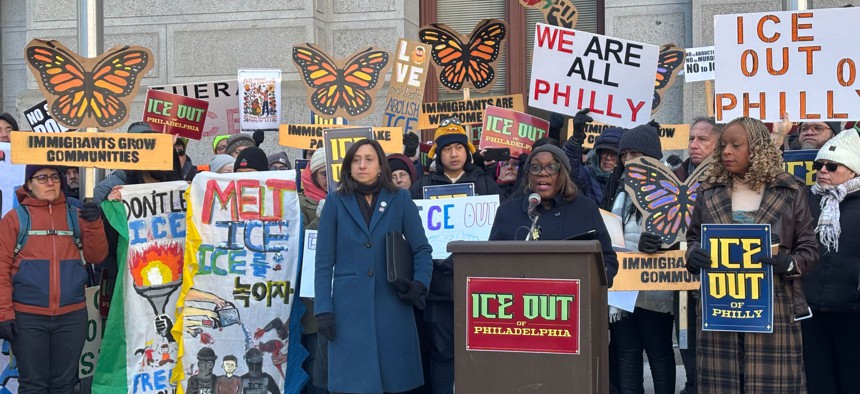
Philadelphia City Councilwoman Kendra Brooks, with her colleague, Rue Landau, at left, introduced ICE OUT legislation at City Hall. Harrison Cann

On Tuesday, with Philadelphia City Hall as the backdrop and Minneapolis’ ongoing immigration-enforcement violence as the subtext, Philadelphia City Councilmembers-At-Large Rue Landau and Kendra Brooks presented a legislative package aimed at curbing the activities of U.S. Immigration and Customs Enforcement within the city.
“We are doing everything within the city’s power to limit ICE activity in Philadelphia and get ICE out of our city,” said Minority Leader Brooks at a press conference outside City Hall. Brooks and Landau were joined on a frigid January day by a crowd bearing posters and chanting “ICE OUT!” – the nickname of the legislative package.
“This legislation sends clear messages,” Brooks added. “One, we want ICE out of the shadows…We want ICE out of city-owned property…We want ICE out of our data.”
The legislation includes measures that prohibit ICE agents from using face masks or unmarked vehicles or otherwise concealing their identities; bar ICE activity on City of Philadelphia property, including using public spaces as staging grounds for raids; restrict the agency’s access to Philadelphians’ personal data; and codify existing practices restricting collaboration between ICE and City of Philadelphia employees, including law enforcement.
Another provision bars discrimination based on immigration status, adding specificity to Philadelphia’s existing anti-discrimination laws.
“What we’re fighting for is simple but profound: a city where people can walk down the street without fear, where families can access services and care without hesitation, and where every neighbor feels the support and protection of their community and their government,” said Landau, an attorney who previously led Philadelphia’s Commission on Human Relations.
The proposals, she added, are a response to a year of ICE “terrorizing our communities,” with neighborhoods of color suffering the heaviest burden.
Philadelphia’s ICE office did not respond to a request for comment.
While thus far spared the kind of military presence and high-profile clashes between protesters and federal agents that have roiled Minneapolis and other cities – including, recently, several fatal shootings of American citizens – Philadelphia has seen repeated raids across its Latino, African and Asian immigrant communities. The crackdown fulfills a key priority of President Donald Trump, who was elected on a promise of curbing immigration.
The council legislation also pointedly shores up Philadelphia’s status as an immigrant-friendly refuge at a moment when the city appears on a U.S. Department of Justice list of so-called sanctuary jurisdictions that are targets for potential federal defunding – places “identified as having policies, laws, or regulations that impede enforcement of federal immigration laws,” according to the DOJ website.
In May 2025, Philadelphia Mayor Cherelle Parker said Philadelphia would shed its longtime designation as a “sanctuary city” – a term without an official definition, but which has long been understood to imply refuge for immigrants and local non-cooperation with federal immigration authorities. Since last year, Philadelphia has called itself a “welcoming city,” a term that highlights inclusivity rather than legal protection.
“‘Welcoming City’ is more than just rhetoric; it’s a promise that every person who lives here can thrive in safety and peace,” said Landau, the first openly LGBTQ member of City Council, who has long championed immigrant and minority protections. “We’re taking the steps that we need to take to protect all Philadelphians as much as we possibly can.”
Brooks noted that Philadelphia is following the lead of other Pennsylvania cities, like Allentown and Reading, that have set firm boundaries around ICE activity within their boundaries. She also placed the anti-ICE bills within Philadelphia’s long history of social justice activism: “We’re here today because this is what Philly does.”
“The goal … is to ensure that our local tax dollars, our city employees, are not assisting a rogue agency that is helping dismantle democracy and is killing our people,” said Jasmine Rivera, the executive director of the Pennsylvania Immigration Coalition, who worked with the councilmembers on the legislative package. “Where there is a local collaboration, either by state or at the local level, the number of people arrested and detained is so much larger than when there is no collaboration.”
Erika Guadalupe Nunez, who leads JUNTOS, described the palpable dread suffusing the calls to the immigrant advocacy organization’s hotline. “Since launching this line a year ago, we have received hundreds of calls reporting ICE agents using … communal spaces to prepare and mask for an enforcement action, inciting panic in anyone who sees them,” she said. The new legislation, she said, will go a long way toward tempering that fear.
As the crowd bopped to a rousing brass chorus, Philadelphia District Attorney Larry Krasner took the microphone to urge Philadelphians to resist ICE, which he called “a small bunch of wannabe Nazis.” He emphasized the need for the “ICE OUT” legislation in order to maintain civil society.
“You can hardly see a more chaotic situation in America” than Minneapolis, Krasner said. “We are the ones who believe in law and order. They are the ones who believe in crime and disorder … We are going to fight against federal overreach.”