
News & Politics
New poll shows growing number of Pennsylvanians think vaccines cause autism
A new health poll from Muhlenberg College also examined healthcare affordability and trust in AI chatbots for medical advice.
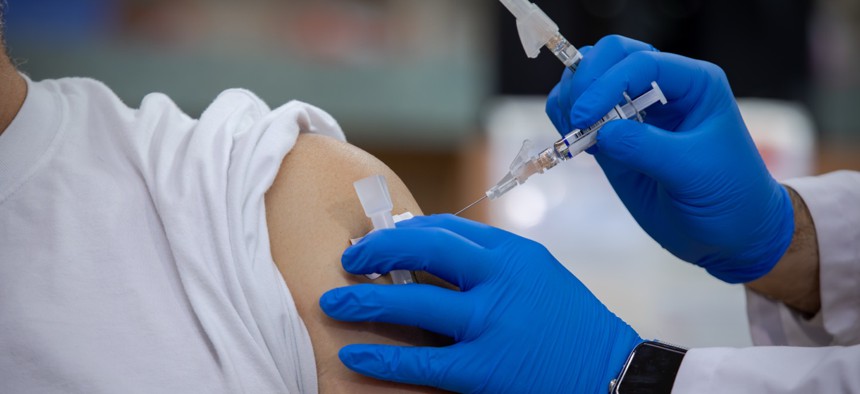
New polling data shows that the number of Pennsylvanians who think vaccines cause autism is increasing. Commonwealth Media Services

A new poll examining Pennsylvanians’ opinions on public health shows a growing number of commonwealth residents believe unsubstantiated claims that childhood immunizations are linked to autism.
The annual health survey, conducted by Muhlenberg College’s Institute of Public Opinion, reveals that 37% of Pennsylvanians “strongly” or “somewhat” agree that recommended childhood vaccines increase the risk of autism – the highest rate recorded in the 14-year history of the college’s annual poll.
The 37% figure also represents a 25-point increase in the share of Pennsylvanians who believe childhood immunizations are linked to autism since 2021, when just 11% of Pennsylvanians “strongly” or “somewhat” agreed that there was a link between vaccines and autism.
Chris Borick, a political science professor and director of the Muhlenberg College Institute of Public Opinion, told City & State that there are a few potential factors that could be contributing to Pennsylvanians’ shifting views on vaccines, including conversations about vaccines entering the public discourse during the COVID-19 pandemic, as well as the appointment of Robert F. Kennedy Jr. as U.S. Health and Human Services Secretary.
Kennedy has claimed that “autism does come from vaccines,” and has said that he personally directed the Centers for Disease Control and Prevention to remove language from their website stating that vaccines do not cause autism.
“When elites – be it elected officials, people in the media, celebrities, whoever – communicate positions and people trust them and they find a connection, people will respond – and that’s what’s happened,” Borick said of Kennedy. “He certainly … had a role in the shifting public attitudes that we’ve seen in the last two years, and his place in the minds of Pennsylvanians is quite polarizing.”
The poll, which surveyed 500 adult residents between March 10 and March 17, also examined whether Pennsylvanians trust Kennedy to handle healthcare issues: 57% said they have “not too much” or “no trust at all” in Kennedy, while 39% said they have either “some” or “a lot of trust” in the HHS secretary.
“He’s an impactful figure,” Borick added. “He’s not someone that a majority of Pennsylvanians turn to for healthcare advice or health information, but among those that do, he matters.”
Healthcare access and affordability
The Muhlenberg College poll also surveyed Pennsylvanians on healthcare affordability and access, with roughly a quarter saying they have had trouble accessing healthcare due to cost, or that someone in their household has.
According to the poll, 26% of respondents said the cost of healthcare has made it difficult to access care, while 71% said they have not been affected by the cost of care.
When asked what the greatest threat to public health is Pennsylvania, 21% said cost and access to healthcare are their chief concerns; 9% said President Donald Trump, Kennedy and Republicans are their top concern, and 8% listed health infrastructure, including access to hospitals and doctors, as their primary concern.
Borick noted that the topic of affordability has dominated the nation’s political discourse in recent years – an issue that he said appears to carry over into healthcare based on the poll’s findings. “The issues of affordability and cost that seem to permeate lots of our political discussions right now are easily located in these poll results,” Borick said.
AI chatbots and health
The survey also polled Pennsylvanians on their trust in artificial intelligence chatbots to advise them on healthcare – and an overwhelming number of Pennsylvanians expressed distrust in chatbots' ability to provide reliable information.
When asked if they trust AI chatbots to provide accurate medical diagnoses and treatment recommendations, 40% said they had no trust at all in chatbots, 26% answered “not too much” trust, 24% said they had “some trust”, and 6% said they have “a lot of trust” in AI chatbots.
“Right now,” Borick said, “the overwhelming sense from Pennsylvanians on this potential tool is caution and a bit of skepticism until we see how it evolves.”