
Philadelphia
Talking trash: Philly neighborhood organizers seek to scale illegal dumping mapping, prevention
The Clean Philadelphia NOW initiative, started in 2023, is working to eliminate litter and dumping by 2028
Trash Academy

Philadelphia’s trash talk is unmatched.
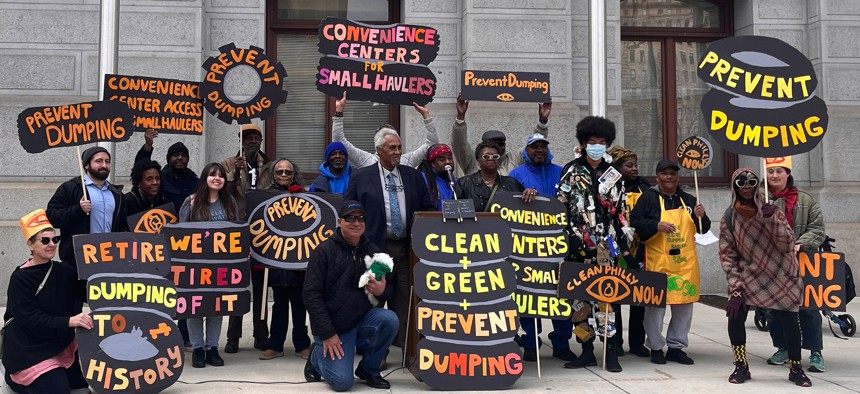
Clean-and-green community organizers made trash the center of attention at the Discovery Center in Philadelphia’s East Fairmount Park Thursday morning, meeting for an illegal-dumping mapping initiative aimed at increasing awareness and coordination of trash hotspots and cleanup efforts.
“There are loopholes in the waste management system that create the opportunity for dumping, and if we close those loopholes, we actually could beat dumping,” said Shari Hersh, co-director of the Trash Academy, a community-led project focused on cleanup and environmental justice. “Prevention requires systems change.”
Through the Trash Academy’s Clean Philadelphia NOW program, neighborhood organizers came together to highlight recurring dumping hotspots and share best practices for community groups to have a more targeted approach to prevention, enforcement and education.
The issue of illegal dumping – defined as leaving trash and waste, often from construction and demolition projects, in vacant lots, sidewalks or parks – has been an ongoing issue throughout Philadelphia, and a major priority of Mayor Cherelle Parker’s administration.
The goal of the community members involved with Clean Philadelphia NOW, an initiative that began in 2023, is to eliminate illegal dumping and litter by 2028.
“It takes a community. It definitely takes a community effort to get it done,” Al Gillyard, who’s worked with Trash Academy, told City & State Thursday.
The first in a planned series of cross-sector gatherings, Thursday’s mapping event is just the start of what organizers plan to be a quarterly convening of people working on dumping issues from across Philadelphia.
The mapping exercise focused on historically hard-hit areas, including: Germantown; Kensington, Harrowgate and Fairhill; Sharswood, Brewerytown and Strawberry Mansion; Hunting Park and Nicetown; Eastwick; Kingsessing; and West Philadelphia.
“Around Ninth and Ontario (streets), Eighth and Tioga (street), and Old York Road and Butler Street – these are the illegal dumping sites that we try to track and keep up on and monitor,” Gillyard said.
Grassroots groups against garbage
The garbage-fighting groups now spread well beyond neighborhood groups and City Hall.
Nearly 100 individuals signed on to the Thursday event, with neighborhood groups, including the 215 People’s Alliance, sharing strategies and tactics to tackle the four pillars of dumping prevention: abatement, prevention, enforcement and engagement.
Organizers said there are more than 125 dumping hot spots in the city’s park system. And although personal litter and food waste is an issue, it’s construction and demolition waste that’s the biggest hill to climb during cleanup efforts.
“Food waste is a big thing, but we actually took on more proactively C&D (construction and demolition) waste,” Hersh added. “(C&D) waste is 50% of our dumping, and it’s about 17% of our waste stream in Philly.”
Currently, none of the city’s six sanitation convenience centers – which accept residents’ oversized trash, yard waste and recycling – accept small loads of construction waste. In many cases, due to high disposal fees at sanitation facilities, contractors or small haulers will dispose of waste wherever they can get away with it, rather than paying the $200 minimum needed to drop off construction debris, tires, furniture and more.
Community groups have sought to offer vouchers to subsidize legal disposal, offering contractors and small independent haulers anywhere from $120 to $150 to help cover legal drop-off fees.
“I would like the mayor’s office to get behind (vouchers) more, to support it more,” Gillyard said. “We do it by the neighborhood now, but it could expand citywide.”
Ambassador approach
As of the 2027 budget, the city has allocated roughly $101 million toward cleaning and greening initiatives. But, as Clean Philadelphia NOW organizers noted, 85% of those funds are set aside for abatement – not initiatives seeking to prevent dumping in the first place.
In an attempt to bolster ongoing clean-and-green initiatives, Parker’s administration authorized 40 additional city employees – known as park ambassadors – to issue notices of violation against illegal dumpers late last year.
The ambassadors have now been working in the city for roughly a month, monitoring and reporting chronic dumping sites. Natalie Walker, sustainability director for Parks and Rec, sees the ambassadors as an opportunity to expand the community engagement that’s driving a lot of the neighborhood groups.
“We really haven’t had capacity to engage community members in what solutions they might see or what they might need to properly dispose of materials,” Walker told City & State. “The park ambassadors are kind of really like our first opportunity as Parks and Rec to have that conversation.”
Under current law, a dumping violation can result in fines of up to $5,000 per illegally dumped item when a vehicle is used in the dumping, and up to $2,000 per item when a person dumps on foot.
According to city data, Philadelphia’s 311 system has received more than 244,000 reports of illegal dumping since 2014. In 2026, the city collected more than $900,000 in judgments related to illegal dumping cases.
Cleanup Philadelphia NOW and its partners want the community mapping and organizing to provide yet another opportunity to let residents raise their voice – and get their neighborhood cleaned up in the process.
“We’re giving neighbors the opportunity to map dump sites using their computers and phones,” Tia Tynes, Trash Academy co-director, remarked at the event Thursday. “311 is a service that documents and routes your complaints; this (mapping exercise) provides our city another way to analyze and eliminate this offensive problem.”