
Healthcare
Pennie drops: PA’s insurance marketplace suffers massive decline in enrollment
Following the cancellation of federal subsidies, more than a third of enrollees in the state’s Affordable Care Act insurance marketplace have canceled their plans since last November, with downstream effects on hospitals and economies statewide
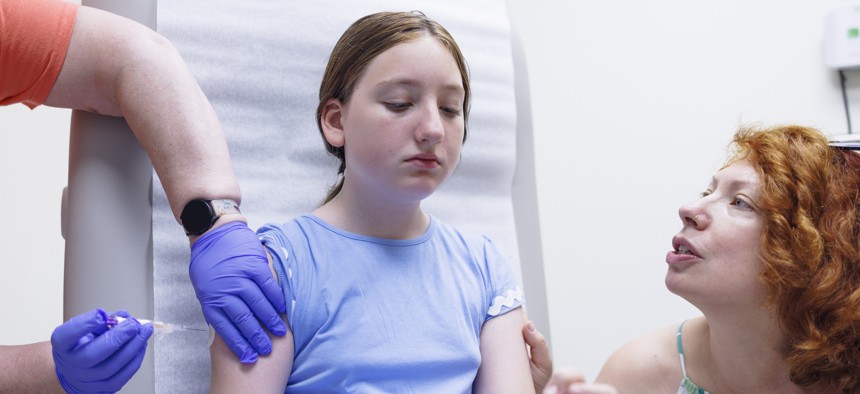
A young patient gets vaccinated at a family medicine clinic in the Poconos. Alex Potemkin - Getty

The Trump administration’s decision to end federal subsidies for the Affordable Care Act has led to worries that hundreds of thousands of newly uninsured Pennsylvanians with urgent medical needs will burden emergency rooms and urgent-care clinics – and to warnings about the downstream effects of a torrent of uninsured patients on financially stressed health systems, small businesses and the local economies that depend on them.
Healthcare leaders insist they have good reason to worry: Five years of progress expanding health insurance coverage across the commonwealth evaporated in just months when the cancellation of federal subsidies prompted over 50,000 Pennsylvanians to cancel their state marketplace insurance plans for 2026 – meaning more than 10% of the half-million enrolled in 2025 no longer are insured through Pennie, the state’s Affordable Care Act marketplace.
“What we saw coming into 2026 was the largest single-year increase (in premiums) that we had ever seen in the marketplace, and it has ended up reversing many years of progress towards having a lower uninsured rate in Pennsylvania,” said Pennie Director Devon Trolley. “And that has a lot of broader impacts across our healthcare system and our local economies that are not positive changes.”
Pennie enrollment had grown by about 150,000 since 2021, when enhanced tax credits – a pandemic-era federal initiative originally designed to be temporary – made health insurance newly affordable for many Pennsylvanians.
In voting to end the subsidies, Republicans had pointed to Congressional Budget Office figures showing the tax credits would add some $350 billion to the ballooning federal debt over the next decade. Many also expressed concern that subsidizing ever-higher premiums does nothing to rein in healthcare costs and may, in fact, enable their growth.
But Trolley noted that additional pending federal policy updates “will continue to make it harder to enroll and stay enrolled,” likely continuing the downward enrollment trajectory.
“I think the key point is that the cost of coverage matters,” she said. “When people can afford it, they want coverage. They understand the value of it, and they know it provides access to medical care and financial protection.”
A rising burden
With subsidies withdrawn, the average monthly amount that Pennie enrollees owe for their health premium more than doubled for 2026; in some counties, average premiums tripled or even quadrupled, with the highest increase, 485%, in Juniata County. “We saw a lot of price sensitivity at lower incomes,” said Trolley, noting that rising inflation is compounding the equation: “Even at a small dollar amount, people are already extremely stretched on their budgets.”
Those who have dropped coverage are more likely to live in rural counties, and to be younger and what Trolley described as more “risk-tolerant” – willing to gamble on youthful good health to avoid spending double on insurance they might not use much.
But when younger people drop insurance, the remaining market tilts more heavily toward older, sicker clients with higher medical costs, prompting insurers to raise premiums. That can send an insurance market into a kind of death spiral, where escalating costs spur further exits and, in turn, higher costs that ultimately make insurance unaffordable for all but a few.
Consistently, about one-third of Pennie subscribers have been between the ages of 55 and 65 – the age when Medicare coverage kicks in – and that trend continues, Trolley said. That demographic “has enough health needs that they are going to make whatever sacrifices they have to make to keep this coverage,” she explained.
But as health plans grow less affordable, the prospect emerges of a population signing up for Medicare with chronic, poorly managed health conditions that are more costly to address at age 65. “It just becomes a very inefficient way to have a healthy population,” Trolley said. “It makes you wonder: Are we not paying more by having people uncovered than we would have just to subsidize health insurance?”
Compounding Medicaid cuts
Pending cuts to the federal Medicaid insurance program have already put a strain on the commonwealth’s health infrastructure. “The real burden is going to be felt on our ERs and our local hospital systems, who are going to be absorbing more of these individuals, quite frankly, through urgent care or (the emergency room),” affirmed Allentown Health Bureau Director Dave Synnamon.
Since last year’s passage of the One Big Beautiful Bill, which cuts Medicaid spending by $1 trillion over a decade, Synnamon has been meeting with county officials, local hospital systems, Federally Qualified Health Centers, and agencies such as United Way to strategize the Lehigh Valley's health needs. Lehigh County is among the Pennsylvania counties with the highest proportion of Pennie dropouts – with this year’s premiums up by an average 205% – complicating the picture even further.
Some 300,000 Pennsylvanians are projected to lose Medicaid coverage next year, according to the Hospital + Healthsystem Association of Pennsylvania, which said the state’s hospitals – already reimbursed at rates below the cost of care – are poised to lose an additional $4.5 billion in direct funding over the coming decade.
“Imminent cuts and rising uncompensated care will worsen this trajectory,” said Nicole Stallings, the association’s president and CEO. “At the same time, expenses for drugs, labor and supplies continue to rise.”
The result, she said, may well be myriad facility closures. Already, the state has lost more than two dozen hospitals over the past decade to financial challenges, leaving vast regions without critical services and prompting lawmakers to consider measures to protect health systems from predatory investors.
Without further intervention, at least a dozen Pennsylvania hospitals could shutter by 2030, with many more forced to cut services to survive, according to a January analysis the association commissioned from the firm of Oliver Wyman.
Rural hospitals are particularly vulnerable. One institution that is feeling the strain is Geisinger, a 10-hospital academic health system serving a mix of rural and urban communities in Central and Northeastern Pennsylvania.
“These changes in ACA funding and enrollment, combined with our projection of up to $188 million in annual revenue losses for our system beginning in 2028 as a result of (last year’s federal spending bill, including Medicaid cuts), will create a very challenging environment for rural healthcare providers,” Terry Gilliland, Geisinger’s CEO, told City & State.
Like Trolley, he is worried about a new wave of uninsured patients showing up with the more serious, costlier conditions that result from delayed care – and the resulting economic impacts. Geisinger has already seen a 10% increase in unique uninsured patients in the first six months of 2026.
Forced to spend more on uncompensated or undercompensated care for those uninsured patients, the health system will likely “struggle to generate the revenue needed to cover expenses and invest in our people, facilities and technology,” Gilliland noted.
The trickle-down effect
In many of the 45 counties where Geisinger operates, the health system is also the largest employer in the area, “so any reduction in investment will significantly impact the local economy,” the CEO said.
Health systems are far from the only organizations that will feel the impact of skyrocketing insurance costs. Many mom-and-pop businesses buy their health plans through Pennie, as do many of the farmers who power Pennsylvania’s critical agricultural sector.
“We have heard throughout the last eight months from small business after small business trying to figure out how to even stay open with these cost increases,” Trolley said. “They’re saying, ‘I either have to shut down my business and go to a large employer, or I have to increase the cost of my goods and services.’ Or from farmers, ‘I'm going to have to increase the cost of the food that I sell.’”
All of which, said Stalling, illustrates how the economic health of a region is interwoven with the physical health of residents – and that health depends on access to affordable care.
“Communities feel these consequences, not just hospitals,” she said. “We cannot have healthy, vibrant and economically competitive communities in Pennsylvania without financially stable hospitals.”
Shoring up a stressed system
Insurance coverage is evidently beyond the scope of the Pennsylvania House Health Committee, noted Erika Fricke, the Democratic executive director of the committee.
But she said the committee’s Democratic chair, state Rep. Dan Frankel, was spearheading efforts to approach the burgeoning crisis from another angle – by exploring ways to ensure more stable revenue for the commonwealth’s hospitals.
“The truth is that hospitals have fixed costs. They have buildings, they have equipment, they have medical staff, and that doesn’t change based on the number of paying patients,” Fricke said.
One potential alternative the Health Committee is exploring, Fricke said, is an arrangement along the lines of the Pennsylvania Rural Health Model, a program of the federal Centers for Medicare & Medicaid Services that proposes transitioning financially stressed rural hospitals from a fee-for-service model to global budget payments to ensure a more stable revenue flow.
“They would set an amount that would be sustainable, that the hospitals would know was coming in, so that they can budget more effectively,” explained Fricke. Long before this year’s axed subsidies increased the strain on the commonwealth’s hospitals, financial sustainability has been “one of the main issues that the committee has focused on.
“And obviously it’s going to continue to be,” she said, “because it’s not going away.” Urban or rural, she added, the patients in question “are people who just deserve access to healthcare in their communities.”
This article has been updated to reflect that the total number of Pennie enrollees in August 2026 is down 56,000 from the same time last year.